12 MLM, Longitudinal: Hox ch 5 - student GPA
Load/activate these packages
library(haven)
library(tidyverse)
library(flextable)
library(apaSupp)      # Not on CRAN, on GitHub (see above)
library(psych)
library(VIM)
library(naniar)
library(lme4)
library(lmerTest)
library(optimx)
library(performance)
library(interactions)
library(effects)
library(emmeans)
library(ggResidpanel)
library(HLMdiag)
library(sjPlot)
library(sjstats)
12.1 BACKGROUND
The text “Multilevel Analysis: Techniques and Applications, Third Edition” (Hox et al. 2017) has a companion website which includes links to all the data files used throughout the book (housed on the book’s GitHub repository).
The following example is used through out Hox et al. (2017)’s chapater 5.
The GPA for 200 college students were followed for 6 consecutive semesters (simulated). Job status was also measured as number of hours worked for the same size occations. Time-invariant covariates are the student’s gender and high school GPA. The variable admitted will not be used.
12.1.1 Long Format
df_raw <- haven::read_sav("data/gpa2long.sav") %>%
  haven::as_factor() %>%             # retain the labels from SPSS --> factor
haven::zap_label() Rows: 1,200
Columns: 7
$ student <dbl> 1, 1, 1, 1, 1, 1, 2, 2, 2, 2, 2, 2, 3, 3, 3, 3, 3, 3, 4, 4, 4…
$ occas <fct> year 1 semester 1, year 1 semester 2, year 2 semester 1, year…
$ gpa <dbl> 2.3, 2.1, 3.0, 3.0, 3.0, 3.3, 2.2, 2.5, 2.6, 2.6, 3.0, 2.8, 2…
$ job <fct> 2 hours, 2 hours, 2 hours, 2 hours, 2 hours, 2 hours, 2 hours…
$ sex <fct> female, female, female, female, female, female, male, male, m…
$ highgpa <dbl> 2.8, 2.8, 2.8, 2.8, 2.8, 2.8, 2.5, 2.5, 2.5, 2.5, 2.5, 2.5, 2…
$ admitted <fct> yes, yes, yes, yes, yes, yes, no, no, no, no, no, no, yes, ye…df_gpa_long <- df_raw %>%
dplyr::mutate_if(is.factor, forcats::fct_drop) %>%
dplyr::mutate(student = factor(student)) %>%
dplyr::mutate(sex = forcats::fct_recode(sex,
"Female" = "female",
"Male" = "male")) %>%
dplyr::mutate(sem = case_when(occas == "year 1 semester 1" ~ 1,
occas == "year 1 semester 2" ~ 2,
occas == "year 2 semester 1" ~ 3,
occas == "year 2 semester 2" ~ 4,
occas == "year 3 semester 1" ~ 5,
occas == "year 3 semester 2" ~ 6) - 1) %>%
dplyr::mutate(job = fct_drop(job)) %>%
dplyr::mutate(hrs = case_when(job == "1 hour" ~ 1,
job == "2 hours" ~ 2,
job == "3 hours" ~ 3)) %>%
dplyr::select(student, sex, highgpa, sem, job, hrs, gpa) %>%
dplyr::arrange(student, sem)Rows: 1,200
Columns: 7
$ student <fct> 1, 1, 1, 1, 1, 1, 2, 2, 2, 2, 2, 2, 3, 3, 3, 3, 3, 3, 4, 4, 4,…
$ sex <fct> Female, Female, Female, Female, Female, Female, Male, Male, Ma…
$ highgpa <dbl> 2.8, 2.8, 2.8, 2.8, 2.8, 2.8, 2.5, 2.5, 2.5, 2.5, 2.5, 2.5, 2.…
$ sem <dbl> 0, 1, 2, 3, 4, 5, 0, 1, 2, 3, 4, 5, 0, 1, 2, 3, 4, 5, 0, 1, 2,…
$ job <fct> 2 hours, 2 hours, 2 hours, 2 hours, 2 hours, 2 hours, 2 hours,…
$ hrs <dbl> 2, 2, 2, 2, 2, 2, 2, 3, 2, 2, 2, 2, 2, 2, 2, 3, 2, 2, 3, 2, 2,…
$ gpa <dbl> 2.3, 2.1, 3.0, 3.0, 3.0, 3.3, 2.2, 2.5, 2.6, 2.6, 3.0, 2.8, 2.…df_gpa_long %>%
psych::headTail(top = 14,
bottom = 8) %>%
flextable::flextable() %>%
apaSupp::theme_apa(caption = "Sample of LONG format of the dataset") %>%
flextable::hline(i = c(6, 12, 17))student | sex | highgpa | sem | job | hrs | gpa |
|---|---|---|---|---|---|---|
1 | Female | 2.8 | 0 | 2 hours | 2 | 2.3 |
1 | Female | 2.8 | 1 | 2 hours | 2 | 2.1 |
1 | Female | 2.8 | 2 | 2 hours | 2 | 3 |
1 | Female | 2.8 | 3 | 2 hours | 2 | 3 |
1 | Female | 2.8 | 4 | 2 hours | 2 | 3 |
1 | Female | 2.8 | 5 | 2 hours | 2 | 3.3 |
2 | Male | 2.5 | 0 | 2 hours | 2 | 2.2 |
2 | Male | 2.5 | 1 | 3 hours | 3 | 2.5 |
2 | Male | 2.5 | 2 | 2 hours | 2 | 2.6 |
2 | Male | 2.5 | 3 | 2 hours | 2 | 2.6 |
2 | Male | 2.5 | 4 | 2 hours | 2 | 3 |
2 | Male | 2.5 | 5 | 2 hours | 2 | 2.8 |
3 | Female | 2.5 | 0 | 2 hours | 2 | 2.4 |
3 | Female | 2.5 | 1 | 2 hours | 2 | 2.9 |
... | ... | ... | ... | |||
199 | Female | 2.3 | 4 | 2 hours | 2 | 2.8 |
199 | Female | 2.3 | 5 | 3 hours | 3 | 2.8 |
200 | Male | 3.4 | 0 | 2 hours | 2 | 2.8 |
200 | Male | 3.4 | 1 | 2 hours | 2 | 3.2 |
200 | Male | 3.4 | 2 | 2 hours | 2 | 3.4 |
200 | Male | 3.4 | 3 | 2 hours | 2 | 3.5 |
200 | Male | 3.4 | 4 | 1 hour | 1 | 3.3 |
200 | Male | 3.4 | 5 | 1 hour | 1 | 3.4 |
df_raw %>%
  dplyr::select(job,
                "Occation" = occas) %>%
  apaSupp::tab1(split = "job",
                missing = "ifany",
                percent = "row",
                caption = "Distribution of Hours Worked at a Job at each Occation")
| Total | no job | 1 hour | 2 hours | 3 hours | 4 or more hours | p-value |
|---|---|---|---|---|---|---|---|
Occation | < .001*** | ||||||
year 1 semester 1 | 200 (100.0%) | 0 (0.0%) | 0 (0.0%) | 172 (86.0%) | 28 (14.0%) | 0 (0.0%) | |
year 1 semester 2 | 200 (100.0%) | 0 (0.0%) | 0 (0.0%) | 169 (84.5%) | 31 (15.5%) | 0 (0.0%) | |
year 2 semester 1 | 200 (100.0%) | 0 (0.0%) | 7 (3.5%) | 159 (79.5%) | 34 (17.0%) | 0 (0.0%) | |
year 2 semester 2 | 200 (100.0%) | 0 (0.0%) | 5 (2.5%) | 169 (84.5%) | 26 (13.0%) | 0 (0.0%) | |
year 3 semester 1 | 200 (100.0%) | 0 (0.0%) | 18 (9.0%) | 150 (75.0%) | 32 (16.0%) | 0 (0.0%) | |
year 3 semester 2 | 200 (100.0%) | 0 (0.0%) | 22 (11.0%) | 148 (74.0%) | 30 (15.0%) | 0 (0.0%) | |
Note. . . | |||||||
* p < .05. ** p < .01. *** p < .001. | |||||||
12.1.2 Wide Format
df_gpa_wide <- df_gpa_long %>%
  dplyr::select(-job) %>%
  tidyr::pivot_wider(names_from = sem,
                     values_from = c(hrs, gpa),
names_sep = "_")Rows: 200
Columns: 15
$ student <fct> 1, 2, 3, 4, 5, 6, 7, 8, 9, 10, 11, 12, 13, 14, 15, 16, 17, 18,…
$ sex <fct> Female, Male, Female, Male, Male, Female, Male, Female, Male, …
$ highgpa <dbl> 2.8, 2.5, 2.5, 3.8, 3.1, 2.9, 2.3, 3.9, 2.0, 2.8, 3.9, 2.9, 3.…
$ hrs_0 <dbl> 2, 2, 2, 3, 2, 2, 3, 2, 2, 2, 2, 3, 2, 2, 2, 2, 2, 3, 2, 2, 2,…
$ hrs_1 <dbl> 2, 3, 2, 2, 2, 3, 2, 2, 2, 2, 3, 2, 2, 2, 2, 2, 2, 2, 2, 2, 2,…
$ hrs_2 <dbl> 2, 2, 2, 2, 2, 3, 3, 2, 3, 2, 2, 2, 2, 2, 3, 2, 2, 2, 2, 2, 2,…
$ hrs_3 <dbl> 2, 2, 3, 2, 2, 2, 2, 2, 2, 3, 2, 2, 2, 2, 3, 2, 3, 2, 3, 2, 2,…
$ hrs_4 <dbl> 2, 2, 2, 2, 2, 3, 2, 2, 2, 2, 2, 2, 2, 2, 3, 2, 3, 2, 2, 2, 2,…
$ hrs_5 <dbl> 2, 2, 2, 2, 2, 3, 2, 2, 2, 2, 2, 2, 2, 2, 2, 2, 2, 3, 3, 2, 2,…
$ gpa_0 <dbl> 2.3, 2.2, 2.4, 2.5, 2.8, 2.5, 2.4, 2.8, 2.8, 2.8, 2.6, 2.6, 2.…
$ gpa_1 <dbl> 2.1, 2.5, 2.9, 2.7, 2.8, 2.4, 2.4, 2.8, 2.7, 2.8, 2.9, 3.0, 3.…
$ gpa_2 <dbl> 3.0, 2.6, 3.0, 2.4, 2.8, 2.4, 2.8, 3.1, 2.7, 3.0, 3.2, 2.3, 3.…
$ gpa_3 <dbl> 3.0, 2.6, 2.8, 2.7, 3.0, 2.3, 2.6, 3.3, 3.1, 2.7, 3.6, 2.9, 3.…
$ gpa_4 <dbl> 3.0, 3.0, 3.3, 2.9, 2.9, 2.7, 3.0, 3.3, 3.1, 3.0, 3.6, 3.1, 3.…
$ gpa_5 <dbl> 3.3, 2.8, 3.4, 2.7, 3.1, 2.8, 3.0, 3.4, 3.5, 3.0, 3.8, 3.3, 3.…df_gpa_wide %>%
psych::headTail() %>%
flextable::flextable() %>%
apaSupp::theme_apa(caption = "Sample of WIDE format of the dataset")student | sex | highgpa | hrs_0 | hrs_1 | hrs_2 | hrs_3 | hrs_4 | hrs_5 | gpa_0 | gpa_1 | gpa_2 | gpa_3 | gpa_4 | gpa_5 |
|---|---|---|---|---|---|---|---|---|---|---|---|---|---|---|
1 | Female | 2.8 | 2 | 2 | 2 | 2 | 2 | 2 | 2.3 | 2.1 | 3 | 3 | 3 | 3.3 |
2 | Male | 2.5 | 2 | 3 | 2 | 2 | 2 | 2 | 2.2 | 2.5 | 2.6 | 2.6 | 3 | 2.8 |
3 | Female | 2.5 | 2 | 2 | 2 | 3 | 2 | 2 | 2.4 | 2.9 | 3 | 2.8 | 3.3 | 3.4 |
4 | Male | 3.8 | 3 | 2 | 2 | 2 | 2 | 2 | 2.5 | 2.7 | 2.4 | 2.7 | 2.9 | 2.7 |
... | ... | ... | ... | ... | ... | ... | ... | ... | ... | ... | ... | ... | ||
197 | Female | 2.1 | 2 | 2 | 3 | 2 | 2 | 2 | 2.9 | 2.5 | 2.8 | 3.2 | 3.3 | 3.8 |
198 | Male | 4 | 2 | 2 | 2 | 2 | 1 | 2 | 2.5 | 2.9 | 3 | 3.2 | 3.3 | 3.4 |
199 | Female | 2.3 | 2 | 2 | 3 | 2 | 2 | 3 | 2.6 | 2.3 | 2.7 | 2.7 | 2.8 | 2.8 |
200 | Male | 3.4 | 2 | 2 | 2 | 2 | 1 | 1 | 2.8 | 3.2 | 3.4 | 3.5 | 3.3 | 3.4 |
12.2 EXPLORTATORY DATA ANLAYSIS
12.2.1 Sample Summary
df_gpa_wide %>%
  dplyr::select(sex,
                "High School GPA" = highgpa,
                "Initial College GPA" = gpa_0,
                "Initial Hrs Working" = hrs_0) %>%
  apaSupp::tab1(split = "sex",
                missing = "ifany",
                caption = "Demographic Summary by Sex")
| Total | Male | Female | p-value |
|---|---|---|---|---|
High School GPA | 2.99 (0.60) | 3.03 (0.59) | 2.95 (0.60) | .309 |
Initial College GPA | 2.59 (0.31) | 2.55 (0.31) | 2.63 (0.31) | .095 |
Initial Hrs Working | .192 | |||
2 | 172 (86.0%) | 78 (82.1%) | 94 (89.5%) | |
3 | 28 (14.0%) | 17 (17.9%) | 11 (10.5%) | |
Note. Continuous variables are summarized with means (SD) and significant group differences assessed via independent t-tests. Categorical variables are summarized with counts (%) and significant group differences assessed via Chi-squared tests for independence. | ||||
* p < .05. ** p < .01. *** p < .001. | ||||
df_gpa_wide %>%
  dplyr::select(sex,
                "Year 1, Semester 1" = gpa_0,
                "Year 1, Semester 2" = gpa_1,
                "Year 2, Semester 1" = gpa_2,
                "Year 2, Semester 2" = gpa_3,
                "Year 3, Semester 1" = gpa_4,
                "Year 3, Semester 2" = gpa_5) %>%
  apaSupp::tab1(split = "sex",
                missing = "ifany",
                caption = "Hox Table 5.2 (page 77) GPA means at six occations, for male and female students")
| Total | Male | Female | p-value |
|---|---|---|---|---|
Year 1, Semester 1 | 2.59 (0.31) | 2.55 (0.31) | 2.63 (0.31) | .095 |
Year 1, Semester 2 | 2.72 (0.34) | 2.67 (0.32) | 2.76 (0.35) | .048* |
Year 2, Semester 1 | 2.81 (0.35) | 2.74 (0.36) | 2.87 (0.34) | .010** |
Year 2, Semester 2 | 2.92 (0.36) | 2.82 (0.35) | 3.01 (0.34) | < .001*** |
Year 3, Semester 1 | 3.02 (0.36) | 2.91 (0.36) | 3.11 (0.33) | < .001*** |
Year 3, Semester 2 | 3.13 (0.38) | 3.03 (0.38) | 3.23 (0.35) | < .001*** |
Note. Continuous variables are summarized with means (SD) and significant group differences assessed via independent t-tests. Categorical variables are summarized with counts (%) and significant group differences assessed via Chi-squared tests for independence. | ||||
* p < .05. ** p < .01. *** p < .001. | ||||
12.3 MULTILEVEL MODELING
12.3.1 Null Models and ICC
# Intraclass Correlation Coefficient

    Adjusted ICC: 0.369
  Unadjusted ICC: 0.369
Over a third of the variance in the 6 GPA measures is variance between individuals, and about two-thirds is variance within individuals across time, ICC = .369.
# Intraclass Correlation Coefficient

    Adjusted ICC: 0.523
  Unadjusted ICC: 0.412
After accounting for the linear change in GPA over semesters, about half of the remaining variance in GPA scores is attributable to person-to-person difference, adj-ICC = .523.
Another way to say it, is about half of the variance in initial GPAs is due to student-to-student differences.
apaSupp::tab_lmers(list("M0: Null w/o Time" = fit_lmer_0_re,
                        "M1: Null w/Time"   = fit_lmer_1_re),
                   caption = "Parameter Estimates for the Null Models")
| M0: Null w/o Time | M1: Null w/Time | ||||
|---|---|---|---|---|---|---|
Variable | b | (SE) | p | b | (SE) | p |
(Intercept) | 2.87 | (0.02) | < .001*** | 2.60 | (0.02) | < .001*** |
sem | 0.11 | (0.00) | < .001*** | |||
student.var__(Intercept) | 0.06 | 0.06 | ||||
Residual.var__Observation | 0.10 | 0.06 | ||||
AIC | 926 | 417 | ||||
BIC | 941 | 437 | ||||
Log-likelihood | -460 | -204 | ||||
Note. | ||||||
* p < .05. ** p < .01. *** p < .001. | ||||||
12.3.2 Fixed Effects
fit_lmer_0_ml <- lmerTest::lmer(gpa ~ 1 + (1|student),
                                data = df_gpa_long,
                                REML = FALSE)

fit_lmer_1_ml <- lmerTest::lmer(gpa ~ sem + (1|student),
                                data = df_gpa_long,
                                REML = FALSE)


fit_lmer_2_ml <- lmerTest::lmer(gpa ~ sem + hrs + (1|student),
                                data = df_gpa_long,
                                REML = FALSE)


fit_lmer_3_ml <- lmerTest::lmer(gpa ~ sem + hrs + highgpa + sex + (1|student),
                                data = df_gpa_long,
REML = FALSE)apaSupp::tab_lmers(list("M2: Occ" = fit_lmer_1_ml,
"M3: Job" = fit_lmer_2_ml,
"M4: hsGPA, Sex" = fit_lmer_3_ml),
var_labels = c("(Intercept)" = "(Intercept)",
"sem" = "Semester",
"hrs" = "Hours Working",
"highgpa" = "High School GPA",
"sex" = "Sex",
"male" = "Male",
"female" = "Female"),
narrow = TRUE,
caption = "Hox Table 5.3 (page 78) Results of Multilevel Anlaysis of GPA, Fixed Effects",
general_note = "Intercept refers to population mean for a Male who is working a single hours during their first semester")
| M2: Occ | M3: Job | M4: hsGPA, Sex | |||
|---|---|---|---|---|---|---|
Variable | b | (SE) | b | (SE) | b | (SE) |
(Intercept) | 2.60 | (0.02) *** | 2.97 | (0.04) *** | 2.64 | (0.10) *** |
Semester | 0.11 | (0.00) *** | 0.10 | (0.00) *** | 0.10 | (0.00) *** |
Hours Working | -0.17 | (0.02) *** | -0.17 | (0.02) *** | ||
High School GPA | 0.08 | (0.03) ** | ||||
Sex | ||||||
Male | — | — | ||||
Female | 0.15 | (0.03) *** | ||||
student.var__(Intercept) | 0.06 | 0.05 | 0.04 | |||
Residual.var__Observation | 0.06 | 0.06 | 0.06 | |||
AIC | 402 | 318 | 297 | |||
BIC | 422 | 344 | 332 | |||
Log-likelihood | -197 | -154 | -141 | |||
Note. Intercept refers to population mean for a Male who is working a single hours during their first semester | ||||||
* p < .05. ** p < .01. *** p < .001. | ||||||
tab_lmer_fits(list("M0: Null w/o Time" = fit_lmer_0_re,
                   "M1: Null w/Time"   = fit_lmer_1_re,
                   "M2: Occ"           = fit_lmer_1_ml,
                   "M3: Job"           = fit_lmer_2_ml,
"M4: hsGPA, Sex" = fit_lmer_3_ml))Model | AIC | BIC | RMSE |
| |
|---|---|---|---|---|---|
Conditional | Marginal | ||||
M0: Null w/o Time | 919.46 | 934.73 | 0.29 | .369 | < .001 |
M1: Null w/Time | 401.65 | 422.01 | 0.22 | .625 | .213 |
M2: Occ | 401.65 | 422.01 | 0.22 | .624 | .214 |
M3: Job | 318.40 | 343.85 | 0.22 | .622 | .263 |
M4: hsGPA, Sex | 296.76 | 332.39 | 0.22 | .625 | .319 |
Note. Larger values indicated better performance. Smaller values indicated better performance for Akaike's Information Criteria (AIC), Bayesian information criteria (BIC), and Root Mean Squared Error (RMSE). | |||||
Data: df_gpa_long
Models:
fit_lmer_0_ml: gpa ~ 1 + (1 | student)
fit_lmer_1_ml: gpa ~ sem + (1 | student)
fit_lmer_2_ml: gpa ~ sem + hrs + (1 | student)
fit_lmer_3_ml: gpa ~ sem + hrs + highgpa + sex + (1 | student)
              npar    AIC    BIC  logLik -2*log(L)   Chisq Df Pr(>Chisq)
fit_lmer_0_ml    3 919.46 934.73 -456.73    913.46
fit_lmer_1_ml    4 401.65 422.01 -196.82    393.65 519.807  1  < 2.2e-16 ***
fit_lmer_2_ml    5 318.40 343.85 -154.20    308.40  85.250  1  < 2.2e-16 ***
fit_lmer_3_ml    7 296.76 332.39 -141.38    282.76  25.639  2  2.707e-06 ***
---
Signif. codes:  0 '***' 0.001 '**' 0.01 '*' 0.05 '.' 0.1 ' ' 1
12.3.3 Variance Explained by linear TIME at Level ONE
12.3.3.1 Nakagawa
Marginal and conditional r-squared values for mixed models are calculated based on Nakagawa et al. (2017).
The random effect variances are actually the mean random effect variances, thus the r-squared value is also appropriate for mixed models with random slopes or nested random effects (see Johnson, 2014).
-
Conditional R2: takes both the fixed and random effects into account.
-
Marginal R2: considers only the variance of the fixed effects.
The contribution of random effects can be deduced by subtracting the
marginal R2 from the conditional R2 or by computing the
performance::icc().
-
Hox, J. J. (2010). Multilevel analysis: techniques and applications (2nd ed). New York: Routledge.
-
Johnson, P. C. D. (2014). Extension of Nakagawa and Schielzeth’s R2 GLMM to random slopes models. Methods in Ecology and Evolution, 5(9), 944–946. doi:10.1111/2041-210X.12225
-
Nakagawa, S., and Schielzeth, H. (2013). A general and simple method for obtaining R2 from generalized linear mixed-effects models. Methods in Ecology and Evolution, 4(2), 133–142. doi:10.1111/j.2041-210x.2012.00261.x
-
Nakagawa, S., Johnson, P. C. D., and Schielzeth, H. (2017). The coefficient of determination R2 and intra-class correlation coefficient from generalized linear mixed-effects models revisited and expanded. Journal of The Royal Society Interface, 14(134), 20170213.
# R2 for Mixed Models

  Conditional R2: 0.624
Marginal R2: 0.214# Explained Variance by Level
Level | R2
----------------
Level 1 | 0.405
student | -0.11612.3.3.2 Raudenbush and Bryk
BL = Baseline Model (simpler)
 Groups   Name        Variance Std.Dev.
 student  (Intercept) 0.0568   0.238
 Residual             0.0976   0.312
MC = Main Comparison Model (more complex)
lme4::VarCorr(fit_lmer_1_ml) %>%  # model to compare
  print(comp = c("Variance", "Std.Dev"),
        digits = 3)
Groups Name Variance Std.Dev.
student (Intercept) 0.0634 0.252
Residual 0.0580 0.241 - Explained variance is a proportion of first-level variance only
- A good option when the multilevel sampling process is is close to two-stage simple random sampling
Raudenbush and Bryk Approximate Formula - Level 1 approximate \[ approx \;R^2_1 = \frac{\sigma^2_{e-BL} - \sigma^2_{e-MC}} {\sigma^2_{e-BL} } \tag{Hox 4.8} \]
[1] 0.408163312.3.4 Variance Explained by linear TIME at Level TWO
12.3.4.1 Raudenbush and Bryk
Raudenbush and Bryk Approximate Formula - Level 2 \[ approx \; R^2_s = \frac{\sigma^2_{u0-BL} - \sigma^2_{u0-MC}} {\sigma^2_{u0-BL} } \tag{Hox 4.9} \]
[1] -0.1052632YIKES! Negative Variance explained!
12.3.4.2 Snijders and Bosker
Snijders and Bosker Formula Extended - Level 2 \[ R^2_2 = 1 - \frac{\frac{\sigma^2_{e-MC}}{B} + \sigma^2_{u0-MC}} {\frac{\sigma^2_{e-BL}}{B} + \sigma^2_{u0-BL}} \]
\(B\) is the average size of the Level 2 units. Technically, you should use the harmonic mean, but unless the clusters differ greatly in size, it doesn’t make a huge difference.
[1] 0.009090909Reason: The intercept only model overestimates the variance at the occasion level and underestimates the variance at the subject level (see chapter 4 of Hox et al. (2017))
12.3.5 Random Effects
fit_lmer_3_re <- lmerTest::lmer(gpa ~ sem + hrs + highgpa + sex +
                                  (1|student),
                                data = df_gpa_long,
                                REML = TRUE)


fit_lmer_4_re <- lmerTest::lmer(gpa ~ sem + hrs + highgpa + sex +
                                  (sem|student),
                                data = df_gpa_long,
                                REML = TRUE,
control = lmerControl(optimizer ="Nelder_Mead"))Data: df_gpa_long
Models:
fit_lmer_3_re: gpa ~ sem + hrs + highgpa + sex + (1 | student)
fit_lmer_4_re: gpa ~ sem + hrs + highgpa + sex + (sem | student)
npar AIC BIC logLik -2*log(L) Chisq Df Pr(>Chisq)
fit_lmer_3_re 7 328.84 364.47 -157.42 314.84
fit_lmer_4_re 9 219.93 265.75 -100.97 201.94 112.9 2 < 2.2e-16 ***
---
Signif. codes: 0 '***' 0.001 '**' 0.01 '*' 0.05 '.' 0.1 ' ' 112.3.6 Cross-Level Interaction
fit_lmer_4_ml <- lmerTest::lmer(gpa ~ sem + hrs + highgpa + sex +
                                  (sem|student),
                                data = df_gpa_long,
                                REML = FALSE)

fit_lmer_5_ml <- lmerTest::lmer(gpa ~ sem + hrs + highgpa + sex + sem:sex +
                                  (sem|student),
                                data = df_gpa_long,
                                REML = FALSE)

fit_lmer_5_re <- lmerTest::lmer(gpa ~ sem + hrs + highgpa + sex + sem:sex +
                                  (sem|student),
                                data = df_gpa_long,
REML = TRUE)apaSupp::tab_lmers(list("M5: Occ Rand" = fit_lmer_4_ml,
"M6: Xlevel Int" = fit_lmer_5_ml),
var_labels = c("(Intercept)" = "(Intercept)",
"sem" = "Semester",
"hrs" = "Hours Working",
"sexfemale" = "Sex: Female vs. Male",
"highgpa" = "High School GPA",
"sem:sexfemale" = "Semester X Sex"),
caption = "Hox Table 5.4 (page 80) Results of Multilevel Anlaysis of GPA, Varying Effects for Occation",
general_note = "Intercept refers to population mean for a Male who is not working during their first semester and had a high school GPA = 0.",
d = 3)
| M5: Occ Rand | M6: Xlevel Int | ||||
|---|---|---|---|---|---|---|
Variable | b | (SE) | p | b | (SE) | p |
(Intercept) | 2.558 | (0.092) | < .0010*** | 2.581 | (0.092) | < .0010*** |
Semester | 0.103 | (0.006) | < .0010*** | 0.088 | (0.008) | < .0010*** |
Hours Working | -0.131 | (0.017) | < .0010*** | -0.132 | (0.017) | < .0010*** |
High School GPA | 0.089 | (0.026) | < .0010*** | 0.089 | (0.026) | < .0010*** |
sex | ||||||
Male | — | — | — | — | ||
Female | 0.116 | (0.031) | < .0010*** | 0.076 | (0.035) | .0305* |
sem * sex | ||||||
sem * Female | 0.030 | (0.011) | .0076** | |||
student.var__(Intercept) | 0.038 | 0.038 | ||||
student.var__sem | 0.004 | 0.004 | ||||
student.cov__(Intercept).sem | -0.002 | -0.002 | ||||
Residual.var__Observation | 0.042 | 0.042 | ||||
AIC | 188 | 183 | ||||
BIC | 234 | 234 | ||||
Log-likelihood | -85.1 | -81.5 | ||||
Note. Intercept refers to population mean for a Male who is not working during their first semester and had a high school GPA = 0. | ||||||
* p < .05. ** p < .01. *** p < .001. | ||||||
Data: df_gpa_long
Models:
fit_lmer_4_ml: gpa ~ sem + hrs + highgpa + sex + (sem | student)
fit_lmer_5_ml: gpa ~ sem + hrs + highgpa + sex + sem:sex + (sem | student)
              npar    AIC    BIC  logLik -2*log(L)  Chisq Df Pr(>Chisq)
fit_lmer_4_ml    9 188.12 233.93 -85.059    170.12
fit_lmer_5_ml   10 182.97 233.87 -81.486    162.97 7.1464  1   0.007511 **
---
Signif. codes:  0 '***' 0.001 '**' 0.01 '*' 0.05 '.' 0.1 ' ' 1
12.3.7 Visualize the Model
Est | (SE) | p | |
|---|---|---|---|
(Intercept) | 2.580 | (0.093) | < .0010*** |
sem | 0.088 | (0.008) | < .0010*** |
hrs | -0.132 | (0.017) | < .0010*** |
highgpa | 0.089 | (0.026) | < .0010*** |
sex | |||
Male | — | — | |
Female | 0.076 | (0.035) | .0317* |
sem * sex | |||
sem * Female | 0.030 | (0.011) | .0079** |
student.var__(Intercept) | 0.039 | ||
student.var__sem | 0.004 | ||
student.cov__(Intercept).sem | -0.002 | ||
Residual.var__Observation | 0.042 | ||
Note. Est = estimated regresssion coefficient for fixed effects and varaince/covariance estimates for random effects. p = significance from Wald t-test for parameter estimate using Satterthwaite's method for degrees of freedom. | |||
* p < .05. ** p < .01. *** p < .001. | |||
12.3.7.1 Using interactions::interact_plot()
Figure 12.1
Hox Figure 5.4 (page 82) Multilevel model (M6) comapring linear increase in GPA over semester, but student’s sex.
interactions::interact_plot(model = fit_lmer_5_re,
                            pred = sem,
                            modx = sex,
                            mod2 = hrs,
                            mod2.values = c(1, 2, 3),
                            interval = TRUE)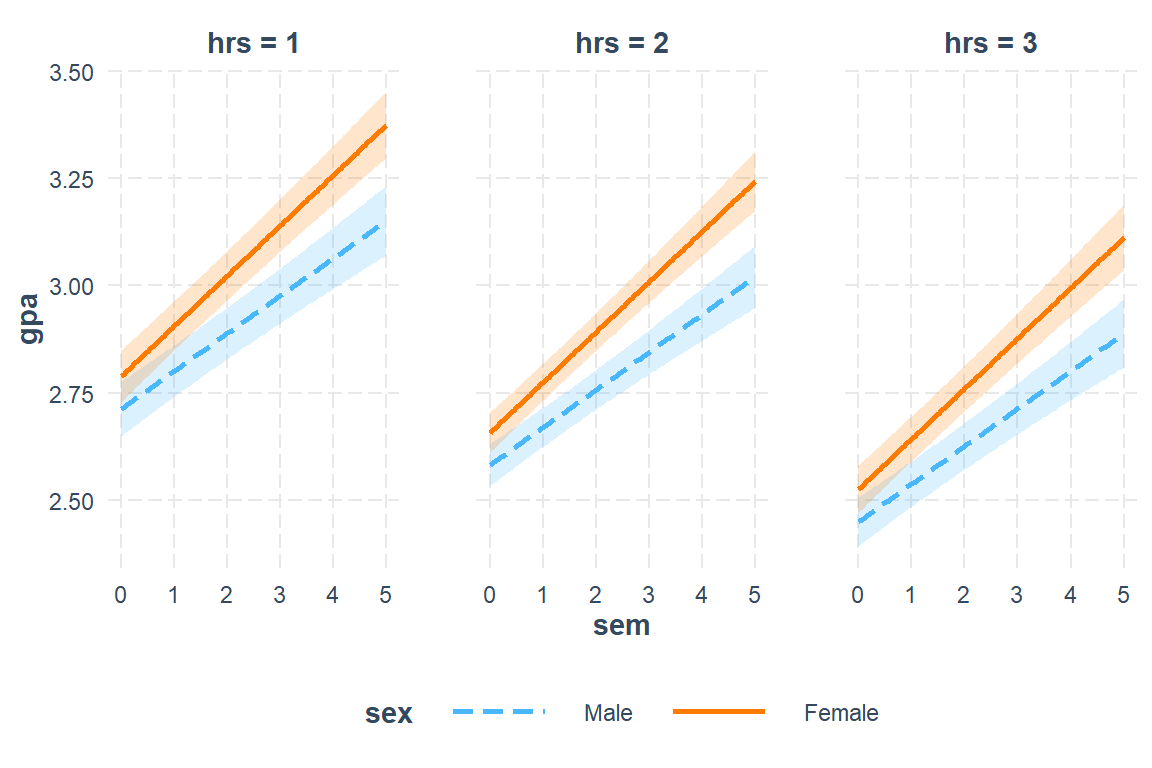
interactions::interact_plot(model = fit_lmer_5_re,
                            pred = sem,
                            modx = sex,
                            mod2 = highgpa,
                            mod2.values = c(2, 3, 4),
                            interval = TRUE)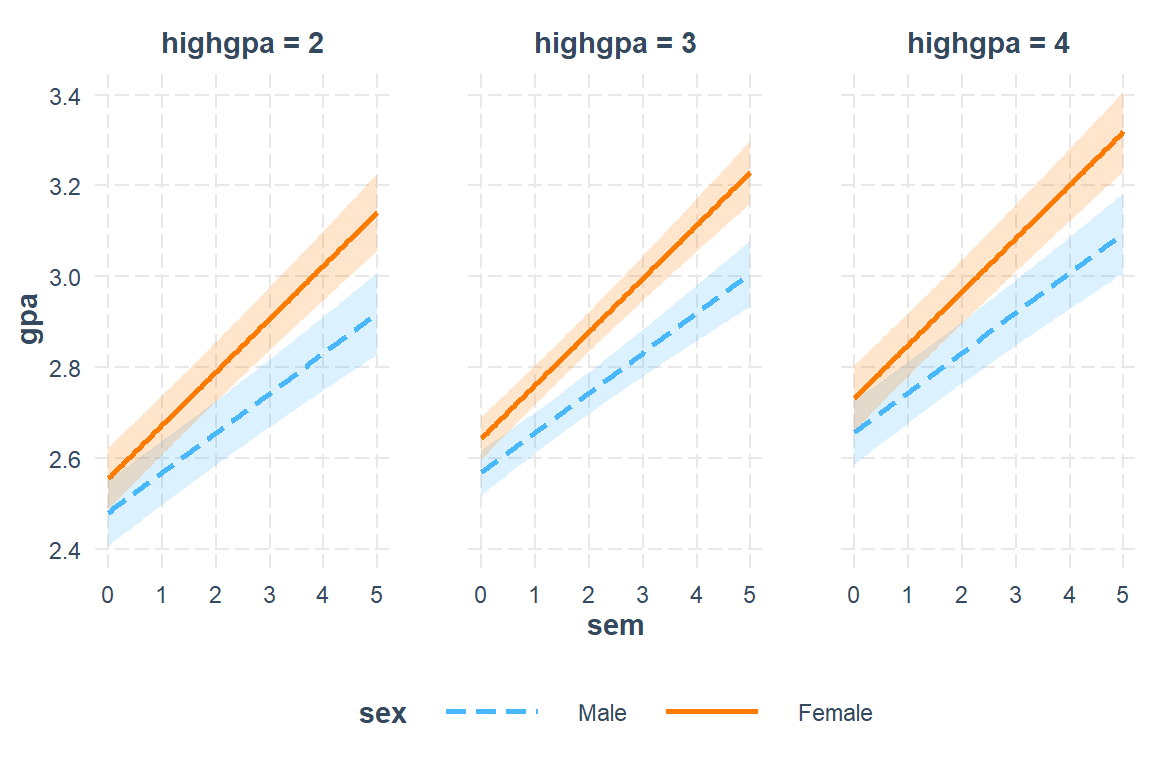
12.3.7.2 Using emmeans::emmeans() & ggplot
 sem sex    emmean     SE  df lower.CL upper.CL
   0 Male     2.57 0.0253 198     2.52     2.62
   1 Male     2.65 0.0230 198     2.61     2.70
   2 Male     2.74 0.0234 197     2.70     2.79
   3 Male     2.83 0.0263 197     2.78     2.88
   4 Male     2.92 0.0311 197     2.86     2.98
   5 Male     3.01 0.0370 198     2.93     3.08
   0 Female   2.64 0.0240 197     2.60     2.69
   1 Female   2.76 0.0219 197     2.72     2.80
   2 Female   2.88 0.0222 197     2.83     2.92
   3 Female   2.99 0.0250 197     2.95     3.04
   4 Female   3.11 0.0296 198     3.05     3.17
   5 Female   3.23 0.0352 198     3.16     3.30

Degrees-of-freedom method: kenward-roger
Confidence level used: 0.95
fit_lmer_5_re %>%
emmeans::emmeans(~sem*sex,
at = list(sem = 0:5)) %>%
data.frame() %>%
dplyr::mutate(sex = sex %>%
forcats::fct_recode("Male" = "male",
"Female" = "female") %>%
forcats::fct_rev()) %>%
ggplot(aes(x = sem,
y = emmean,
group = sex)) +
geom_ribbon(aes(ymin = emmean - SE,
ymax = emmean + SE,
fill = sex),
alpha = .2) +
geom_point(aes(shape = sex,
color = sex),
size = 3) +
geom_line(aes(linetype = sex,
color = sex)) +
theme_bw() +
labs(x = NULL,
y = "Estimated Marginal Mean\nCollege GPA",
fill = NULL,
color = NULL,
shape = NULL,
linetype = NULL) +
scale_x_continuous(breaks = 0:5,
labels = c("Year 1\nSem 1",
"Year 1\nSem 2",
"Year 2\nSem 1",
"Year 2\nSem 2",
"Year 3\nSem 1",
"Year 3\nSem 2")) +
scale_y_continuous(breaks = seq(from = 0, to = 4, by = .2)) +
scale_linetype_manual(values = c("solid", "longdash")) +
theme(legend.position = "inside",
legend.position.inside = c(0, 1),
legend.justification = c(-.1, 1.1),
legend.key.width = unit(1.5, "cm"),
legend.background = element_rect(color = "black"))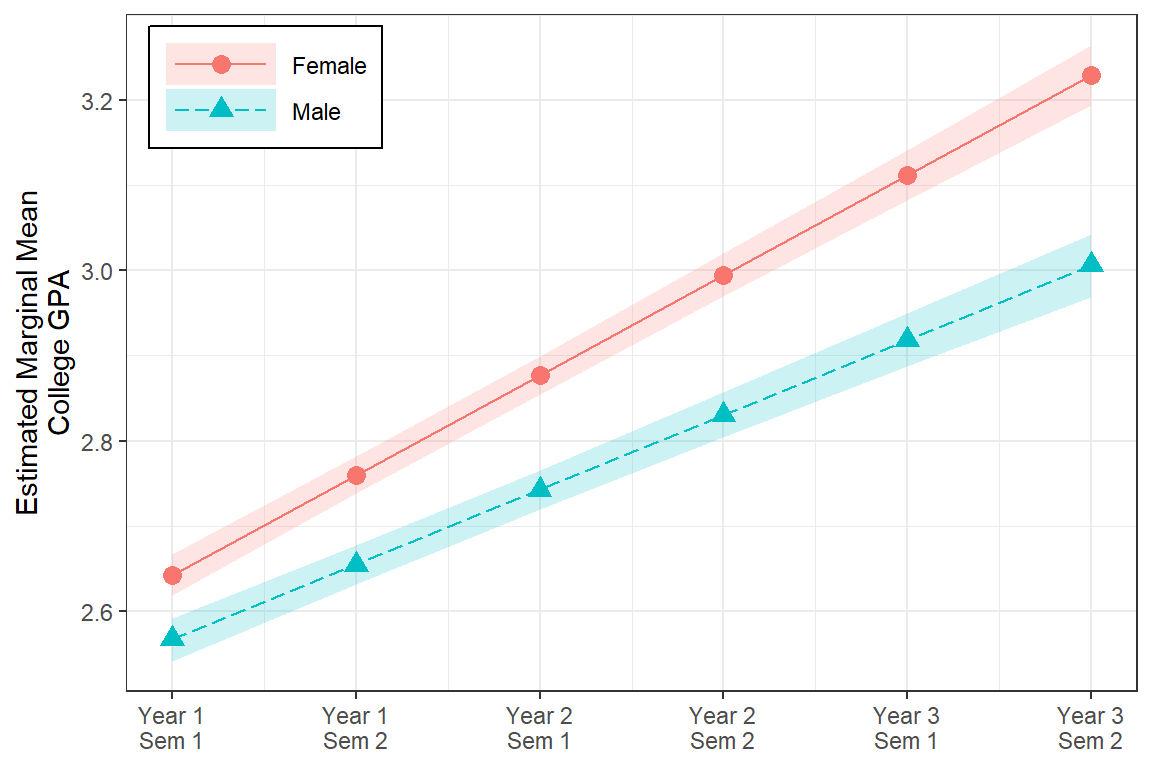
12.3.8 Effect Sizes
12.3.8.1 Standardized Parameters
# Standardization method: refit

Parameter          | Std. Coef. |         95% CI
------------------------------------------------
(Intercept)        |      -0.20 | [-0.32, -0.08]
sem                |       0.38 | [ 0.31,  0.45]
hrs                |      -0.14 | [-0.18, -0.11]
highgpa            |       0.13 | [ 0.06,  0.21]
sex [Female]       |       0.38 | [ 0.21,  0.55]
sem × sex [Female] |       0.13 | [ 0.03,  0.22]
12.3.8.2 R-squared type measures
# R2 for Mixed Models

  Conditional R2: 0.719
Marginal R2: 0.306# Explained Variance by Level
Level | R2
---------------
Level 1 | 0.019
student | 0.33612.3.8.3 Pairwise Differences in Means
sem = 0:
 sex    emmean     SE  df lower.CL upper.CL
 Male     2.57 0.0253 198     2.52     2.62
 Female   2.64 0.0240 197     2.60     2.69

sem = 1:
 sex    emmean     SE  df lower.CL upper.CL
 Male     2.65 0.0230 198     2.61     2.70
 Female   2.76 0.0219 197     2.72     2.80

sem = 2:
 sex    emmean     SE  df lower.CL upper.CL
 Male     2.74 0.0234 197     2.70     2.79
 Female   2.88 0.0222 197     2.83     2.92

sem = 3:
 sex    emmean     SE  df lower.CL upper.CL
 Male     2.83 0.0263 197     2.78     2.88
 Female   2.99 0.0250 197     2.95     3.04

sem = 4:
 sex    emmean     SE  df lower.CL upper.CL
 Male     2.92 0.0311 197     2.86     2.98
 Female   3.11 0.0296 198     3.05     3.17

sem = 5:
 sex    emmean     SE  df lower.CL upper.CL
 Male     3.01 0.0370 198     2.93     3.08
 Female   3.23 0.0352 198     3.16     3.30

Degrees-of-freedom method: kenward-roger
Confidence level used: 0.95 sem = 0:
contrast estimate SE df t.ratio p.value
Male - Female -0.0755 0.0349 198 -2.164 0.0317
sem = 1:
contrast estimate SE df t.ratio p.value
Male - Female -0.1051 0.0318 197 -3.307 0.0011
sem = 2:
contrast estimate SE df t.ratio p.value
Male - Female -0.1347 0.0323 197 -4.167 <0.0001
sem = 3:
contrast estimate SE df t.ratio p.value
Male - Female -0.1642 0.0364 198 -4.517 <0.0001
sem = 4:
contrast estimate SE df t.ratio p.value
Male - Female -0.1938 0.0429 198 -4.515 <0.0001
sem = 5:
contrast estimate SE df t.ratio p.value
Male - Female -0.2233 0.0510 198 -4.376 <0.0001
Degrees-of-freedom method: kenward-roger fit_lmer_5_re %>%
emmeans::emmeans(~sex | sem,
at = list(sem = 0:5)) %>%
pairs(adjust = "none") %>%
data.frame() %>%
dplyr::mutate(p_Unadj = apaSupp::p_num(p.value)) %>%
dplyr::mutate(p_Adj = apaSupp::p_num(p.adjust(p.value, method = "fdr"))) %>%
dplyr::mutate(SMD = estimate/apaSupp::lmer_sd(fit_lmer_5_re)) %>%
dplyr::select("Semester" = sem,
"EMM Difference_Est" = estimate,
"EMM Difference_(SE)" = SE,
SMD,
p_Unadj,
p_Adj) %>%
flextable::flextable() %>%
flextable::separate_header() %>%
apaSupp::theme_apa(caption = "Sex Differences in Estimated Marginal Mean Collegate GPA for each Semester",
general_note = "EMM = estimated marginal means. SMD = standardized mean difference. P-values given both unadjusted (Unadj) and adjusted (Adj) via the method of Benjamini, Hochberg, and Yekutieli to control the false discovery rate (FDR)") %>%
flextable::hline(part = "header", i = 1)Semester | EMM Difference | SMD | p | ||
|---|---|---|---|---|---|
Est | (SE) | Unadj | Adj | ||
0 | -0.08 | 0.03 | -0.26 | .032* | .032* |
1 | -0.11 | 0.03 | -0.37 | .001** | .001** |
2 | -0.13 | 0.03 | -0.47 | < .001*** | < .001*** |
3 | -0.16 | 0.04 | -0.57 | < .001*** | < .001*** |
4 | -0.19 | 0.04 | -0.68 | < .001*** | < .001*** |
5 | -0.22 | 0.05 | -0.78 | < .001*** | < .001*** |
Note. EMM = estimated marginal means. SMD = standardized mean difference. P-values given both unadjusted (Unadj) and adjusted (Adj) via the method of Benjamini, Hochberg, and Yekutieli to control the false discovery rate (FDR) | |||||
12.3.9 Significance
12.3.9.1 Fixed Effects
The Likelyhood Ratio Test (Deviance Difference Test) is best for establishing significance of fixed effects.
Wald-tests
Linear mixed model fit by REML. t-tests use Satterthwaite's method [
lmerModLmerTest]
Formula: gpa ~ sem + hrs + highgpa + sex + sem:sex + (sem | student)
   Data: df_gpa_long

REML criterion at convergence: 202

Scaled residuals:
    Min      1Q  Median      3Q     Max
-3.0001 -0.5275 -0.0151  0.5261  3.3470

Random effects:
 Groups   Name        Variance Std.Dev. Corr
 student  (Intercept) 0.038669 0.19664
          sem         0.003678 0.06065  -0.19
 Residual             0.041592 0.20394
Number of obs: 1200, groups:  student, 200

Fixed effects:
                Estimate Std. Error         df t value Pr(>|t|)
(Intercept)    2.580e+00  9.300e-02  2.909e+02  27.742  < 2e-16 ***
sem            8.784e-02  7.995e-03  1.967e+02  10.987  < 2e-16 ***
hrs           -1.317e-01  1.725e-02  1.038e+03  -7.632  5.2e-14 ***
highgpa        8.852e-02  2.648e-02  1.947e+02   3.343 0.000993 ***
sexFemale      7.553e-02  3.491e-02  1.976e+02   2.164 0.031668 *
sem:sexFemale  2.956e-02  1.102e-02  1.957e+02   2.683 0.007921 **
---
Signif. codes:  0 '***' 0.001 '**' 0.01 '*' 0.05 '.' 0.1 ' ' 1

Correlation of Fixed Effects:
            (Intr) sem    hrs    highgp sexFml
sem         -0.139
hrs         -0.426  0.054
highgpa     -0.872  0.001  0.022
sexFemale   -0.265  0.312  0.030  0.066
sem:sexFeml  0.088 -0.724 -0.008  0.000 -0.429
F-test with Satterthwaite adjusted degrees of freedom
Type III Analysis of Variance Table with Satterthwaite's method
         Sum Sq Mean Sq NumDF   DenDF  F value    Pr(>F)
sem     14.3609 14.3609     1  197.45 345.2775 < 2.2e-16 ***
hrs      2.4229  2.4229     1 1037.87  58.2545 5.204e-14 ***
highgpa  0.4649  0.4649     1  194.68  11.1772 0.0009931 ***
sex      0.1948  0.1948     1  197.59   4.6827 0.0316679 *
sem:sex  0.2994  0.2994     1  195.74   7.1984 0.0079211 **
---
Signif. codes:  0 '***' 0.001 '**' 0.01 '*' 0.05 '.' 0.1 ' ' 1
12.3.9.2 Random Effects
Likelyhood Ratio Tests (Deviance Difference Test), by single term deletion
ANOVA-like table for random-effects: Single term deletions

Model:
gpa ~ sem + hrs + highgpa + sex + sem:sex + (sem | student)
                       npar  logLik    AIC    LRT Df Pr(>Chisq)
<none>                   10 -101.01 222.01
sem in (sem | student)    8 -154.30 324.59 106.58  2  < 2.2e-16 ***
---
Signif. codes:  0 '***' 0.001 '**' 0.01 '*' 0.05 '.' 0.1 ' ' 1