14 GEE, Continuous Outcome: Beat the Blues
14.1 PREPARATION
14.1.2 Background
This dataset was used as an example in Chapter 11 of “A Handbook of Statistical Analysis using R” by Brian S. Everitt and Torsten Hothorn. The authors include this data set in their HSAUR package on
CRAN.
The Background
“These data resulted from a clinical trial of an interactive multimedia program called ‘Beat the Blues’ designed to deliver cognitive behavioral therapy (CBT) to depressed patients via a computer terminal. Full details are given here: Proudfoot et. al (2003), but in essence Beat the Blues is an interactive program using multimedia techniques, in particular video vignettes.”
“In a randomized controlled trial of the program, patients with depression recruited in primary care were randomized to either the Beating the Blues program or to”Treatment as Usual” (TAU). Patients randomized to the BEat the Blues also received pharmacology and/or general practice (GP) support and practical/social help,offered as part of treatment as usual, with the exception of any face-to-face counseling or psychological intervention. Patients allocated to TAU received whatever treatment their GP prescribed. The latter included, besides any medication, discussion of problems with GP, provisions of practical/social help, referral to a counselor, referral to a practice nurse, referral to mental health professionals, or further physical examination.
The Research Question
Net of other factors (use of antidepressants and length of the current episode), does the Beat-the-Blues program results in better depression trajectories over treatment as usual?
The Data
The variables are as follows:
drugdid the patient take anti-depressant drugs (No or Yes)
lengththe length of the current episode of depression, a factor with levels:
- “<6m” less than six months
- “>6m” more than six months
treatmenttreatment group, a factor with levels:
- “TAU” treatment as usual
- “BtheB” Beat the Blues
bdi.preBeck Depression Inventory II, before treatment
bdi.2mBeck Depression Inventory II, after 2 months
bdi.4mBeck Depression Inventory II, after 4 months
bdi.6mBeck Depression Inventory II, after 6 months
bdi.8mBeck Depression Inventory II, after 8 months
14.1.3 Read in the data
    drug length treatment bdi.pre bdi.2m bdi.4m bdi.6m bdi.8m
1     No    >6m       TAU      29      2      2   <NA>   <NA>
2    Yes    >6m     BtheB      32     16     24     17     20
3    Yes    <6m       TAU      25     20   <NA>   <NA>   <NA>
4     No    >6m     BtheB      21     17     16     10      9
... <NA>   <NA>      <NA>     ...    ...    ...    ...    ...
97   Yes    <6m       TAU      28   <NA>   <NA>   <NA>   <NA>
98    No    >6m     BtheB      11     22      9     11     11
99    No    <6m       TAU      13      5      5      0      6
100  Yes    <6m       TAU      43   <NA>   <NA>   <NA>   <NA>
14.1.3.1 Wide Format
Tidy up the dataset
WIDE format * One line per person * Good for descriptive tables & correlation matrices
df_btb_wide <- BtheB %>%
  dplyr::mutate(id = row_number()) %>% # create a new variable to ID participants
  dplyr::select(id, treatment,         # specify that ID variable is first
                drug, length,
                bdi.pre, bdi.2m, bdi.4m, bdi.6m, bdi.8m)
df_btb_wide %>%
psych::headTail(top = 10, bottom = 10) %>%
flextable::flextable() %>%
apaSupp::theme_apa(caption = "Wide Format")id | treatment | drug | length | bdi.pre | bdi.2m | bdi.4m | bdi.6m | bdi.8m |
|---|---|---|---|---|---|---|---|---|
1 | TAU | No | >6m | 29 | 2 | 2 | ||
2 | BtheB | Yes | >6m | 32 | 16 | 24 | 17 | 20 |
3 | TAU | Yes | <6m | 25 | 20 | |||
4 | BtheB | No | >6m | 21 | 17 | 16 | 10 | 9 |
5 | BtheB | Yes | >6m | 26 | 23 | |||
6 | BtheB | Yes | <6m | 7 | 0 | 0 | 0 | 0 |
7 | TAU | Yes | <6m | 17 | 7 | 7 | 3 | 7 |
8 | TAU | No | >6m | 20 | 20 | 21 | 19 | 13 |
9 | BtheB | Yes | <6m | 18 | 13 | 14 | 20 | 11 |
10 | BtheB | Yes | >6m | 20 | 5 | 5 | 8 | 12 |
... | ... | ... | ... | ... | ... | |||
91 | TAU | No | <6m | 16 | ||||
92 | BtheB | Yes | <6m | 30 | 26 | 28 | ||
93 | BtheB | Yes | <6m | 17 | 8 | 7 | 12 | |
94 | BtheB | No | >6m | 19 | 4 | 3 | 3 | 3 |
95 | BtheB | No | >6m | 16 | 11 | 4 | 2 | 3 |
96 | BtheB | Yes | >6m | 16 | 16 | 10 | 10 | 8 |
97 | TAU | Yes | <6m | 28 | ||||
98 | BtheB | No | >6m | 11 | 22 | 9 | 11 | 11 |
99 | TAU | No | <6m | 13 | 5 | 5 | 0 | 6 |
100 | TAU | Yes | <6m | 43 |
14.1.3.2 Long Format
Restructure to long format
LONG FORMAT * One line per observation * Good for plots and modeling
df_btb_long <- df_btb_wide %>%
  tidyr::pivot_longer(cols = c(bdi.2m, bdi.4m, bdi.6m, bdi.8m),
                      names_to = "month",
                      names_pattern = "bdi.(.)m",
                      values_to = "bdi") %>%
  dplyr::mutate(month = as.numeric(month)) %>%
  dplyr::filter(complete.cases(id, bdi, treatment, month)) %>%
  dplyr::arrange(id, month) %>%
  dplyr::select(id, treatment, drug, length, bdi.pre, month, bdi)
df_btb_long %>%
psych::headTail(top = 10, bottom = 10) %>%
flextable::flextable() %>%
apaSupp::theme_apa(caption = "Long Format")id | treatment | drug | length | bdi.pre | month | bdi |
|---|---|---|---|---|---|---|
1 | TAU | No | >6m | 29 | 2 | 2 |
1 | TAU | No | >6m | 29 | 4 | 2 |
2 | BtheB | Yes | >6m | 32 | 2 | 16 |
2 | BtheB | Yes | >6m | 32 | 4 | 24 |
2 | BtheB | Yes | >6m | 32 | 6 | 17 |
2 | BtheB | Yes | >6m | 32 | 8 | 20 |
3 | TAU | Yes | <6m | 25 | 2 | 20 |
4 | BtheB | No | >6m | 21 | 2 | 17 |
4 | BtheB | No | >6m | 21 | 4 | 16 |
4 | BtheB | No | >6m | 21 | 6 | 10 |
... | ... | ... | ... | |||
96 | BtheB | Yes | >6m | 16 | 6 | 10 |
96 | BtheB | Yes | >6m | 16 | 8 | 8 |
98 | BtheB | No | >6m | 11 | 2 | 22 |
98 | BtheB | No | >6m | 11 | 4 | 9 |
98 | BtheB | No | >6m | 11 | 6 | 11 |
98 | BtheB | No | >6m | 11 | 8 | 11 |
99 | TAU | No | <6m | 13 | 2 | 5 |
99 | TAU | No | <6m | 13 | 4 | 5 |
99 | TAU | No | <6m | 13 | 6 | 0 |
99 | TAU | No | <6m | 13 | 8 | 6 |
14.2 EXPLORATORY DATA ANLAYSIS
14.2.1 Visualize: Person-profile Plots
Create spaghetti plots of the raw, observed data
df_btb_long %>%
  dplyr::mutate(treatment = treatment %>%
                  forcats::fct_recode("Treatment as Usual" = "TAU",
                                      "Beat the Blues Program" = "BtheB")) %>%
  ggplot(aes(x = month,
             y = bdi)) +
  geom_point() +
  geom_line(aes(group = id),
            size = 1,
            alpha = 0.3) +
  geom_smooth(method = "lm") +
  theme_bw() +
  facet_grid(.~ treatment) +
  labs(x = "Time from Baseline, months",
       y = "Beck Depression Inventory Score")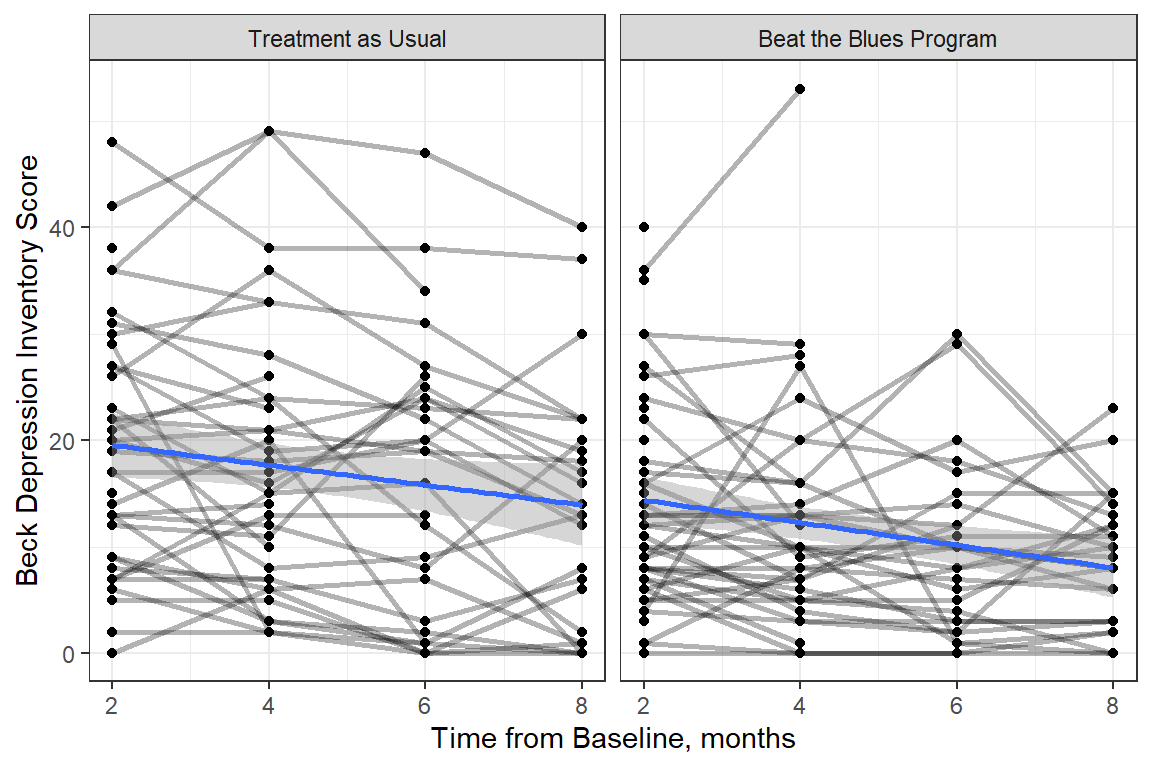
Figure 14.1
Observed Trajectories of Depression Across Time with LM Smoother by Treatment
df_btb_long %>%
  dplyr::mutate(treatment = treatment %>%
                  forcats::fct_recode("Treatment as Usual" = "TAU",
                                      "Beat the Blues Program" = "BtheB")) %>%
  dplyr::mutate(drug = drug %>%
                  forcats::fct_recode("Not Using Antidepressants" = "No",
                                      "Using Antidepressants" = "Yes")) %>%
  ggplot(aes(x = month,
             y = bdi)) +
  geom_line(aes(group = id),
            size = 1,
            alpha = 0.3) +
  geom_smooth(method = "lm") +
  facet_grid(drug ~ treatment) +
  theme_bw() +
  labs(x = "Time from Baseline, months",
       y = "Beck Depression Inventory Score")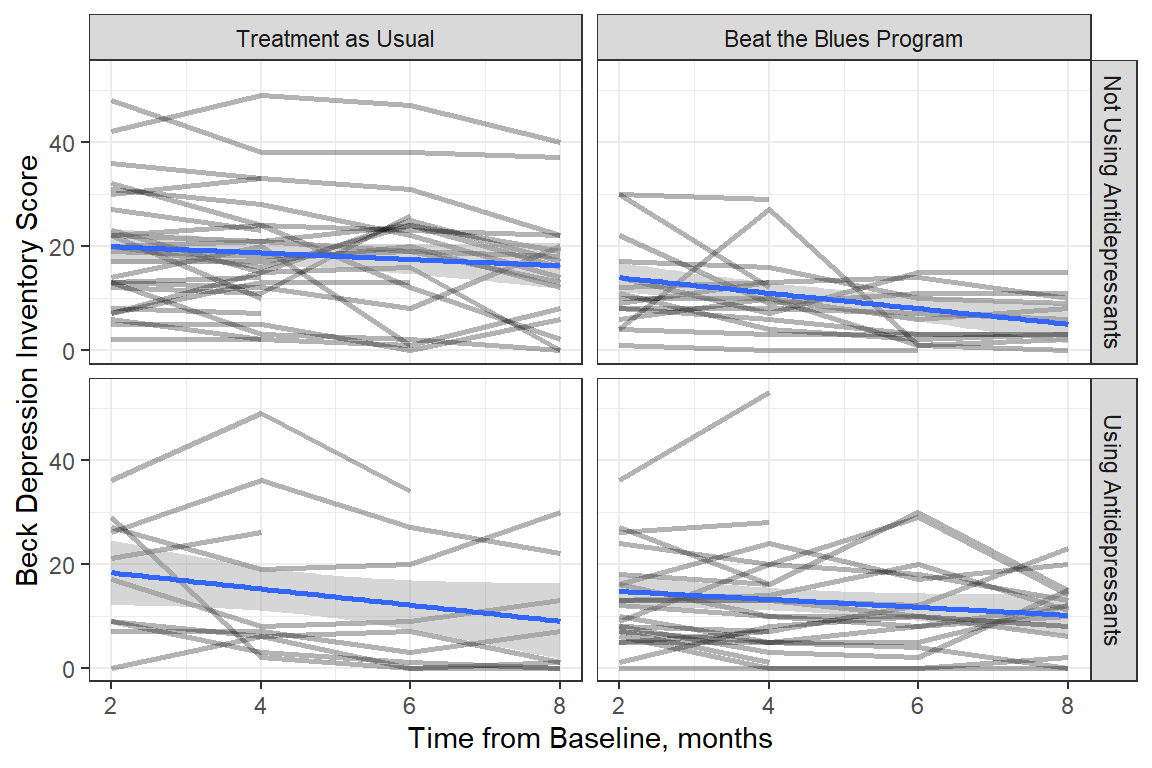
Figure 14.2
Observed Trajectories of Depression Across Time with LM Smoother by Treatment and Antidepressant Use
df_btb_long %>%
  dplyr::mutate(treatment = treatment %>%
                  forcats::fct_recode("Treatment as Usual" = "TAU",
                                      "Beat the Blues Program" = "BtheB")) %>%
  dplyr::mutate(drug = drug %>%
                  forcats::fct_recode("Not Using Antidepressants" = "No",
                                      "Using Antidepressants" = "Yes")) %>%
  ggplot(aes(x = month,
             y = bdi)) +
  geom_line(aes(group = id,
                color = length),
            size = 1,
            alpha = 0.3) +
  geom_smooth(aes(color = length),
              method = "lm",
              size = 1.25,
              se = FALSE) +
  facet_grid(drug ~ treatment) +
  theme_bw() +
  labs(x = "Time from Baseline, months",
       y = "Beck Depression Inventory Score",
       color = "Current Episode Length") +
  theme(legend.position = "inside",
        legend.position.inside = c(1, 1),
        legend.justification = c(1.1, 1.1),
        legend.key.width = unit(2, "cm"),
        legend.background = element_rect(color = "black"))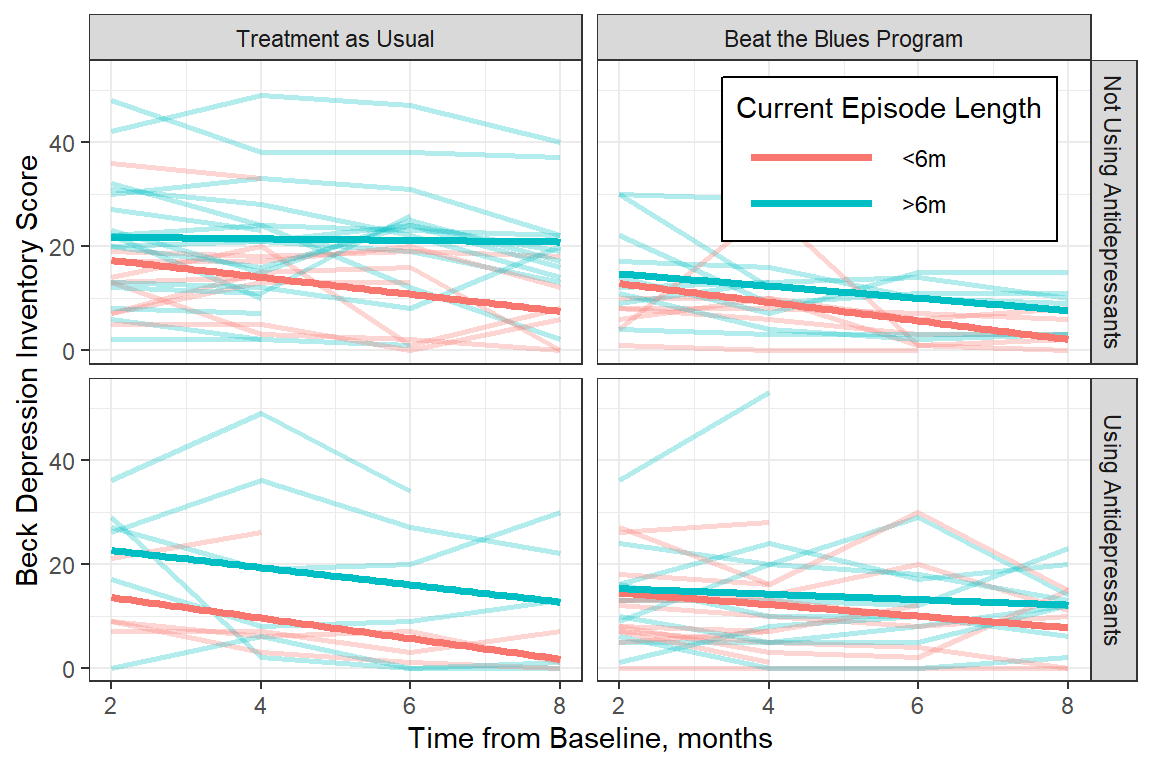
Figure 14.3
Observed Trajectories of Depression Across Time with LM Smoother by Treatment, Antidepressant Use, and Length of Current Episode
df_btb_long %>%
  dplyr::mutate(treatment = treatment %>%
                  forcats::fct_recode("Treatment as Usual" = "TAU",
                                      "Beat the Blues Program" = "BtheB")) %>%
  ggplot(aes(x = month,
             y = bdi,
             color = treatment,
             fill = treatment)) +
  geom_smooth(method = "lm") +
  theme_bw()  +
  labs(x = "Time from Baseline, months",
       y = "Beck Depression Inventory Score",
       color = NULL,
       fill = NULL) +
  theme(legend.position = "inside",
        legend.position.inside = c(1, 1),
        legend.justification = c(1.1, 1.1),
        legend.key.width = unit(2, "cm"),
        legend.background = element_rect(color = "black"))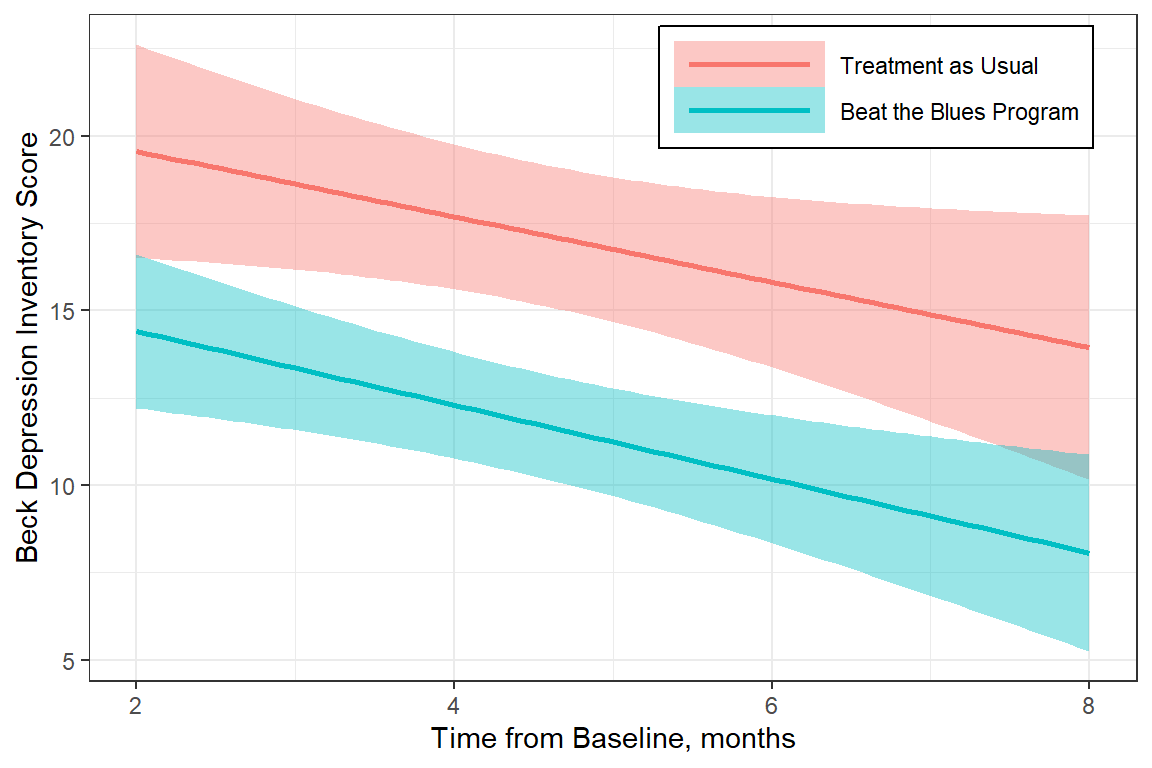
Figure 14.4
Linear Regression Line for Subgroup Analysis by Treatment
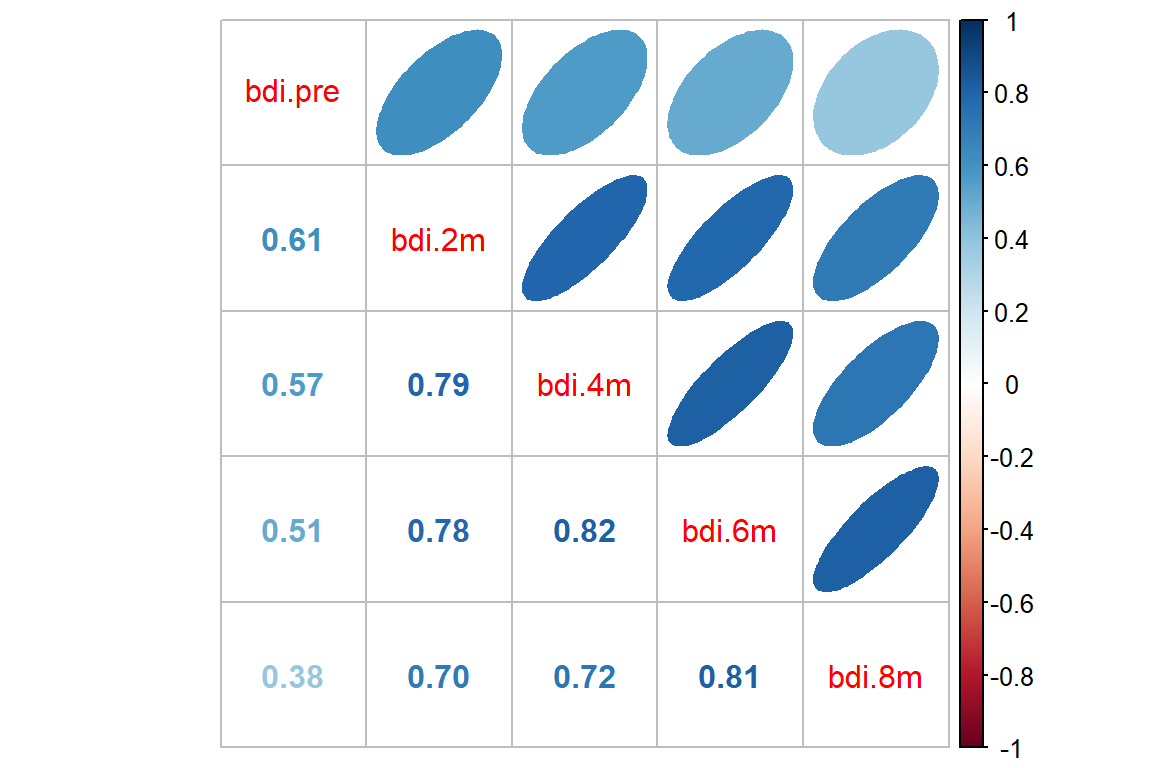
14.2.2 Calculate the Observed Correlation Structure
bdi_corr <- df_btb_wide %>%
  dplyr::select(starts_with("bdi")) %>%
  stats::cor(use="pairwise.complete.obs")

bdi_corr
bdi.pre bdi.2m bdi.4m bdi.6m bdi.8m
bdi.pre 1.0000000 0.6142207 0.5691248 0.5077286 0.3835090
bdi.2m 0.6142207 1.0000000 0.7903346 0.7849188 0.7038158
bdi.4m 0.5691248 0.7903346 1.0000000 0.8166591 0.7220149
bdi.6m 0.5077286 0.7849188 0.8166591 1.0000000 0.8107773
bdi.8m 0.3835090 0.7038158 0.7220149 0.8107773 1.0000000df_btb_wide %>%
dplyr::select(starts_with("bdi")) %>%
apaSupp::tab_cor(caption = "Correlation Between Repeated Measures of Depression")Variable Pair | r | p | |
|---|---|---|---|
bdi.pre | bdi.2m | .610 | < .001*** |
bdi.pre | bdi.4m | .570 | < .001*** |
bdi.pre | bdi.6m | .510 | < .001*** |
bdi.pre | bdi.8m | .380 | .005** |
bdi.2m | bdi.4m | .790 | < .001*** |
bdi.2m | bdi.6m | .780 | < .001*** |
bdi.2m | bdi.8m | .700 | < .001*** |
bdi.4m | bdi.6m | .820 | < .001*** |
bdi.4m | bdi.8m | .720 | < .001*** |
bdi.6m | bdi.8m | .810 | < .001*** |
Note. N = 100. r = Pearson's Product-Moment correlation coefficient. | |||
* p < .05. ** p < .01. *** p < .001. | |||
14.3 LINEAR REGRESSION, LM
This ignores any correlation between repeated measures on the same individual and treats all observations as independent.
14.3.1 Fit the models
btb_lm_1 <- stats::lm(bdi ~ bdi.pre + length + drug + treatment + month,
                      data = df_btb_long)

btb_lm_2 <- stats::lm(bdi ~ bdi.pre + length + drug + treatment*month,
                      data = df_btb_long)

btb_lm_3 <- stats::lm(bdi ~ bdi.pre + length + drug + treatment + drug*month,
                      data = df_btb_long)

btb_lm_4 <- stats::lm(bdi ~ bdi.pre + length + drug*treatment*month,
                      data = df_btb_long)
14.3.2 Parameter Estimates Table
apaSupp::tab_lms(list(btb_lm_1, btb_lm_2, btb_lm_3, btb_lm_4),
                 narrow = TRUE,
                 caption = "Multiple Linear Regression - Ignoring correlation WRONG!")
| Model 1 | Model 2 | Model 3 | Model 4 | ||||
|---|---|---|---|---|---|---|---|---|
Variable | b | (SE) | b | (SE) | b | (SE) | b | (SE) |
(Intercept) | 7.88 | (1.78) *** | 7.77 | (2.08) *** | 7.21 | (2.03) *** | 7.33 | (2.30) ** |
bdi.pre | 0.57 | (0.05) *** | 0.57 | (0.05) *** | 0.57 | (0.05) *** | 0.56 | (0.05) *** |
length | ||||||||
<6m | — | — | — | — | — | — | — | — |
>6m | 1.75 | (1.11) | 1.75 | (1.11) | 1.78 | (1.11) | 1.86 | (1.10) |
drug | ||||||||
No | — | — | — | — | — | — | — | — |
Yes | -3.55 | (1.14) ** | -3.55 | (1.15) ** | -2.10 | (2.39) | -2.00 | (3.75) |
treatment | ||||||||
TAU | — | — | — | — | — | — | — | — |
BtheB | -3.35 | (1.10) ** | -3.13 | (2.36) | -3.36 | (1.10) ** | -3.31 | (3.13) |
month | -0.96 | (0.23) *** | -0.93 | (0.34) ** | -0.82 | (0.31) ** | -0.60 | (0.40) |
treatment * month | ||||||||
BtheB * month | -0.05 | (0.47) | -0.56 | (0.63) | ||||
drug * month | ||||||||
Yes * month | -0.32 | (0.47) | -1.02 | (0.73) | ||||
drug * treatment | ||||||||
Yes * BtheB | -0.23 | (4.92) | ||||||
drug * treatment * month | ||||||||
Yes * BtheB * month | 1.31 | (0.98) | ||||||
AIC | 2011.01 | 2013.00 | 2012.52 | 2009.78 | ||||
BIC | 2036.45 | 2042.08 | 2041.60 | 2049.77 | ||||
R² | .398 | .398 | .399 | .417 | ||||
Adjusted R² | .387 | .385 | .386 | .398 | ||||
Note. | ||||||||
* p < .05. ** p < .01. *** p < .001. | ||||||||
14.4 MULTILEVEL MODELING, MLM
14.4.1 Fit the models
btb_lmer_RI   <- lmerTest::lmer(bdi ~ bdi.pre + length + drug + treatment +
                                  month + (1 | id),
                                data = df_btb_long,
                                REML = TRUE)

btb_lmer_RIAS <- lmerTest::lmer(bdi ~ bdi.pre + length + drug + treatment +
                                  month + (month | id),
                                data = df_btb_long,
                                REML = TRUE,
                                control = lmerControl(optimizer = "Nelder_Mead"))
14.4.2 Parameter Estimates Table
| MLM - RI | MLM - RIAS | ||||
|---|---|---|---|---|---|---|
Variable | b | (SE) | p | b | (SE) | p |
(Intercept) | 5.92 | (2.31) | .012* | 5.94 | (2.30) | .011* |
bdi.pre | 0.64 | (0.08) | < .001*** | 0.64 | (0.08) | < .001*** |
length | ||||||
<6m | — | — | — | — | ||
>6m | 0.24 | (1.68) | .887 | 0.10 | (1.67) | .954 |
drug | ||||||
No | — | — | — | — | ||
Yes | -2.79 | (1.77) | .118 | -2.89 | (1.76) | .105 |
treatment | ||||||
TAU | — | — | — | — | ||
BtheB | -2.36 | (1.71) | .171 | -2.49 | (1.71) | .149 |
month | -0.71 | (0.15) | < .001*** | -0.70 | (0.16) | < .001*** |
id.var__(Intercept) | 51.44 | 50.56 | ||||
Residual.var__Observation | 25.27 | 23.87 | ||||
id.var__month | 0.23 | |||||
id.cov__(Intercept).month | -0.31 | |||||
AIC | 1,882 | 1,885 | ||||
BIC | 1,911 | 1,922 | ||||
Log-likelihood | -933 | -933 | ||||
Note. | ||||||
* p < .05. ** p < .01. *** p < .001. | ||||||
14.4.3 Likelihood Ratio Test
Data: df_btb_long
Models:
btb_lmer_RI: bdi ~ bdi.pre + length + drug + treatment + month + (1 | id)
btb_lmer_RIAS: bdi ~ bdi.pre + length + drug + treatment + month + (month | id)
              npar    AIC    BIC  logLik -2*log(L)  Chisq Df Pr(>Chisq)
btb_lmer_RI      8 1882.1 1911.2 -933.04    1866.1
btb_lmer_RIAS   10 1885.2 1921.5 -932.58    1865.2 0.9236  2     0.6301
14.4.4 Plot the model predictions
interactions::interact_plot(model = btb_lmer_RI,
                            pred = month,
                            modx = treatment,
                            modx.labels = c("Treatment as Usual",
                                            "Beat the Blues Program"),
                            mod2 = drug,
                            mod2.labels = c("Not Using Antidepressants",
                                            "Using Antidepressants"),
                            legend.main = "Treatment",
                            interval = TRUE) +
  theme_bw()  +
  labs(x = "Time from Baseline, months",
       y = "Estimated Margial Mean\nBeck Depression Inventory Score") +
  theme(legend.position = c(0, 0),
        legend.justification = c(-0.1, -0.1),
        legend.background = element_rect(color = "black"),
        legend.key.width = unit(1.5, "cm"))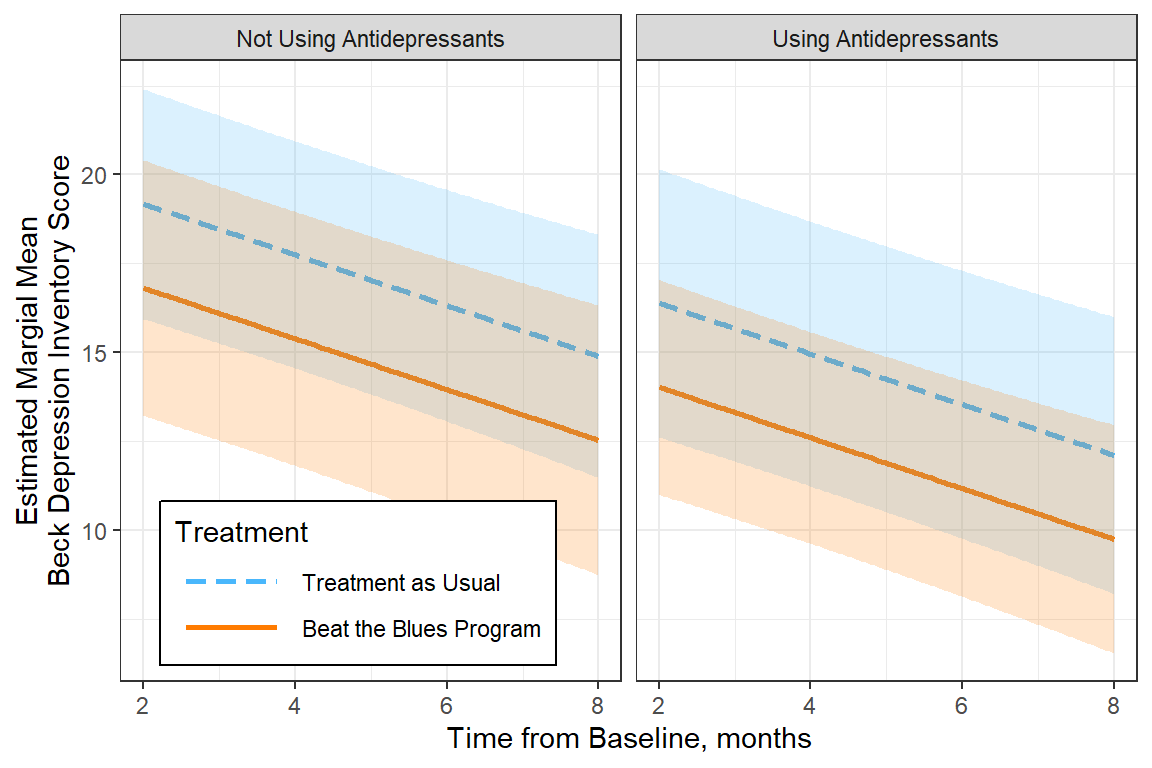
Figure 14.5
Estimated Marginal Means from a Multilevel Model (MLM)
effects::Effect(c("treatment", "month", "drug"),
                mod = btb_lmer_RI) %>%
  data.frame %>%
  dplyr::mutate(treatment = treatment %>%
                  forcats::fct_recode("Treatment as Usual" = "TAU",
                                      "Beat the Blues Program" = "BtheB")) %>%
  dplyr::mutate(drug = drug %>%
                  forcats::fct_recode("Not Using Antidepressants" = "No",
                                      "Using Antidepressants" = "Yes")) %>%
  dplyr::mutate(treatment = fct_reorder2(treatment, month, fit)) %>%
  ggplot(aes(x = month,
             y = fit)) +
  geom_line(aes(color = treatment,
                linetype = treatment),
            size = 1) +
  geom_ribbon(aes(ymin = lower,
                  ymax = upper,
                  fill = treatment),
              alpha = 0.3) +
  theme_bw() +
  facet_grid(.~ drug)+
  labs(x = "Time from Baseline, months",
       y = "Estimated Margial Mean\nBeck Depression Inventory Score") +
  theme(legend.position = c(0, 0),
        legend.justification = c(-0.1, -0.1),
        legend.background = element_rect(color = "black"),
        legend.key.width = unit(1.5, "cm"))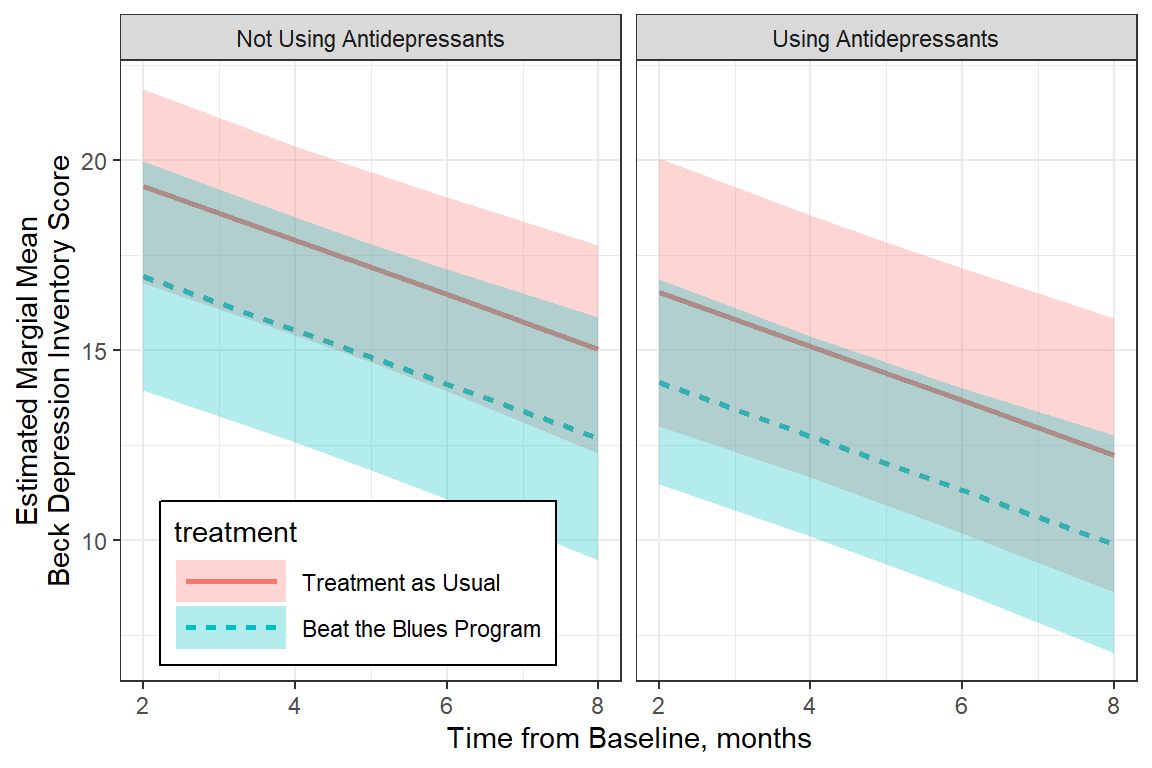
14.5 GENERAL ESTIMATING EQUATIONS, GEE
14.5.1 Explore Various Correlation Structures
Main effects to determine correlation structure
14.5.1.1 Fit the models - gee::gee()
btb_gee_in <- gee::gee(bdi ~ bdi.pre + length + drug + treatment + month,
                       data = df_btb_long,
                       id = id,
                       family = gaussian,
                       corstr = 'independence',
                                 scale.fix = TRUE,
                                 scale.value = 1)
(Intercept) bdi.pre length>6m drugYes treatmentBtheB
7.8830747 0.5723729 1.7530800 -3.5460058 -3.3539662
month
-0.9608077 btb_gee_ex <- gee::gee(bdi ~ bdi.pre + length + drug + treatment + month,
data = df_btb_long,
id = id,
family = gaussian,
corstr = 'exchangeable',
scale.fix = TRUE,
scale.value = 1) (Intercept) bdi.pre length>6m drugYes treatmentBtheB
7.8830747 0.5723729 1.7530800 -3.5460058 -3.3539662
month
-0.9608077 # btb_gee_ar <- gee::gee(bdi ~ bdi.pre + length + drug + treatment + month,
# data = df_btb_long,
# id = id,
# family = gaussian,
# corstr = "AR-M", Mv = 1,
# scale.fix = TRUE,
# scale.value = 1)
#
# cgee: M-dependence, M=1, but clustsize=1
# fatal error for this model
btb_gee_un <- gee::gee(bdi ~ bdi.pre + length + drug + treatment + month,
data = df_btb_long,
id = id,
family = gaussian,
corstr = 'unstructured',
scale.fix = TRUE,
scale.value = 1) (Intercept) bdi.pre length>6m drugYes treatmentBtheB
7.8830747 0.5723729 1.7530800 -3.5460058 -3.3539662
month
-0.9608077
 GEE:  GENERALIZED LINEAR MODELS FOR DEPENDENT DATA
 gee S-function, version 4.13 modified 98/01/27 (1998)

Model:
 Link:                      Identity
 Variance to Mean Relation: Gaussian
 Correlation Structure:     Independent

Call:
gee::gee(formula = bdi ~ bdi.pre + length + drug + treatment +
    month, id = id, data = df_btb_long, family = gaussian, corstr = "independence",
    scale.fix = TRUE, scale.value = 1)

Summary of Residuals:
         Min           1Q       Median           3Q          Max
-24.20158432  -5.31202378   0.01101526   5.29503741  27.77789553


Coefficients:
                 Estimate  Naive S.E.   Naive z Robust S.E.  Robust z
(Intercept)     7.8830747 0.205750420  38.31377  2.19973944  3.583640
bdi.pre         0.5723729 0.006339623  90.28500  0.08853253  6.465114
length>6m       1.7530800 0.128096295  13.68564  1.41954159  1.234962
drugYes        -3.5460058 0.132278613 -26.80710  1.73069664 -2.048889
treatmentBtheB -3.3539662 0.126920001 -26.42583  1.71390982 -1.956909
month          -0.9608077 0.026882849 -35.74055  0.17688635 -5.431780

Estimated Scale Parameter:  1
Number of Iterations:  1

Working Correlation
     [,1] [,2] [,3] [,4]
[1,]    1    0    0    0
[2,]    0    1    0    0
[3,]    0    0    1    0
[4,]    0    0    0    1
 GEE:  GENERALIZED LINEAR MODELS FOR DEPENDENT DATA
 gee S-function, version 4.13 modified 98/01/27 (1998)

Model:
 Link:                      Identity
 Variance to Mean Relation: Gaussian
 Correlation Structure:     Exchangeable

Call:
gee::gee(formula = bdi ~ bdi.pre + length + drug + treatment +
    month, id = id, data = df_btb_long, family = gaussian, corstr = "exchangeable",
    scale.fix = TRUE, scale.value = 1)

Summary of Residuals:
        Min          1Q      Median          3Q         Max
-25.4478843  -6.3276726  -0.8152833   4.3622258  25.4078115


Coefficients:
                 Estimate  Naive S.E.    Naive z Robust S.E.   Robust z
(Intercept)     5.8855129 0.264574859  22.245171  2.10712166  2.7931529
bdi.pre         0.6399964 0.009146473  69.971936  0.07931263  8.0692874
length>6m       0.2084783 0.192618294   1.082339  1.48052530  0.1408137
drugYes        -2.7742506 0.203113138 -13.658647  1.64824318 -1.6831561
treatmentBtheB -2.3360241 0.196537140 -11.885917  1.66217026 -1.4054060
month          -0.7078407 0.016228921 -43.616005  0.15394156 -4.5981134

Estimated Scale Parameter:  1
Number of Iterations:  5

Working Correlation
          [,1]      [,2]      [,3]      [,4]
[1,] 1.0000000 0.6915241 0.6915241 0.6915241
[2,] 0.6915241 1.0000000 0.6915241 0.6915241
[3,] 0.6915241 0.6915241 1.0000000 0.6915241
[4,] 0.6915241 0.6915241 0.6915241 1.0000000
 GEE:  GENERALIZED LINEAR MODELS FOR DEPENDENT DATA
 gee S-function, version 4.13 modified 98/01/27 (1998)

Model:
 Link:                      Identity
 Variance to Mean Relation: Gaussian
 Correlation Structure:     Unstructured

Call:
gee::gee(formula = bdi ~ bdi.pre + length + drug + treatment +
    month, id = id, data = df_btb_long, family = gaussian, corstr = "unstructured",
    scale.fix = TRUE, scale.value = 1)

Summary of Residuals:
        Min          1Q      Median          3Q         Max
-25.1527937  -6.1091139  -0.5896205   4.7316139  25.9041542


Coefficients:
                 Estimate  Naive S.E.    Naive z Robust S.E.   Robust z
(Intercept)     6.3905215 0.261722706  24.417146  2.15668950  2.9631162
bdi.pre         0.6171798 0.008860129  69.658110  0.08081777  7.6366846
length>6m       0.5834398 0.184908020   3.155297  1.46837275  0.3973377
drugYes        -2.7908835 0.194277260 -14.365467  1.63741987 -1.7044398
treatmentBtheB -2.4261698 0.187935122 -12.909613  1.65519523 -1.4657907
month          -0.7628336 0.020731817 -36.795308  0.15643591 -4.8763329

Estimated Scale Parameter:  1
Number of Iterations:  5

Working Correlation
          [,1]      [,2]      [,3]      [,4]
[1,] 1.0000000 0.7069560 0.5704892 0.4714744
[2,] 0.7069560 1.0000000 0.6086188 0.4637445
[3,] 0.5704892 0.6086188 1.0000000 0.5454963
[4,] 0.4714744 0.4637445 0.5454963 1.0000000
14.5.1.2 Fit the models - geepack::geeglm()
The output below each model is the ‘starting’ model assuming independence, so they will all be the same here.
btb_geeglm_in <- geepack::geeglm(bdi ~ bdi.pre + length + drug + treatment + month,
                                 data = df_btb_long,
                                 id = id,
                                 wave = month,
                                 family = gaussian,
                                 corstr = 'independence')

btb_geeglm_ex <- geepack::geeglm(bdi ~ bdi.pre + length + drug + treatment + month,
                                 data = df_btb_long,
                                 id = id,
                                 wave = month,
                                 family = gaussian,
                                 corstr = 'exchangeable')

btb_geeglm_ar <- geepack::geeglm(bdi ~ bdi.pre + length + drug + treatment + month,
                                 data = df_btb_long,
                                 id = id,
                                 wave = month,
                                 family = gaussian,
                                 corstr = 'ar1')

btb_geeglm_un <- geepack::geeglm(bdi ~ bdi.pre + length + drug + treatment + month,
                                 data = df_btb_long,
                                 id = id,
                                 wave = month,
                                 family = gaussian,
                                 corstr = 'unstructured')
14.5.1.3 Working Correlation Matrix
    alpha
0.6945624 alpha
0.7992866 alpha.1:2 alpha.1:3 alpha.1:4 alpha.2:3 alpha.2:4 alpha.3:4
0.6767183 0.6991541 0.6506675 0.7408944 0.6382619 0.7488595 14.5.1.4 Parameter Estimates Table
apaSupp::tab_gees(list("Exchangeable" = btb_geeglm_ex,
                       "Autoregressive" = btb_geeglm_ar,
                       "Unstructured" = btb_geeglm_un),
                  narrow = TRUE)
| Exchangeable | Autoregressive | Unstructured | |||
|---|---|---|---|---|---|---|
b | 95% CI | b | 95% CI | b | 95% CI | |
(Intercept) | 5.88 | [1.75, 10.01]** | 6.62 | [2.30, 10.93]** | 6.07 | [1.91, 10.23]** |
bdi.pre | 0.64 | [0.48, 0.80]*** | 0.60 | [0.44, 0.75]*** | 0.63 | [0.47, 0.79]*** |
length | ||||||
<6m | — | — | — | — | — | — |
>6m | 0.20 | [-2.70, 3.11] | 0.71 | [-2.26, 3.68] | 0.22 | [-2.67, 3.11] |
drug | ||||||
No | — | — | — | — | — | — |
Yes | -2.77 | [-6.00, 0.46] | -2.37 | [-5.55, 0.82] | -2.72 | [-5.93, 0.49] |
treatment | ||||||
TAU | — | — | — | — | — | — |
BtheB | -2.33 | [-5.59, 0.92] | -2.51 | [-5.74, 0.72] | -2.38 | [-5.62, 0.86] |
month | -0.71 | [-1.01, -0.41]*** | -0.74 | [-1.05, -0.42]*** | -0.71 | [-1.01, -0.40]*** |
Note. | ||||||
* p < .05. ** p < .01. *** p < .001. | ||||||
Can’t Use the Likelihood Ratio Test
The anova() function is used to compare nested models for parameters (fixed effects), not correlation structures.
Models are identicalNULLModels are identicalNULLModels are identicalNULL14.5.1.5 Variaous QIC Measures of Fit
References:
Pan, W. 2001. Akaike’s information criterion in generalized estimating equations. Biometrics 57:120-125. https://onlinelibrary.wiley.com/doi/abs/10.1111/j.0006-341X.2001.00120.x
Burnham, K. P. and D. R. Anderson. 2002. Model selection and multimodel inference: a practical information-theoretic approach. Second edition. Springer Science and Business Media, Inc., New York. https://cds.cern.ch/record/1608735/files/9780387953649_TOC.pdf
The QIC() is one way to try to measure model fit. You can enter more than one model into a single function call.
QIC(I) based on independence model <– suggested by Pan (Biometric, March 2001), asymptotically unbiased estimator (choose the correlation stucture that produces the smallest QIC(I), p122)
                   QIC
btb_geeglm_in 306.5589
btb_geeglm_ex 296.2554
btb_geeglm_ar 298.2556
btb_geeglm_un 296.5794
QIC(R) is based on quasi-likelihood of a working correlation R model, can NOT be used to select the working correlation matrix.
MuMIn::QIC(btb_geeglm_in,
           btb_geeglm_ex,
           btb_geeglm_ar,
           btb_geeglm_un,
           typeR = TRUE)    # NOT the default
QIC
btb_geeglm_in 306.5589
btb_geeglm_ex 304.5003
btb_geeglm_ar 304.6425
btb_geeglm_un 304.4087QIC_U(R) approximates QIC(R), and while both are useful for variable selection, they can NOT be applied to select the working correlation matrix.
                  QICu
btb_geeglm_in 292.0000
btb_geeglm_ex 283.7551
btb_geeglm_ar 285.6132
btb_geeglm_un 284.1707MuMIn::model.sel(btb_geeglm_in,
btb_geeglm_ex,
btb_geeglm_ar,
btb_geeglm_un,
rank = "QIC") #sorts the best to the TOP, uses QIC(I)Model selection table
(Int) bdi.pre drg lng mnt trt corstr qLik QIC delta weight
btb_geeglm_ex 5.880 0.6402 + + -0.7070 + exchng -140 296.3 0.00 0.450
btb_geeglm_un 6.068 0.6307 + + -0.7061 + unstrc -140 296.6 0.32 0.382
btb_geeglm_ar 6.620 0.5956 + + -0.7357 + ar1 -140 298.3 2.00 0.165
btb_geeglm_in 7.883 0.5724 + + -0.9608 + indpnd -140 306.6 10.30 0.003
Abbreviations:
corstr: exchng = 'exchangeable', indpnd = 'independence',
unstrc = 'unstructured'
Models ranked by QIC(x) 14.5.2 Final “Best” Model
14.5.2.1 Tabulate Model Parameters
apaSupp::tab_gee(btb_geeglm_ex,
                 var_labels = c("bdi.pre" = "Baseline BDI",
                                "length" = "Current Episode Length",
                                "drug" = "Antidepressant Use",
                                "treatment" = "Intervention",
                                "month" = "Time, Months"),
caption = "Final GEE, exchangeable correlation")b | (SE) | p | |
|---|---|---|---|
(Intercept) | 5.88 | (2.11) | .005** |
Baseline BDI | 0.64 | (0.08) | < .001*** |
Current Episode Length | |||
<6m | — | — | |
>6m | 0.20 | (1.48) | .890 |
Antidepressant Use | |||
No | — | — | |
Yes | -2.77 | (1.65) | .093 |
Intervention | |||
TAU | — | — | |
BtheB | -2.33 | (1.66) | .160 |
Time, Months | -0.71 | (0.15) | < .001*** |
Note. N = 280 observations on 97 participants. Correlation structure: exchangeable | |||
* p < .05. ** p < .01. *** p < .001. | |||
14.5.2.2 Plot the Marginal Effects
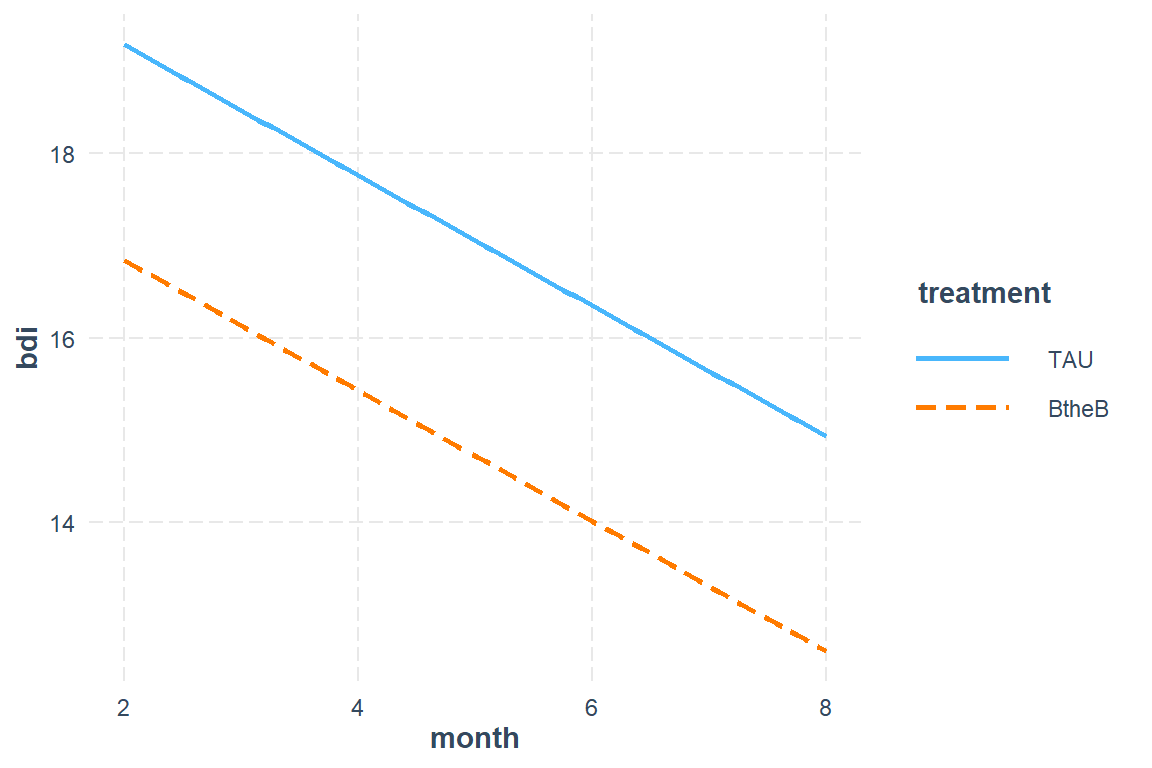
Do not worry about confidence intervals.
expand.grid(bdi.pre = 23,
            length = "<6m",
            drug = "No",
            treatment = levels(df_btb_long$treatment),
            month = seq(from = 2, to = 8, by = 2)) %>%
  dplyr::mutate(fit_in = predict(btb_geeglm_in,
                                 newdata = .,
                                 type = "response")) %>%
  dplyr::mutate(fit_ex = predict(btb_geeglm_ex,
                                 newdata = .,
                                 type = "response")) %>%
  dplyr::mutate(fit_ar = predict(btb_geeglm_ar,
                                 newdata = .,
                                 type = "response")) %>%
  dplyr::mutate(fit_un = predict(btb_geeglm_un,
                                 newdata = .,
                                 type = "response")) %>%
  tidyr::pivot_longer(cols = starts_with("fit_"),
                      names_to = "covR",
                      names_pattern = "fit_(.*)",
                      values_to = "fit") %>%
  dplyr::mutate(covR = factor(covR,
                              levels = c("un", "ar", "ex", "in"),
                              labels = c("Unstructured",
                                         "Auto-Regressive",
                                         "Compound Symetry",
                                         "Independence"))) %>%
  ggplot(aes(x = month,
             y = fit,
             linetype = treatment)) +
  geom_line(alpha = 0.6) +
  theme_bw() +
  labs(title    = "BtheB - Predictions from four GEE models (geeglm)",
       x = "Month",
       y = "Predicted BDI",
       linetype = "Treatment:") +
  scale_linetype_manual(values = c("solid", "longdash")) +
  theme(legend.key.width = unit(1, "cm")) +
  facet_wrap(~ covR)
expand.grid(bdi.pre = 23,
            length = "<6m",
            drug = "No",
            treatment = levels(df_btb_long$treatment),
            month = seq(from = 2, to = 8, by = 2)) %>%
  dplyr::mutate(fit_in = predict(btb_geeglm_in,
                                 newdata = .,
                                 type = "response")) %>%
  dplyr::mutate(fit_ex = predict(btb_geeglm_ex,
                                 newdata = .,
                                 type = "response")) %>%
  dplyr::mutate(fit_ar = predict(btb_geeglm_ar,
                                 newdata = .,
                                 type = "response")) %>%
  dplyr::mutate(fit_un = predict(btb_geeglm_un,
                                 newdata = .,
                                 type = "response")) %>%
  tidyr::pivot_longer(cols = starts_with("fit_"),
                      names_to = "covR",
                      names_pattern = "fit_(.*)",
                      values_to = "fit") %>%
  dplyr::mutate(covR = factor(covR,
                              levels = c("un", "ar", "ex", "in"),
                              labels = c("Unstructured",
                                         "Auto-Regressive",
                                         "Compound Symetry",
                                         "Independence"))) %>%
  ggplot(aes(x = month,
             y = fit,
             color = covR,
             linetype = treatment)) +
  geom_line(alpha = 0.6) +
  theme_bw() +
  labs(title    = "BtheB - Predictions from four GEE models (geeglm)",
       x = "Month",
       y = "Predicted BDI",
       color = "Covariance Pattern:",
       linetype = "Treatment:") +
  scale_linetype_manual(values = c("solid", "longdash")) +
  scale_size_manual(values     = c(2, 1, 1, 1)) +
  scale_color_manual(values    = c("red",
                                   "dodgerblue",
                                   "blue",
                                   "darkgreen")) +
  theme(legend.key.width = unit(1, "cm"))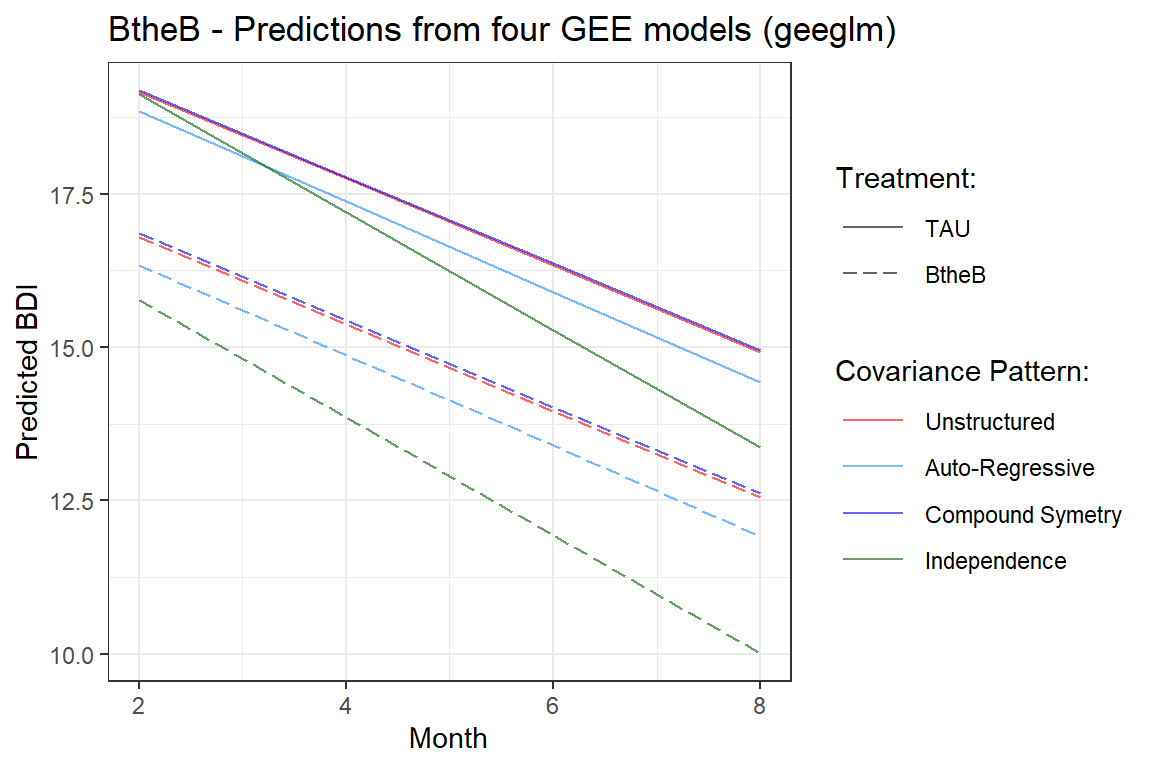
14.5.3 Investigate interactions NOT with time (month)
btb_geeglm_ex_1 <- geepack::geeglm(bdi ~ bdi.pre*length + drug + treatment + month,
                                   data = df_btb_long,
                                   id = id,
                                   wave = month,
                                   family = gaussian,
                                   corstr = 'exchangeable')

btb_geeglm_ex_2 <- geepack::geeglm(bdi ~ bdi.pre*drug + length + treatment + month,
                                   data = df_btb_long,
                                   id = id,
                                   wave = month,
                                   family = gaussian,
                                   corstr = 'exchangeable')

btb_geeglm_ex_3 <- geepack::geeglm(bdi ~  bdi.pre*treatment + length + drug + month,
                                   data = df_btb_long,
                                   id = id,
                                   wave = month,
                                   family = gaussian,
corstr = 'exchangeable')apaSupp::tab_gees(list("Episode Length" = btb_geeglm_ex_1,
"Antidepressant" = btb_geeglm_ex_2,
"Intervention" = btb_geeglm_ex_3),
narrow = TRUE,
caption = "GEE (exchangable): Interactions, not with Time")
| Episode Length | Antidepressant | Intervention | |||
|---|---|---|---|---|---|---|
b | 95% CI | b | 95% CI | b | 95% CI | |
(Intercept) | 3.24 | [-0.65, 7.14] | 3.37 | [-1.89, 8.62] | 3.62 | [-1.82, 9.06] |
bdi.pre | 0.76 | [0.61, 0.90]*** | 0.75 | [0.51, 0.99]*** | 0.74 | [0.49, 0.98]*** |
length | ||||||
<6m | — | — | — | — | — | — |
>6m | 5.66 | [-0.75, 12.07] | 0.47 | [-2.40, 3.34] | 0.22 | [-2.67, 3.12] |
drug | ||||||
No | — | — | — | — | — | — |
Yes | -2.25 | [-5.42, 0.92] | 1.47 | [-4.80, 7.74] | -2.76 | [-5.97, 0.45] |
treatment | ||||||
TAU | — | — | — | — | — | — |
BtheB | -2.42 | [-5.61, 0.77] | -2.19 | [-5.45, 1.08] | 1.24 | [-5.40, 7.87] |
month | -0.70 | [-1.00, -0.40]*** | -0.71 | [-1.01, -0.41]*** | -0.71 | [-1.01, -0.41]*** |
bdi.pre * length | ||||||
bdi.pre * >6m | -0.23 | [-0.55, 0.08] | ||||
bdi.pre * drug | ||||||
bdi.pre * Yes | -0.19 | [-0.51, 0.14] | ||||
bdi.pre * treatment | ||||||
bdi.pre * BtheB | -0.15 | [-0.48, 0.17] | ||||
Note. | ||||||
* p < .05. ** p < .01. *** p < .001. | ||||||
14.5.4 Investigate interactions with time (month)
btb_geeglm_ex_11 <- geepack::geeglm(bdi ~ bdi.pre + length + drug + treatment*month,
                                    data = df_btb_long,
                                    id = id,
                                    wave = month,
                                    family = gaussian,
                                    corstr = 'exchangeable')

btb_geeglm_ex_12 <- geepack::geeglm(bdi ~ bdi.pre + length + treatment + drug*month,
                                    data = df_btb_long,
                                    id = id,
                                    wave = month,
                                    family = gaussian,
                                    corstr = 'exchangeable')

btb_geeglm_ex_13 <- geepack::geeglm(bdi ~ bdi.pre + drug + treatment +  length*month,
                                    data = df_btb_long,
                                    id = id,
                                    wave = month,
                                    family = gaussian,
                                    corstr = 'exchangeable')

btb_geeglm_ex_14 <- geepack::geeglm(bdi ~ length + drug + treatment + bdi.pre*month,
                                    data = df_btb_long,
                                    id = id,
                                    wave = month,
                                    family = gaussian,
corstr = 'exchangeable')apaSupp::tab_gees(list("Intervention" = btb_geeglm_ex_11,
"Antidepressant" = btb_geeglm_ex_12,
"Episode length" = btb_geeglm_ex_13,
"Baseline BDI" = btb_geeglm_ex_14),
narrow = TRUE,
caption = "GEE (exchangable): Interactions with Time")
| Intervention | Antidepressant | Episode length | Baseline BDI | ||||
|---|---|---|---|---|---|---|---|---|
b | 95% CI | b | 95% CI | b | 95% CI | b | 95% CI | |
(Intercept) | 6.83 | [2.48, 11.19]** | 6.63 | [2.29, 10.97]** | 6.28 | [2.07, 10.49]** | 5.09 | [0.50, 9.67]* |
bdi.pre | 0.64 | [0.48, 0.80]*** | 0.64 | [0.48, 0.80]*** | 0.64 | [0.48, 0.79]*** | 0.67 | [0.50, 0.85]*** |
length | ||||||||
<6m | — | — | — | — | — | — | — | — |
>6m | 0.25 | [-2.67, 3.17] | 0.16 | [-2.76, 3.08] | -0.44 | [-4.04, 3.15] | 0.27 | [-2.64, 3.18] |
drug | ||||||||
No | — | — | — | — | — | — | — | — |
Yes | -2.74 | [-5.99, 0.50] | -4.31 | [-8.25, -0.37]* | -2.79 | [-6.01, 0.43] | -2.72 | [-5.96, 0.53] |
treatment | ||||||||
TAU | — | — | — | — | — | — | — | — |
BtheB | -4.23 | [-8.16, -0.30]* | -2.32 | [-5.60, 0.96] | -2.31 | [-5.56, 0.93] | -2.36 | [-5.61, 0.90] |
month | -0.95 | [-1.45, -0.45]*** | -0.88 | [-1.28, -0.48]*** | -0.80 | [-1.11, -0.50]*** | -0.50 | [-1.18, 0.17] |
treatment * month | ||||||||
BtheB * month | 0.47 | [-0.12, 1.06] | ||||||
drug * month | ||||||||
Yes * month | 0.38 | [-0.21, 0.98] | ||||||
length * month | ||||||||
>6m * month | 0.16 | [-0.40, 0.73] | ||||||
bdi.pre * month | -0.01 | [-0.04, 0.02] | ||||||
Note. | ||||||||
* p < .05. ** p < .01. *** p < .001. | ||||||||
14.6 Plot Best Model
Now only plot the significant variables for the ‘best’ model.
interactions::interact_plot(model = btb_geeglm_ex,
                            pred = "month",
                            modx = "bdi.pre",
                            modx.values = c(10, 20, 30),
                            at = list(length = "<6m",
                                      drug = "No",
                                      treatment = "TAU"),
                            colors = rep("black", times = 3),
                            x.label = "Month",
                            y.label = "Predicted BDI",
                            legend.main    = "Baseline BDI:") +
  theme_bw() +
  theme(legend.position = "bottom",
        legend.key.width = unit(2, "cm")) +
  labs(title    = "BtheB - Predictions from the GEE model (exchangable)",
subtitle = "Trajectory for a person with BL depression < 6 months and randomized to TAU") 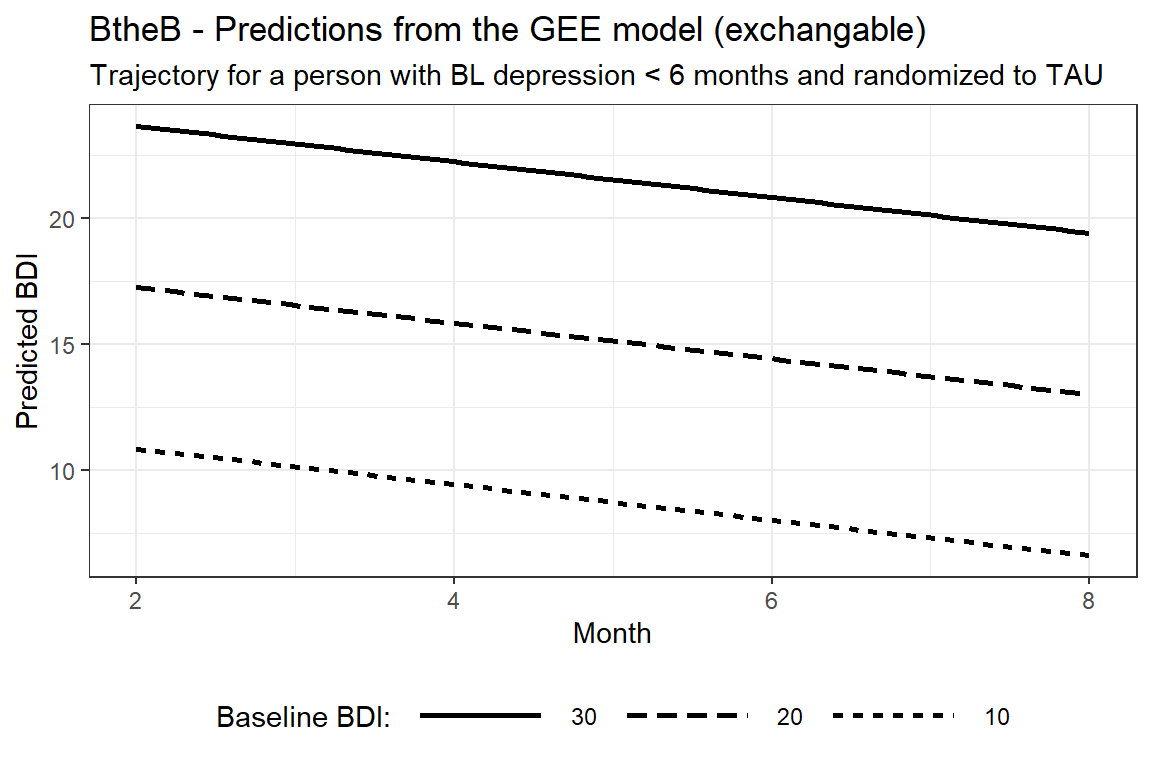
14.7 Conclusion
The Research Question
Does the Beat-the-Blues program
Net of other factors (use of antidepressants and length of the current episode), does the Beat-the-Blues program results in better depression trajectories over treatment as usual?
The Conclusion
There is no evidence that depression trajectories differ between participants randomized to the Beat the Blues program or the Treatment as Usual condition, after accounting for covariates and the correlation between repeated measurements.