11 MLM, Longitudinal: Hedeker & Gibbons - Depression
install.packages("devtools")
devtools::install_github("sarbearschwartz/apaSupp") # updated 9/17/2025
Load/activate these packages
library(tidyverse)
library(flextable)
library(apaSupp)      # Not on CRAN, on GitHub (see above)
library(texreg)
library(psych)
library(corrplot)
library(VIM)
library(naniar)
library(lme4)
library(lmerTest)
library(optimx)
library(performance)
library(interactions)
library(emmeans)
library(ggResidpanel)
library(HLMdiag)
library(sjPlot)
library(sjstats)
library(effects)
11.1 BACKGROUND
Starting in chapter 4, (Hedeker and Gibbons 2006) details analysis of a psychiatric study described by (Reisby et al. 1977). This study focuses on the relationship between Imipramine (IMI) and Desipramine (DMI) plasma levels and clinical response in 66 depressed inpatients (37 endogenous and 29 non-endogenous).
Hedeker, D., & Gibbons, R. D. (2006). Longitudinal data analysis. John Wiley & Sons.
Note: The IMI and DMI measures were only taken in the later weeks, but are not used here.
DEPENDENT VARIABLE
hamdHamilton Depression Scores (HD), measured weekly for 6 weeks
INDEPENDENT VARIABLES
endogDepression Diagnosis: endogenous vs. non-endogenous/reactive
df_raw <- read.table("data/riesby.dat.txt") %>%
  dplyr::rename(id    = "V1",
                hamd  = "V2",
                endog = "V5",
                week  = "V4") %>%
dplyr::select(-V3, -V6) id hamd week endog
1 101 26 0 0
2 101 22 1 0
3 101 18 2 0
4 101 7 3 0
5 101 4 4 0
6 101 3 5 0
7 103 33 0 0
8 103 24 1 0
9 103 15 2 0
10 103 24 3 0
11 103 15 4 0
... ... <NA> ... ...
389 360 28 4 1
390 360 33 5 1
391 361 30 0 1
392 361 22 1 1
393 361 11 2 1
394 361 8 3 1
395 361 7 4 1
396 361 19 5 111.1.1 Long Format
df_long <- df_raw %>%
  dplyr::filter(!is.na(hamd)) %>%                                # remove NA or missing scores
  dplyr::mutate(id = factor(id)) %>%                             # declare grouping var a factor
  dplyr::mutate(endog = factor(endog,                            # attach labels to a grouping variable
                               levels = c(0, 1),                 # order of the levels should match levels
                               labels = c("Reactive",            # order matters!
                                          "Endogenous"))) %>%
  dplyr::mutate(hamd = as.numeric(hamd)) %>%
  dplyr::select(id, week, endog, hamd) %>%                       # select the order of variables to include
dplyr::arrange(id, week) # sort observations Rows: 396
Columns: 4
$ id <fct> 101, 101, 101, 101, 101, 101, 103, 103, 103, 103, 103, 103, 104,…
$ week <int> 0, 1, 2, 3, 4, 5, 0, 1, 2, 3, 4, 5, 0, 1, 2, 3, 4, 5, 0, 1, 2, 3…
$ endog <fct> Reactive, Reactive, Reactive, Reactive, Reactive, Reactive, Reac…
$ hamd <dbl> 26, 22, 18, 7, 4, 3, 33, 24, 15, 24, 15, 13, 29, 22, 18, 13, 19,…df_long %>%
psych::headTail(top = 14, bottom = 8) %>%
flextable::flextable() %>%
apaSupp::theme_apa(caption = "Partial Printout of the Data in LONG Format") %>%
flextable::hline(i = c(6, 12, 17))id | week | endog | hamd |
|---|---|---|---|
101 | 0 | Reactive | 26 |
101 | 1 | Reactive | 22 |
101 | 2 | Reactive | 18 |
101 | 3 | Reactive | 7 |
101 | 4 | Reactive | 4 |
101 | 5 | Reactive | 3 |
103 | 0 | Reactive | 33 |
103 | 1 | Reactive | 24 |
103 | 2 | Reactive | 15 |
103 | 3 | Reactive | 24 |
103 | 4 | Reactive | 15 |
103 | 5 | Reactive | 13 |
104 | 0 | Endogenous | 29 |
104 | 1 | Endogenous | 22 |
... | ... | ||
609 | 4 | Endogenous | 15 |
609 | 5 | Endogenous | 2 |
610 | 0 | Endogenous | 34 |
610 | 1 | Endogenous | |
610 | 2 | Endogenous | 33 |
610 | 3 | Endogenous | 23 |
610 | 4 | Endogenous | |
610 | 5 | Endogenous | 11 |
11.1.2 Wide Format
df_wide <- df_long %>%     # save the dataset as a new name
  tidyr::pivot_wider(names_from = week,
                     names_prefix = "hamd_",
                     values_from = hamd)
Notice the missing values, displayed as NA.
Rows: 66
Columns: 8
$ id     <fct> 101, 103, 104, 105, 106, 107, 108, 113, 114, 115, 117, 118, 120…
$ endog  <fct> Reactive, Reactive, Endogenous, Reactive, Endogenous, Endogenou…
$ hamd_0 <dbl> 26, 33, 29, 22, 21, 21, 21, 21, NA, NA, 19, NA, 20, 20, 15, 18,…
$ hamd_1 <dbl> 22, 24, 22, 12, 25, 21, 22, 23, 17, 16, 16, 26, 19, 22, 15, 22,…
$ hamd_2 <dbl> 18, 15, 18, 16, 23, 16, 11, 19, 11, 16, 13, 18, 17, 19, 15, 16,…
$ hamd_3 <dbl> 7, 24, 13, 16, 18, 19, 9, 23, 13, 16, 12, 18, 18, 19, 13, 8, 14…
$ hamd_4 <dbl> 4, 15, 19, 13, 20, NA, 9, 23, 7, 16, 7, 14, 16, 12, 5, 9, 10, 1…
$ hamd_5 <dbl> 3, 13, 0, 9, NA, 6, 7, NA, 7, 11, 6, 11, 17, 14, 5, 12, 5, 24, …
df_wide %>%
psych::headTail() %>%
flextable::flextable() %>%
apaSupp::theme_apa(caption = "Partial Printout of the Data in WIDE Format") id | endog | hamd_0 | hamd_1 | hamd_2 | hamd_3 | hamd_4 | hamd_5 |
|---|---|---|---|---|---|---|---|
101 | Reactive | 26 | 22 | 18 | 7 | 4 | 3 |
103 | Reactive | 33 | 24 | 15 | 24 | 15 | 13 |
104 | Endogenous | 29 | 22 | 18 | 13 | 19 | 0 |
105 | Reactive | 22 | 12 | 16 | 16 | 13 | 9 |
... | ... | ... | ... | ... | ... | ||
607 | Endogenous | 30 | 39 | 30 | 27 | 20 | 4 |
608 | Reactive | 24 | 19 | 14 | 12 | 3 | 4 |
609 | Endogenous | 25 | 22 | 14 | 15 | 2 | |
610 | Endogenous | 34 | 33 | 23 | 11 |
11.2 EXPLORATORY DATA ANALYSIS
11.2.1 Diagnosis Group
| N = 66 |
|---|---|
Depression Type | |
Reactive | 29 (43.9%) |
Endogenous | 37 (56.1%) |
Unknown | 0 |
Note. . . | |
11.2.2 Missing Data & Attrition
Plot the amount of missing values and the amount of each patter of missing values.
df_wide %>%
  VIM::aggr(numbers = TRUE,   # shows the number to the far right
            prop = FALSE)     # shows counts instead of proportions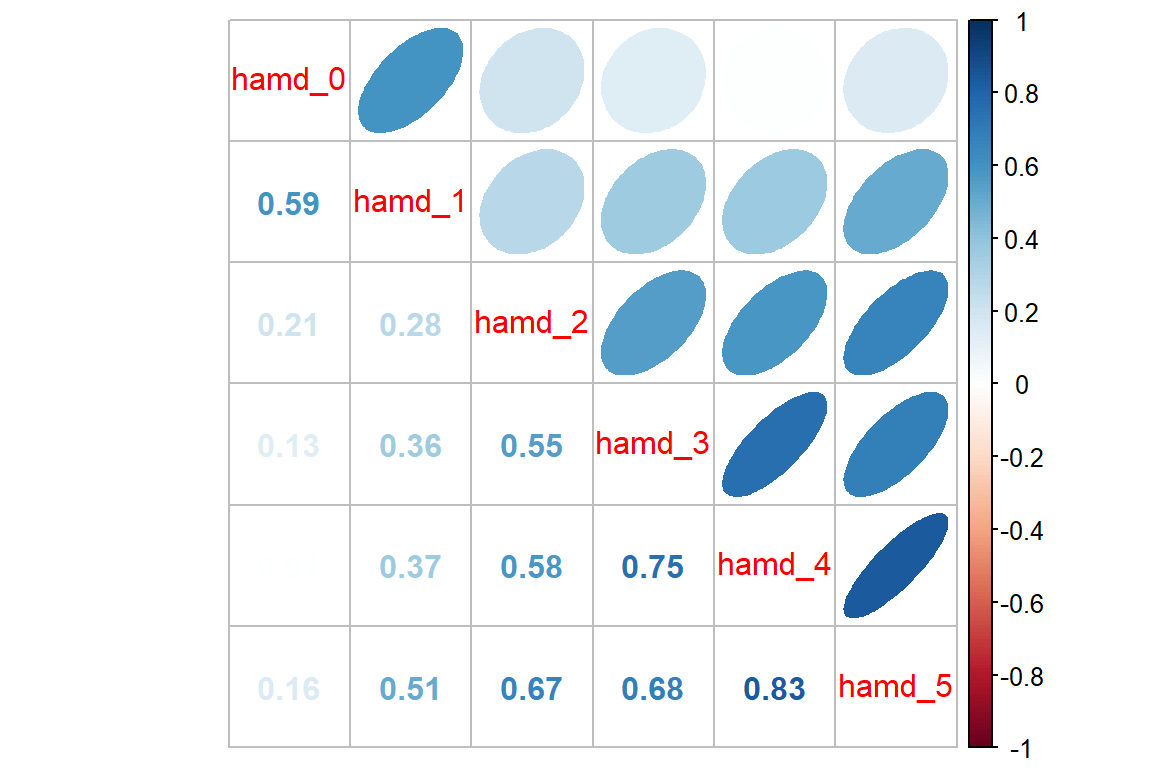
df_wide %>%
  naniar::gg_miss_upset(sets = c("hamd_5_NA",
                                 "hamd_4_NA",
                                 "hamd_3_NA",
                                 "hamd_2_NA",
                                 "hamd_1_NA",
                                 "hamd_0_NA"),
keep.order = TRUE) 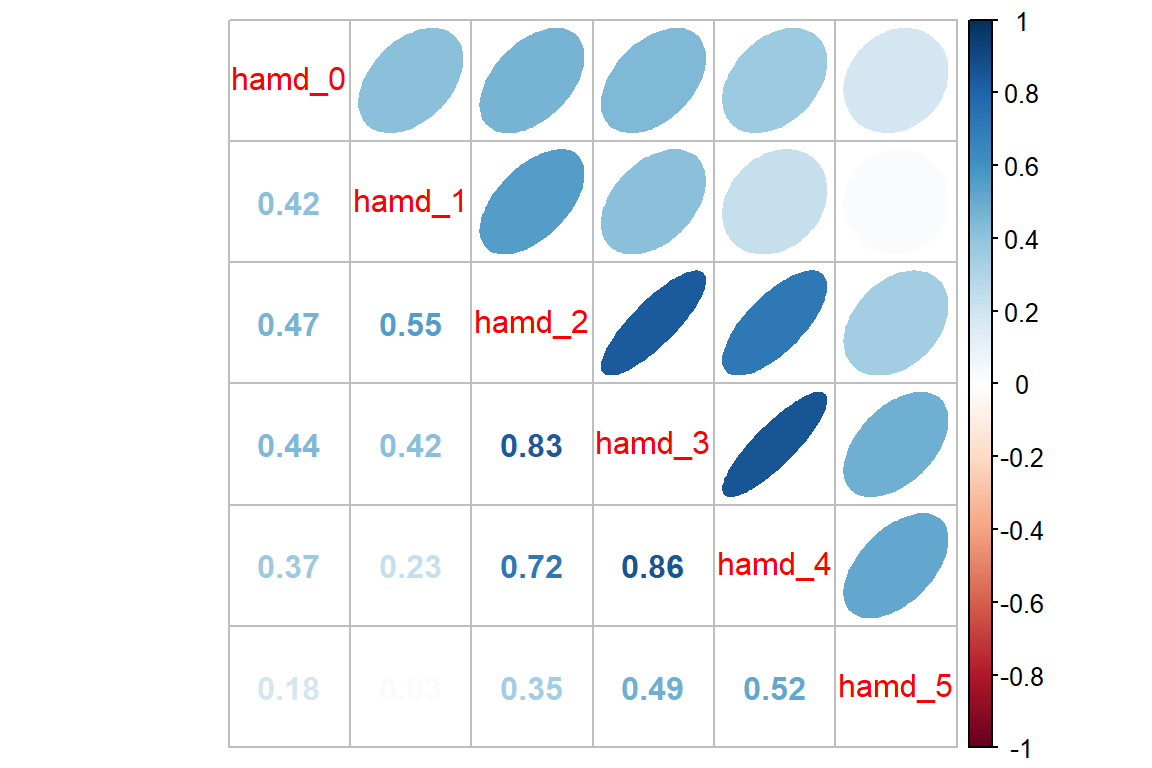
11.2.3 Depression Over Time, by Group
11.2.3.1 Table of Means
df_wide %>%
  dplyr::select(endog,
                "Baseline" = hamd_0,
                "Week 1" = hamd_1,
                "Week 2" = hamd_2,
                "Week 3" = hamd_3,
                "Week 4" = hamd_4,
                "Week 5" = hamd_5) %>%
  apaSupp::tab1(split = "endog",
                caption = "Hamilton Depression Scores Across Time, by Depression Type")
| Total | Reactive | Endogenous | p-value |
|---|---|---|---|---|
Baseline | 23.44 (4.53) | 22.79 (4.12) | 24.00 (4.85) | .295 |
Unknown | 5 | 1 | 4 | |
Week 1 | 21.84 (4.70) | 20.48 (3.83) | 23.00 (5.10) | .029* |
Unknown | 3 | 0 | 3 | |
Week 2 | 18.31 (5.49) | 17.00 (4.35) | 19.30 (6.08) | .081 |
Unknown | 1 | 1 | 0 | |
Week 3 | 16.42 (6.42) | 15.34 (6.17) | 17.28 (6.56) | .227 |
Unknown | 1 | 0 | 1 | |
Week 4 | 13.62 (6.97) | 12.62 (6.72) | 14.47 (7.17) | .295 |
Unknown | 3 | 0 | 3 | |
Week 5 | 11.95 (7.22) | 11.22 (6.34) | 12.58 (7.96) | .473 |
Unknown | 8 | 2 | 6 | |
Note. Continuous variables are summarized with means (SD) and significant group differences assessed via independent t-tests. Categorical variables are summarized with counts (%) and significant group differences assessed via Chi-squared tests for independence. | ||||
* p < .05. ** p < .01. *** p < .001. | ||||
11.2.3.2 Using the LONG formatted dataset
Each person’s data is stored on multiple lines, one for each time point.
FOR ALL DATA AVAILABLE!
df_long %>%
  dplyr::group_by(endog, week) %>%                # specify the groups
  dplyr::filter(!is.na(hamd)) %>%
  dplyr::summarise(hamd_n    = n(),                      # count of valid scores
                   hamd_mean = mean(hamd),               # mean score
                   hamd_sd   = sd(hamd),                 # standard deviation of scores
                   hamd_sem  = hamd_sd / sqrt(hamd_n)) %>%  # stadard error for the mean of scores
  flextable::as_grouped_data(groups = "endog") %>%
  flextable::flextable() %>%
  flextable::separate_header() %>%
  apaSupp::theme_apa(caption = "Depression over Time by Diagnosis Type for the Full Sample") %>%
flextable::hline(part = "header", i = 1)endog | week | hamd | |||
|---|---|---|---|---|---|
n | mean | sd | sem | ||
Reactive | |||||
0 | 28 | 22.79 | 4.12 | 0.78 | |
1 | 29 | 20.48 | 3.83 | 0.71 | |
2 | 28 | 17.00 | 4.35 | 0.82 | |
3 | 29 | 15.34 | 6.17 | 1.15 | |
4 | 29 | 12.62 | 6.72 | 1.25 | |
5 | 27 | 11.22 | 6.34 | 1.22 | |
Endogenous | |||||
0 | 33 | 24.00 | 4.85 | 0.84 | |
1 | 34 | 23.00 | 5.10 | 0.87 | |
2 | 37 | 19.30 | 6.08 | 1.00 | |
3 | 36 | 17.28 | 6.56 | 1.09 | |
4 | 34 | 14.47 | 7.17 | 1.23 | |
5 | 31 | 12.58 | 7.96 | 1.43 | |
FOR COMPLETE CASES ONLY!!!
df_wide %>%
  dplyr::select(endog,
                "At Baseline" = hamd_0,
                "After 1 Week" = hamd_1,
                "After 2 Weeks" = hamd_2,
                "After 3 Weeks" = hamd_3,
                "After 4 Weeks" = hamd_4,
                "After 5 Weeks" = hamd_5) %>%
  apaSupp::tab1(split = "endog",
                total = FALSE,
                test = FALSE,
                missing = "ifany",
                missing_text = "(missing)",
                caption = "Hamilton Depression Scores Across Time, by Depression Type, for the Full Sample")
| Reactive | Endogenous |
|---|---|---|
At Baseline | 22.79 (4.12) | 24.00 (4.85) |
(missing) | 1 | 4 |
After 1 Week | 20.48 (3.83) | 23.00 (5.10) |
(missing) | 0 | 3 |
After 2 Weeks | 17.00 (4.35) | 19.30 (6.08) |
(missing) | 1 | 0 |
After 3 Weeks | 15.34 (6.17) | 17.28 (6.56) |
(missing) | 0 | 1 |
After 4 Weeks | 12.62 (6.72) | 14.47 (7.17) |
(missing) | 0 | 3 |
After 5 Weeks | 11.22 (6.34) | 12.58 (7.96) |
(missing) | 2 | 6 |
Note. Continuous variables are summarized with means (SD). Categorical variables are summarized with counts (%). | ||
df_wide %>%
  dplyr::filter(complete.cases(hamd_0, hamd_1, hamd_2, hamd_3, hamd_4, hamd_5)) %>%
  dplyr::select(endog,
                "At Baseline" = hamd_0,
                "After 1 Week" = hamd_1,
                "After 2 Weeks" = hamd_2,
                "After 3 Weeks" = hamd_3,
                "After 4 Weeks" = hamd_4,
                "After 5 Weeks" = hamd_5) %>%
  apaSupp::tab1(split = "endog",
                total = FALSE,
                test = FALSE,
                missing = "ifany",
                missing_text = "(missing)",
                caption = "Hamilton Depression Scores Across Time, by Depression Type, for Complete Cases")
| Reactive | Endogenous |
|---|---|---|
At Baseline | 22.36 (3.90) | 24.10 (4.87) |
After 1 Week | 20.08 (3.68) | 23.90 (5.47) |
After 2 Weeks | 17.32 (4.34) | 18.95 (6.01) |
After 3 Weeks | 15.88 (5.84) | 17.48 (6.86) |
After 4 Weeks | 12.84 (6.68) | 14.19 (6.98) |
After 5 Weeks | 11.40 (6.54) | 13.05 (8.73) |
Note. Continuous variables are summarized with means (SD). Categorical variables are summarized with counts (%). | ||
11.2.3.3 Person-Profile Plot or Spaghetti Plot
Use the data in LONG format.
A scatterplot of all observations of depression scores over time, joining the dots of each individual’s data.
NOTE: Not all lines have a point for every week!
df_long %>%
  dplyr::filter(!is.na(hamd)) %>%
  ggplot(aes(x = week,
             y = hamd)) +
  geom_count(alpha = .2) +
  geom_line(aes(group = id),
            alpha = .4,
            linewidth = .5) +
  theme_bw() +
  labs(x = "Weeks Since Baseline",
y = "Hamilton Depression Score (HD)") 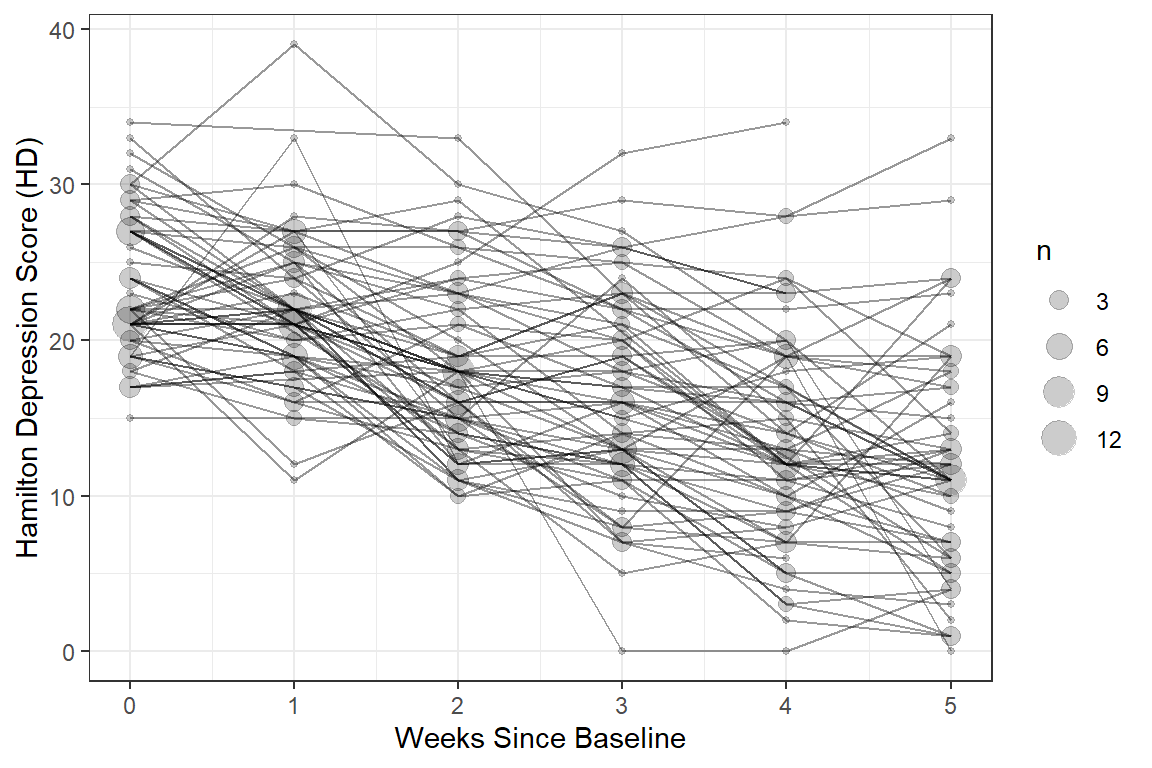
Figure 11.1
Observed Depression Trajectories
df_long %>%
  dplyr::filter(!is.na(hamd)) %>%
  ggplot(aes(x = week,
             y = hamd,
             color = endog)) +    # color points and lines by the "endog" variable
  geom_line(aes(group = id)) +
  theme_bw() +
  labs(x = "Weeks Since Baseline",
       y = "Hamilton Depression Score (HD)",
       color = "Depression Type") +
  theme(legend.position = c(0, 0),
        legend.justification = c(-.1, -.1),
        legend.key.width = unit(1.5, "cm"),
        legend.background = element_rect(color = "black"))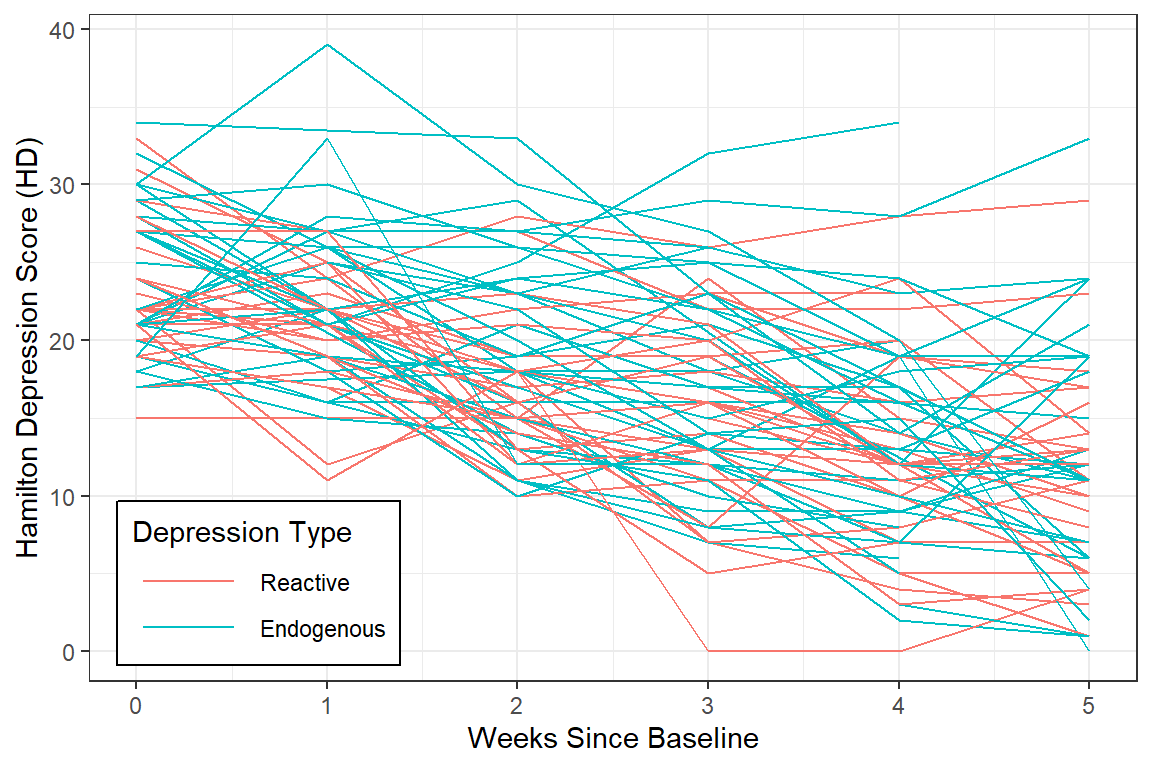
Figure 11.2
Observed Depression Trajectories by Diagnosis - color version
df_long %>%
  dplyr::filter(!is.na(hamd)) %>%
  dplyr::mutate(endog = glue::glue("Depression Type: {endog}")) %>%
  ggplot(aes(x = week,
             y = hamd)) +
  geom_line(aes(group = id)) +
  facet_grid( ~ endog) +           # side-by-side pandels by the "endog" variable
  theme_bw() +
  labs(x = "Weeks Since Baseline",
y = "Hamilton Depression Score (HD)") 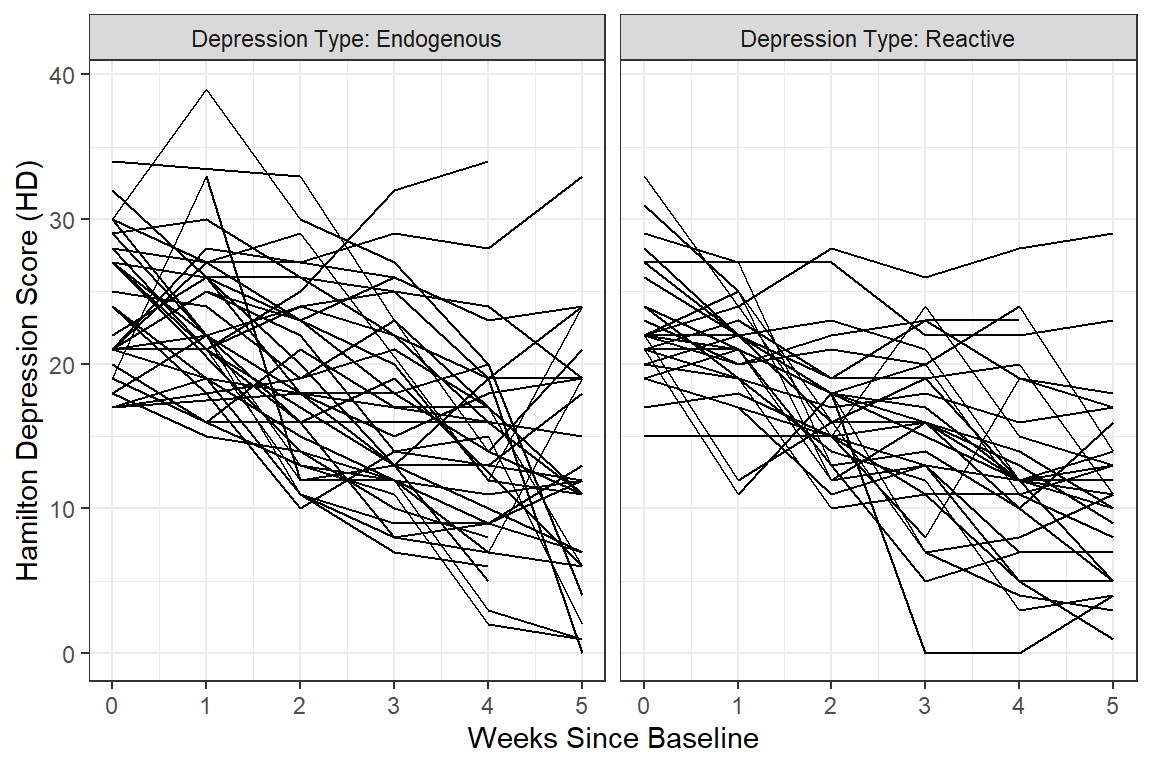
Figure 11.3
Observed Depression Trajectories by Diagnosis - panels version
df_long %>%
  dplyr::filter(!is.na(hamd)) %>%
  dplyr::mutate(endog = glue::glue("Depression Type: {endog}")) %>%
  ggplot(aes(x = week %>% factor(),
             y = hamd)) +
  geom_boxplot() +                   # compare center and spread
  facet_grid( ~ endog) +
  theme_bw() +
  labs(x = "Weeks Since Baseline",
y = "Hamilton Depression Score (HD)") 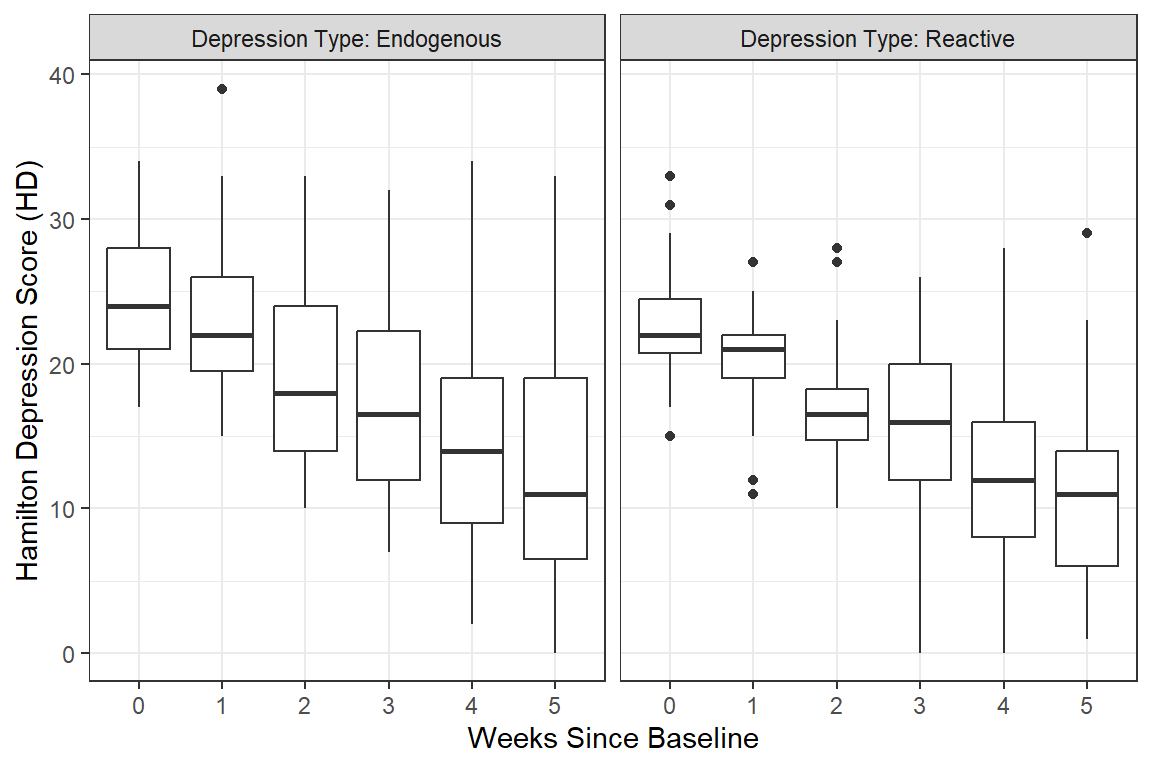
Figure 11.4
Observed Depression Trajectories by Diagnosis - boxplot version
df_long %>%
  dplyr::filter(!is.na(hamd)) %>%
  dplyr::mutate(endog = glue::glue("Depression Type: {endog}")) %>%
  ggplot(aes(x = week %>% factor(),
             y = hamd)) +
  geom_violin(fill = "gray75") +                   # similar to boxplots to show distribution
  stat_summary() +
  stat_summary(aes(group = "endog"),
               fun = mean,
               geom = "line") +
  facet_grid( ~ endog)   +
  theme_bw() +
  labs(x = "Weeks Since Baseline",
y = "Hamilton Depression Score (HD)") 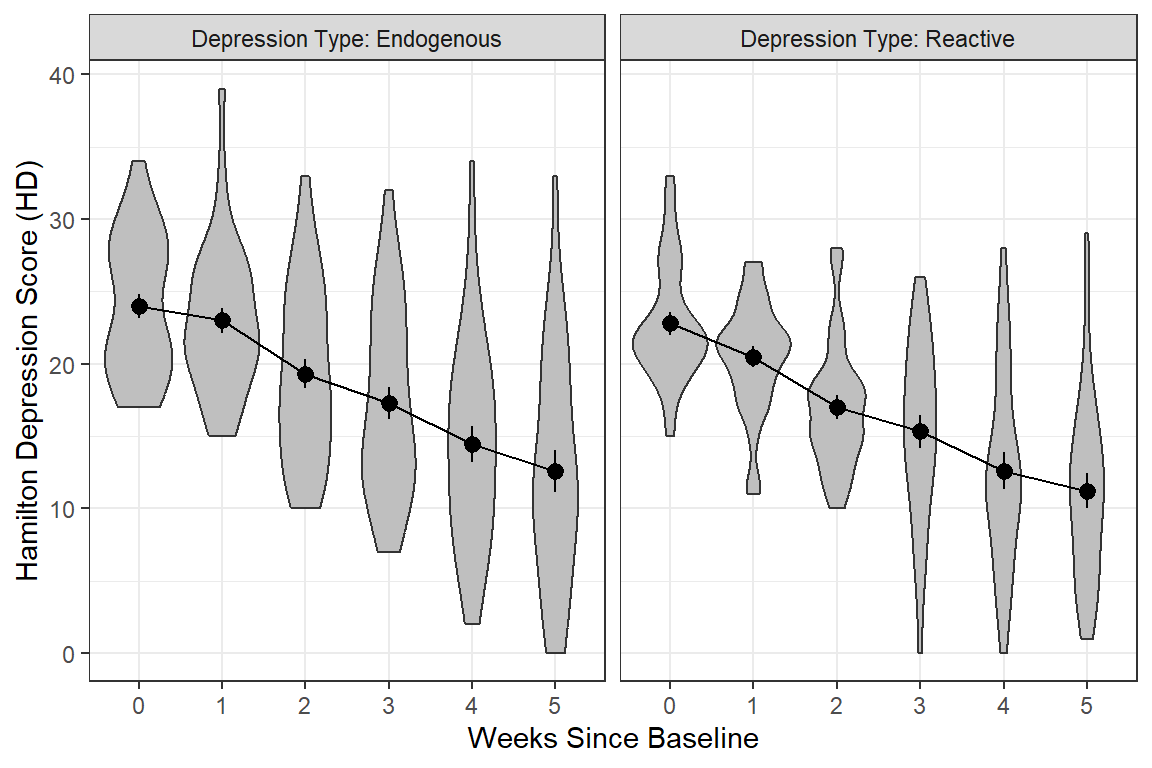
Figure 11.5
Observed Depression Trajectories by Diagnosis - violin version
df_long %>%
  dplyr::filter(!is.na(hamd)) %>%
  ggplot(aes(x = week,
             y = hamd,
             color = endog)) +
  stat_summary() +
  stat_summary(aes(group = endog,
                   linetype = endog),
               fun = mean,
               geom = "line") +
  scale_linetype_manual(values = c("solid", "longdash")) +
  theme(legend.position = "bottom",
        legend.key.width = unit(2, "cm")) +
  theme_bw() +
  labs(x = "Weeks Since Baseline",
       y = "Hamilton Depression Score (HD)",
       color = "Depression Type",
       linetype = "Depression Type") +
  theme(legend.position = c(0, 0),
        legend.justification = c(-.1, -.1),
        legend.key.width = unit(1.5, "cm"),
        legend.background = element_rect(color = "black"))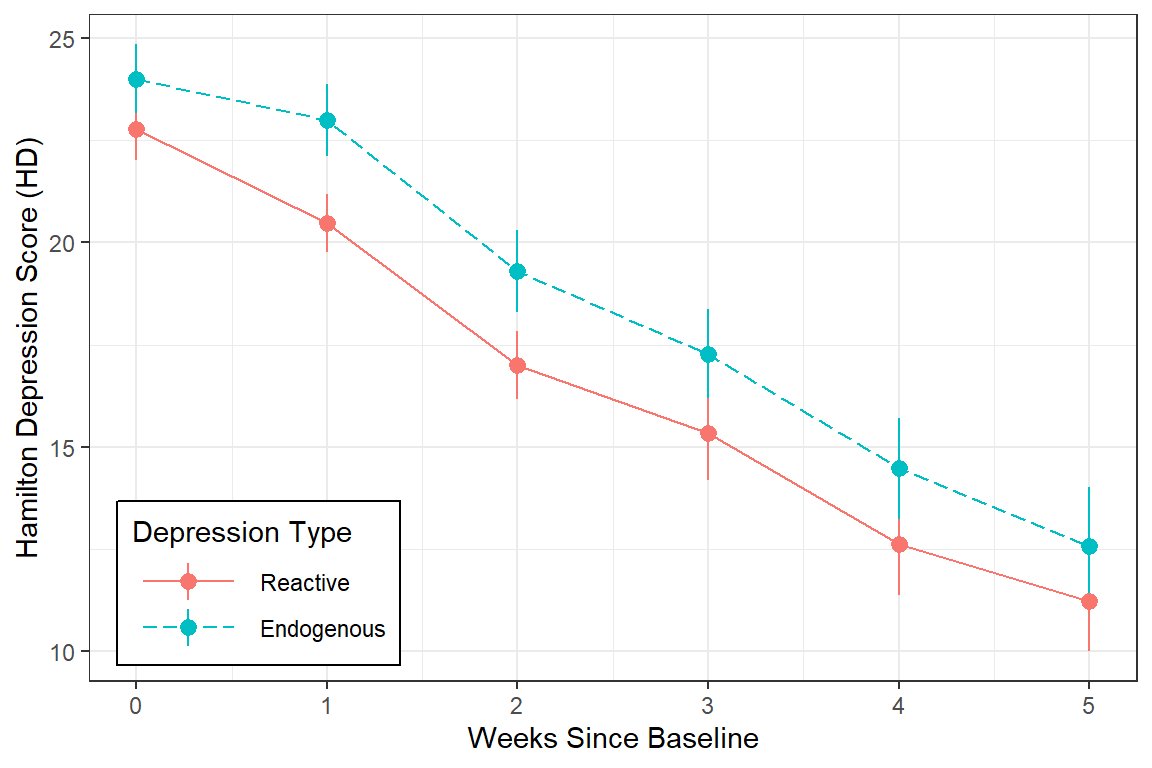
Figure 11.6
Observed Mean Weekly Depression by Diagnosis Group
11.3 Patterns in the Outcome Over Time
11.3.1 Variance-Covariance
11.3.1.1 Full Matrix
- Variances are down the diagonal
- Increasing variance over time violates the ANOVA assumption of homogeity of variance
df_wide %>%
  dplyr::select("Baseline" = hamd_0,
                "Week 1" = hamd_1,
                "Week 2" = hamd_2,
                "Week 3" = hamd_3,
                "Week 4" = hamd_4,
                "Week 5" = hamd_5) %>%  # just the outcome(s)
  cov(use = "complete.obs")  %>%           # covariance matrix, LIST-wise deletion
  data.frame() %>%
  tibble::rownames_to_column(var = "Time") %>%
  flextable::flextable() %>%
  apaSupp::theme_apa(caption = "Variance-Covariance Matrix for Hamilton Depression Over Time for Complete Cases",
general_note = "Values on the diagonal are varainces and other values are covariances.")Time | Baseline | Week.1 | Week.2 | Week.3 | Week.4 | Week.5 |
|---|---|---|---|---|---|---|
Baseline | 19.42 | 10.72 | 9.52 | 12.35 | 9.06 | 7.38 |
Week 1 | 10.72 | 24.24 | 12.54 | 15.93 | 11.59 | 8.47 |
Week 2 | 9.52 | 12.54 | 26.77 | 23.85 | 23.86 | 20.66 |
Week 3 | 12.35 | 15.93 | 23.85 | 39.75 | 33.32 | 29.73 |
Week 4 | 9.06 | 11.59 | 23.86 | 33.32 | 45.94 | 37.11 |
Week 5 | 7.38 | 8.47 | 20.66 | 29.73 | 37.11 | 57.33 |
Note. Values on the diagonal are varainces and other values are covariances. | ||||||
df_wide %>%
  dplyr::select("Baseline" = hamd_0,
                "Week 1" = hamd_1,
                "Week 2" = hamd_2,
                "Week 3" = hamd_3,
                "Week 4" = hamd_4,
                "Week 5" = hamd_5) %>%
  cov(use = "pairwise.complete.obs")  %>%
  data.frame() %>%
  tibble::rownames_to_column(var = "Time") %>%
  flextable::flextable() %>%
  apaSupp::theme_apa(caption = "Variance-Covariance Matrix for Hamilton Depression Over Time for All Data (Pairwise Complete)",
general_note = "Values on the diagonal are varainces and other values are covariances.")Time | Baseline | Week.1 | Week.2 | Week.3 | Week.4 | Week.5 |
|---|---|---|---|---|---|---|
Baseline | 20.55 | 10.11 | 10.14 | 10.09 | 7.19 | 6.28 |
Week 1 | 10.11 | 22.07 | 12.28 | 12.55 | 10.26 | 7.72 |
Week 2 | 10.14 | 12.28 | 30.09 | 25.13 | 24.63 | 18.38 |
Week 3 | 10.09 | 12.55 | 25.13 | 41.15 | 37.34 | 23.99 |
Week 4 | 7.19 | 10.26 | 24.63 | 37.34 | 48.59 | 30.51 |
Week 5 | 6.28 | 7.72 | 18.38 | 23.99 | 30.51 | 52.12 |
Note. Values on the diagonal are varainces and other values are covariances. | ||||||
11.3.1.2 Just Variances
Notice the variance in scores increases over time, which is seen in the side-by-side boxplots.
df_wide %>%
  dplyr::select("Baseline" = hamd_0,
                "Week 1" = hamd_1,
                "Week 2" = hamd_2,
                "Week 3" = hamd_3,
                "Week 4" = hamd_4,
                "Week 5" = hamd_5) %>%
  cov(use = "pairwise.complete.obs")  %>%
  diag()                                   #  extracts just the variances
Baseline Week 1 Week 2 Week 3 Week 4 Week 5
20.55082 22.07117 30.09135 41.15288 48.59447 52.12008 11.3.2 Correlation
11.3.2.1 Full Matrix
Pairwise relationships are easier to eye-ball magnitude when presented as correlations, rather than covariances, due to the relative scale.
df_wide %>%
  dplyr::select("Baseline" = hamd_0,
                "Week 1" = hamd_1,
                "Week 2" = hamd_2,
                "Week 3" = hamd_3,
                "Week 4" = hamd_4,
                "Week 5" = hamd_5) %>%
  cor(use = "complete.obs")  %>%
  data.frame() %>%
  tibble::rownames_to_column(var = "Time") %>%
  flextable::flextable() %>%
apaSupp::theme_apa(caption = "Correlation Matrix for Hamilton Depression Over Time for Complete Cases") Time | Baseline | Week.1 | Week.2 | Week.3 | Week.4 | Week.5 |
|---|---|---|---|---|---|---|
Baseline | 1.00 | 0.49 | 0.42 | 0.44 | 0.30 | 0.22 |
Week 1 | 0.49 | 1.00 | 0.49 | 0.51 | 0.35 | 0.23 |
Week 2 | 0.42 | 0.49 | 1.00 | 0.73 | 0.68 | 0.53 |
Week 3 | 0.44 | 0.51 | 0.73 | 1.00 | 0.78 | 0.62 |
Week 4 | 0.30 | 0.35 | 0.68 | 0.78 | 1.00 | 0.72 |
Week 5 | 0.22 | 0.23 | 0.53 | 0.62 | 0.72 | 1.00 |
df_wide %>%
  dplyr::select("Baseline" = hamd_0,
                "Week 1" = hamd_1,
                "Week 2" = hamd_2,
                "Week 3" = hamd_3,
                "Week 4" = hamd_4,
                "Week 5" = hamd_5) %>%
  cor(use = "pairwise.complete.obs")  %>%
  data.frame() %>%
  tibble::rownames_to_column(var = "Time") %>%
  flextable::flextable() %>%
apaSupp::theme_apa(caption = "Correlation Matrix for Hamilton Depression Over Time for All Data (Pairwise Complete)") Time | Baseline | Week.1 | Week.2 | Week.3 | Week.4 | Week.5 |
|---|---|---|---|---|---|---|
Baseline | 1.00 | 0.49 | 0.41 | 0.33 | 0.23 | 0.18 |
Week 1 | 0.49 | 1.00 | 0.49 | 0.41 | 0.31 | 0.22 |
Week 2 | 0.41 | 0.49 | 1.00 | 0.74 | 0.67 | 0.46 |
Week 3 | 0.33 | 0.41 | 0.74 | 1.00 | 0.82 | 0.57 |
Week 4 | 0.23 | 0.31 | 0.67 | 0.82 | 1.00 | 0.65 |
Week 5 | 0.18 | 0.22 | 0.46 | 0.57 | 0.65 | 1.00 |
11.3.2.2 Visualization
Looking for patterns is always easier with a plot. All RM or mixed ANOVA assume sphericity or compound symmetry, meaning that all the correlations in the matrix would be the same. This is not the case for these data. Instead we see a classic pattern of corralary decay. Measures taken close in time, say 1 week apart, exhibit the highest degree of correlation. The farther apart in time that two measures are taken, the less correlated they are. Note that the adjacent measures become more highly correlated, too. This can be due to attrition; later time points having a smaller sample size.
df_wide %>%
  dplyr::select("Baseline" = hamd_0,
                "Week 1" = hamd_1,
                "Week 2" = hamd_2,
                "Week 3" = hamd_3,
                "Week 4" = hamd_4,
                "Week 5" = hamd_5) %>%
  cor(use = "pairwise.complete.obs") %>%
  corrplot::corrplot.mixed(upper = "ellipse")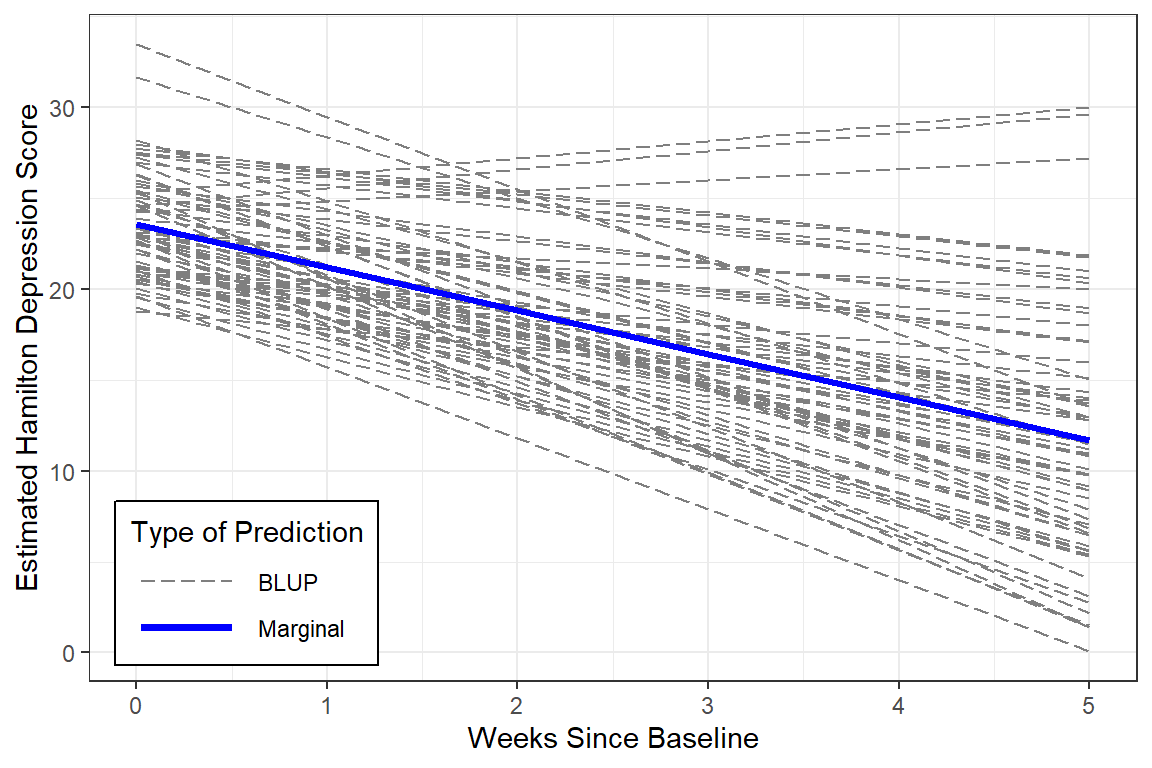
Figure 11.7
Correlation Matrix for Hamilton Depression Over Time for All Data (Pairwise Complete)
11.3.3 For Each Group
It can be a good ideal to investigate if the groups exhibit a similar pattern in correlation.
Reactive Depression
df_wide %>%
  dplyr::filter(endog == "Reactive") %>%
  dplyr::select("Baseline" = hamd_0,
                "Week 1" = hamd_1,
                "Week 2" = hamd_2,
                "Week 3" = hamd_3,
                "Week 4" = hamd_4,
                "Week 5" = hamd_5) %>%
  cor(use = "pairwise.complete.obs") %>%
  corrplot::corrplot.mixed(upper = "ellipse")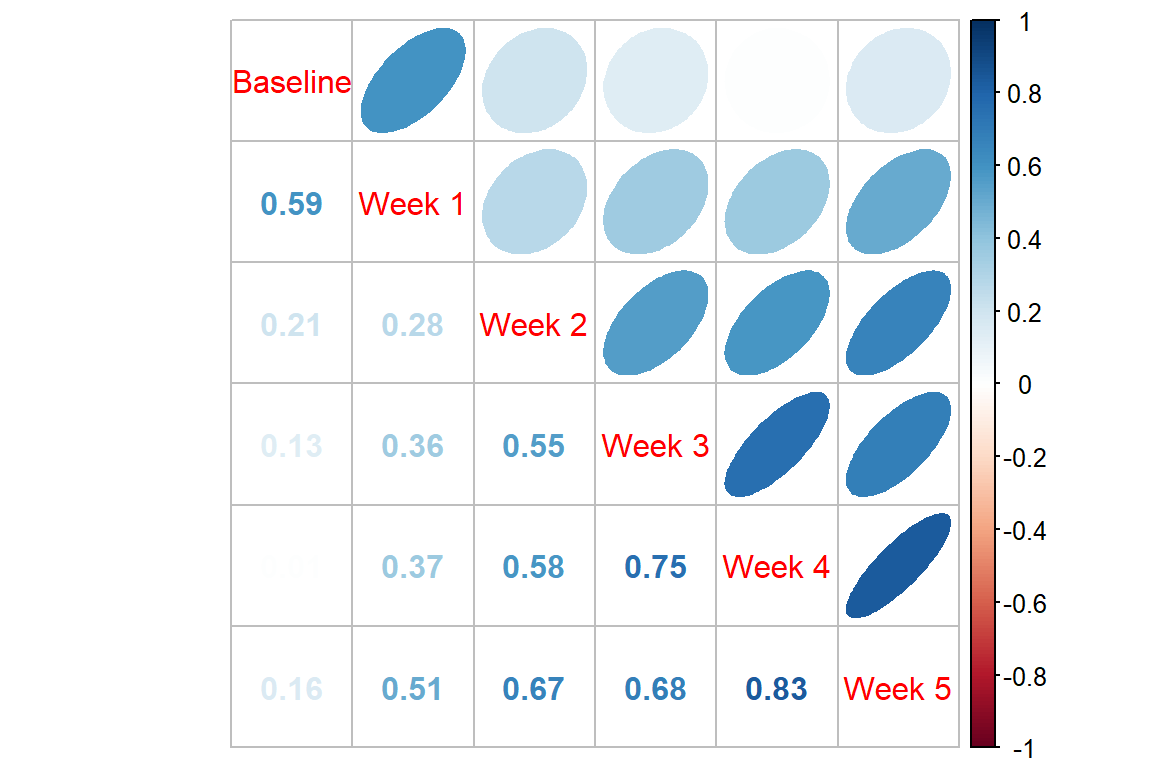
Figure 11.8
Correlation Matrix for Hamilton Depression Over Time for All Reactive Depression Cases (Pairwise Complete)
Endogenous Depression
df_wide %>%
  dplyr::filter(endog == "Endogenous") %>%
  dplyr::select("Baseline" = hamd_0,
                "Week 1" = hamd_1,
                "Week 2" = hamd_2,
                "Week 3" = hamd_3,
                "Week 4" = hamd_4,
                "Week 5" = hamd_5) %>%
  cor(use = "pairwise.complete.obs") %>%
  corrplot::corrplot.mixed(upper = "ellipse")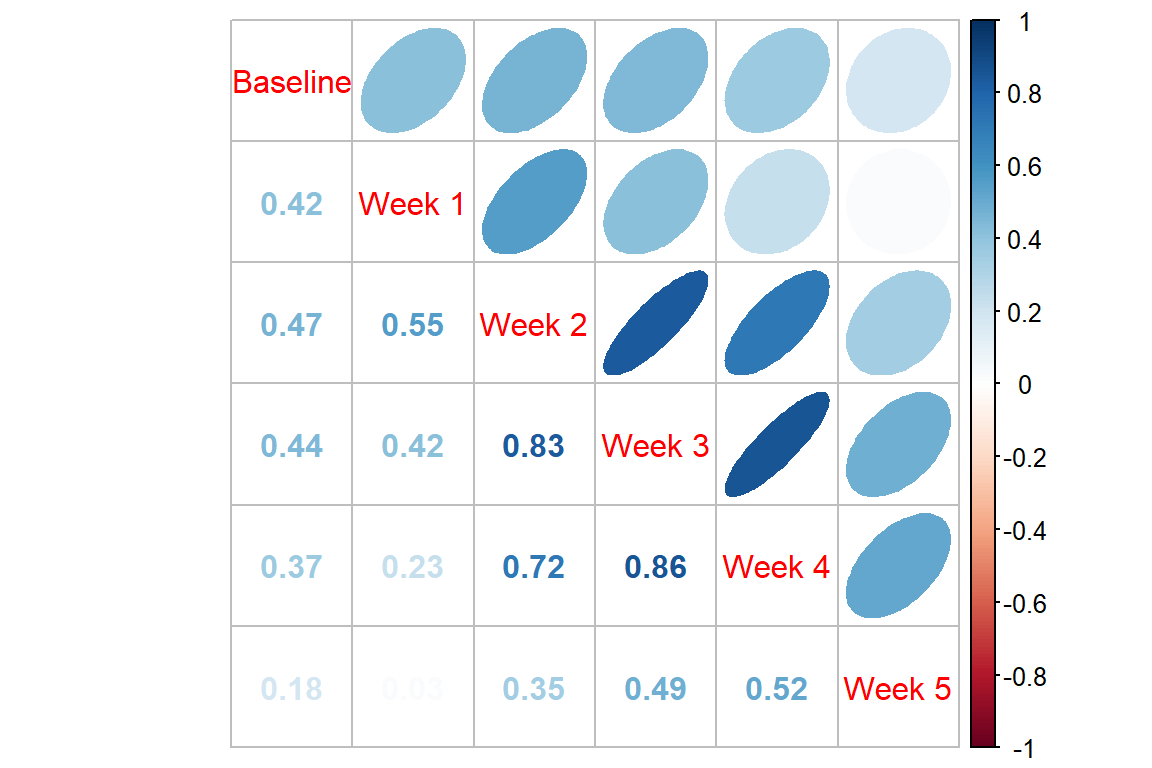
Figure 11.9
Correlation Matrix for Hamilton Depression Over Time for All Endogenous Depression Cases (Pairwise Complete)
11.4 MLM - Null or Emptly Models
11.4.1 Fit the model
Random Intercepts, with Fixed Intercept and Time Slope (i.e. Trend)….@hedeker2006 section 4.3.5, starting on page 55
Since this situation deals with longitudinal data, it is more appropriate to start off including the time variable in the null model as a fixed effect only.
11.4.2 Table of Parameter Estimates
apaSupp::tab_lmer(fit_lmer_wks_RI_reml,
                  caption = "MLM: Random Intercepts Null Model fit w/REML",
general_note = "Reproduction of Hedeker's table 4.3 on page 55, except using REML here instead of ML")Est | (SE) | p | |
|---|---|---|---|
(Intercept) | 23.55 | (0.64) | < .001*** |
week | -2.38 | (0.14) | < .001*** |
id.var__(Intercept) | 16.45 | ||
Residual.var__Observation | 19.10 | ||
Note. Est = estimated regresssion coefficient for fixed effects and varaince/covariance estimates for random effects. p = significance from Wald t-test for parameter estimate using Satterthwaite's method for degrees of freedom. Reproduction of Hedeker's table 4.3 on page 55, except using REML here instead of ML | |||
* p < .05. ** p < .01. *** p < .001. | |||
On average, patients start off with HDRS scores of 23.55 and then change by -2.38 points each week. This weekly improvement of about 2 points a week is statistically significant via the Wald test.
11.4.3 Estimated Marginal Means Plot
Multilevel model on page 55 (Hedeker and Gibbons 2006)
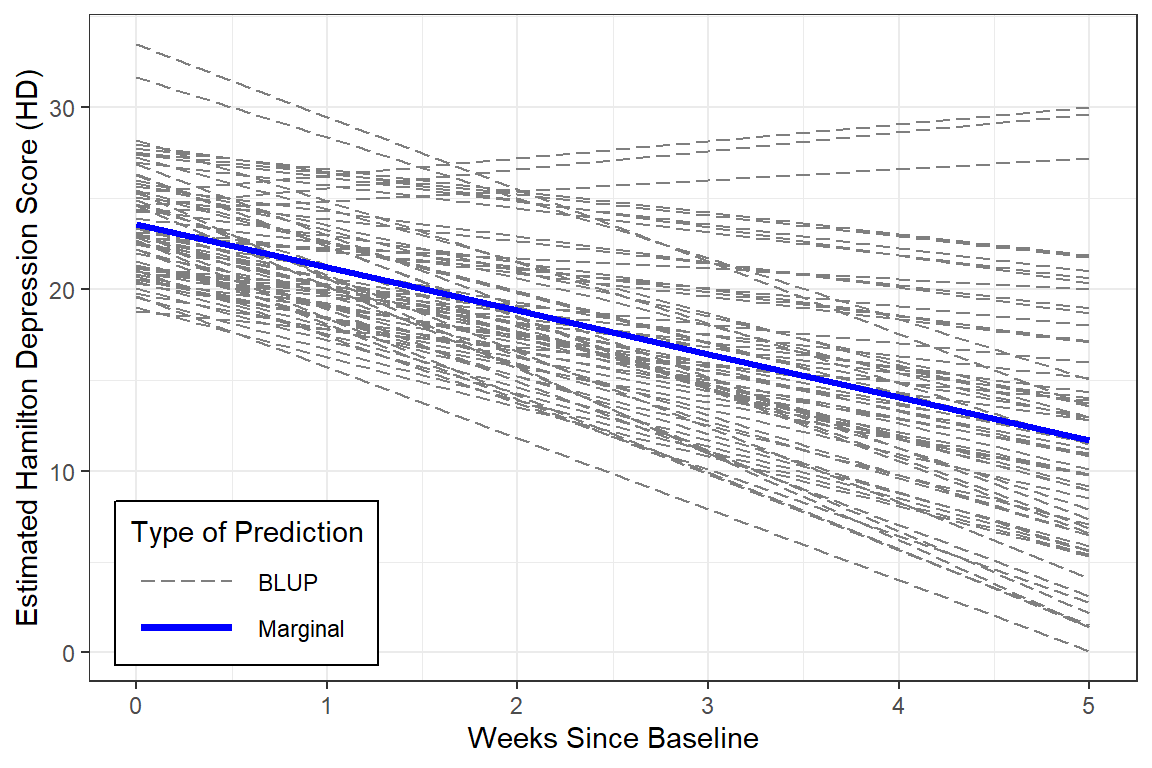
\[ \hat{y} = 23.552 + -2.376 week \]
The fastest way to plot a model is to use the sjPlot::plot_model() function.
Note: you can’t use
interactions::interact_plot()since there is only one predictor (i.e. independent variable) in this model.
11.4.4 Estimated Marginal Means and Emperical Bayes Plots
With a bit more code we can plot not only the marginal model (fixed effects only), but add the Best Linear Unbiased Predictions (BLUPs) or person-specific specific models (both fixed and random effects).
df_long %>%
  dplyr::mutate(pred_fixed = predict(fit_lmer_wks_RI_reml,
                                     re.form = NA,           # fixed effects only
                                     newdata = .)) %>%
  dplyr::mutate(pred_wrand = predict(fit_lmer_wks_RI_reml,  # fixed and random effects both
                                     newdata = .)) %>%
  ggplot(aes(x = week,
             y = hamd,
             group = id)) +
  geom_line(aes(y        = pred_wrand,
                color    = "Individual BLUPs",
                size     = "Individual BLUPs",
                linetype = "Individual BLUPs")) +
  geom_line(aes(y        = pred_fixed,
                color    = "Marginal Mean",
                size     = "Marginal Mean",
                linetype = "Marginal Mean")) +
  theme_bw() +
  scale_color_manual(name   = "Type of Prediction",
                     values = c("Individual BLUPs"     = "gray50",
                                "Marginal Mean" = "blue"))  +
  scale_size_manual(name    = "Type of Prediction",
                    values = c("Individual BLUPs"      = .5,
                               "Marginal Mean" = 1.25))  +
  scale_linetype_manual(name   = "Type of Prediction",
                        values = c("Individual BLUPs"     = "longdash",
                                   "Marginal Mean" = "solid"))  +
  theme(legend.position = c(0, 0),
        legend.justification = c(-0.1, -0.1),
        legend.background = element_rect(color = "black"),
        legend.key.width = unit(1.5, "cm")) +
  labs(x = "Weeks Since Baseline",
       y = "Hamilton Depression Score (HD)")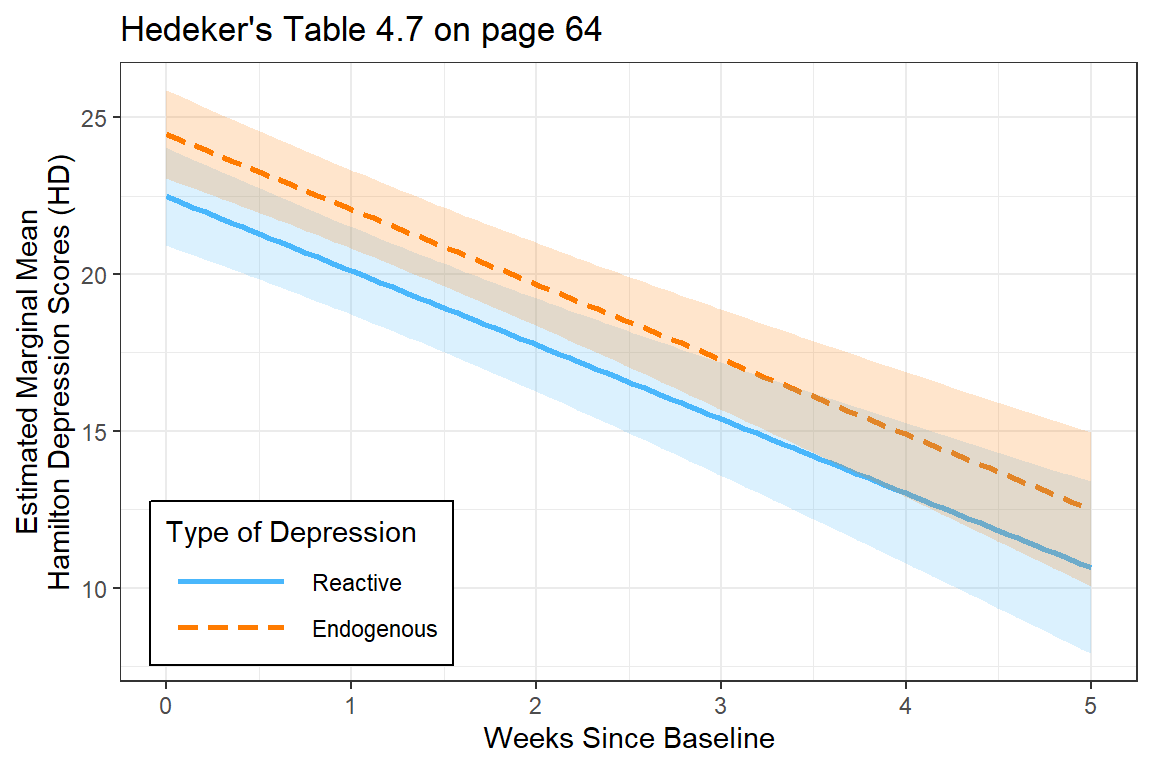
Figure 11.10
Estimated Marginal Means and Best Linear Unbiased Predictions (BLUPs) from the Simple Random Intercetps Model
Notice that in this model, all the BLUPs are parallel. That is because we are only letting the intercept vary from person-to-person while keeping the effect of time (slope) constant.
Reproduce Table 4.4 on page 55 (Hedeker and Gibbons 2006)
One way to judge a model is to compare the estimated means to the observed means to see how accurately they are represented by the model. This excellent fit of the estimated marginal means to the observed data supports the hypothesis that the change in depression across time is LINEAR.
obs <- df_long %>%
  dplyr::group_by(week) %>%
  dplyr::summarise(observed = mean(hamd, na.rm = TRUE))


fit_lmer_wks_RI_reml %>%
  emmeans::emmeans(~ week,
                   at = list(week = 0:5)) %>%
  data.frame() %>%
  dplyr::rename(estimated = emmean) %>%
  dplyr::left_join(obs, by = "week") %>%
  dplyr::select(week, observed, estimated) %>%
  dplyr::mutate(diff = observed - estimated) %>%
  flextable::flextable() %>%
apaSupp::theme_apa(caption = "Observed and Estimated Marginal Means Across Time")week | observed | estimated | diff |
|---|---|---|---|
0 | 23.44 | 23.55 | -0.11 |
1 | 21.84 | 21.18 | 0.67 |
2 | 18.31 | 18.80 | -0.49 |
3 | 16.42 | 16.42 | -0.01 |
4 | 13.62 | 14.05 | -0.43 |
5 | 11.95 | 11.67 | 0.27 |
11.4.5 Intra-individual Correlation (ICC)
The ICC can be interpreted as “the proportion of the variance explained by the grouping structure in the population”.
The grouping structure entails that measurements are organized into groups (e.g., test scores in a school can be grouped by classroom if there are multiple classrooms and each classroom was administered the same test) and ICC indexes how strongly measurements in the same group resemble each other.
This index goes from 0, if the grouping conveys no information, to 1, if all observations in a group are identical (Gelman and Hill, 2007, p. 258). In other word, the ICC - sometimes conceptualized as the measurement repeatability - “can also be interpreted as the expected correlation between two randomly drawn units that are in the same group” (Hox 2010: 15), although this definition might not apply to mixed models with more complex random effects structures.
performane::icc() calculates an adjusted and an
unadjusted ICC, which both take all sources of uncertainty
(i.e. of all random effects) into account.
While the adjusted ICC only relates to the random effects, the unadjusted ICC also takes the fixed effects variances into account, more precisely, the fixed effects variance is added to the denominator of the formula to calculate the ICC (see Nakagawa et al. 2017). Typically, the adjusted ICC is of interest when the analysis of random effects is of interest.
performane::icc() returns a meaningful ICC also for more
complex random effects structures, like models with random slopes or
nested design (more than two levels) and is applicable for models with
other distributions than Gaussian.
# Intraclass Correlation Coefficient

    Adjusted ICC: 0.463
  Unadjusted ICC: 0.319
Interpretation
Just less than a third (\(\rho_c = .32\)) in baseline depression is explained by person-to-person differences. Thus, subjects display considerable heterogeneity in depression levels.
This value of .46 is an oversimplification of the correlation matrix above and may be thought of as the expected correlation between two randomly drawn weeks for any given person.
The coefficient of determination R^2 (that can be
computed with performace::r2()) quantifies the proportion
of variance explained by a statistical model, but its definition in
mixed model is complex (hence, different methods to compute a proxy
exist).
ICC is related to R2 because they are both ratios of variance components.
More precisely, R2 is the proportion of the explained variance (of the full model), while the ICC is the proportion of explained variance that can be attributed to the random effects. In simple cases, the ICC corresponds to the difference between the conditional R2 and the marginal R2
Marginal and conditional r-squared values for mixed models are
calculated based on Nakagawa et al. (2017). For more details on the
computation of the variances, see insight::get_variance().
The random effect variances are actually the mean random effect
variances, thus the r-squared value is also appropriate for mixed models
with random slopes or nested random effects (see Johnson, 2014).
Conditional R2: takes both the fixed and random effects into account.
Marginal R2: considers only the variance of the fixed effects.
The contribution of random effects can be deduced by subtracting the
marginal R2 from the conditional R2 or by computing the
performance::icc().
# R2 for Mixed Models

  Conditional R2: 0.629
     Marginal R2: 0.310
Interpretation
Linear growth accounts for 31% of the variance in Hamilton Depression Scores across the six weeks. Linear growth AND person-to-person differences account for a total 63% of this variance.
This value of 46% is an oversimplification of the correlation matrix above and may be thought of as the expected correlation between two randomly drawn weeks for any given person.
11.4.6 Compare to the Single-Level Null: No Random Effects
Simple Linear Regression, (Hedeker and Gibbons 2006)
To compare, fit the single level regression model
11.4.6.1 Table of Parameter Estimates
Note: the apaSupp tables can not combine models of different types.
texreg::knitreg(list(fit_lm_wks_ml, fit_lmer_wks_RI_reml),
                  custom.model.names = c("Single-Level", "Multilevel"),
                  single.row = TRUE,
                  caption = "MLM: Longitudinal Null Models",
                  caption.above = TRUE,
custom.note = "The singel-level model treats are observations as being independent and unrelated to each other, even if they were made on the same person.")| Single-Level | Multilevel | |
|---|---|---|
| (Intercept) | 23.60 (0.55)*** | 23.55 (0.64)*** |
| week | -2.41 (0.18)*** | -2.38 (0.14)*** |
| R2 | 0.32 | |
| Adj. R2 | 0.32 | |
| Num. obs. | 375 | 375 |
| AIC | 2294.73 | |
| BIC | 2310.43 | |
| Log Likelihood | -1143.36 | |
| Num. groups: id | 66 | |
| Var: id (Intercept) | 16.45 | |
| Var: Residual | 19.10 | |
| The singel-level model treats are observations as being independent and unrelated to each other, even if they were made on the same person. | ||
For the multilevel model, the Wald tests indicated the fixed intercept is significant (no surprised that the depressions scores are not zero at baseline). More of note is the significance of the fixed effect of time. This signifies that depression scores are declining over time. On average, patients are improving (Hamilton Depression Scores get smaller) across time, by an average of 2.4’ish points a week.
For the multilevel model, the Wald tests indicated the fixed intercept is significant (no surprised that the depressions scores are not zero at baseline). More of note is the significance of the fixed effect of time. This signifies that depression scores are declining over time. On average, patients are improving (Hamilton Depression Scores get smaller) across time, by an average of 2.4’ish points a week.
11.4.6.2 Residual Variance
Note, the fixed estimates are very similar for the two models, but the standard errors are different. Additionally, whereas the single-level regression lumps all remaining variance together (\(\sigma^2\)), the multilevel model seperates it into within-subjects (\(\sigma^2_{u0}\) or \(\tau_{00}\)) and between-subjects variance (\(\sigma^2_{e}\) or \(\sigma^2\)).
[1] 35.3997lme4::VarCorr(fit_lmer_wks_RI_reml) %>% # in longitudinal data, a group of observations = a participant or person
print(comp = c("Variance", "Std.Dev")) Groups Name Variance Std.Dev.
id (Intercept) 16.446 4.0554
Residual 19.099 4.3703 [1] 35.545“One statistician’s error term is another’s career!”
(Hedeker and Gibbons 2006), page 56
11.5 MLM: Add Random Slope for Time (i.e. Trend)
11.5.1 Fit the Model
fit_lmer_wks_RIAS_reml <- lmerTest::lmer(hamd ~ week + (week|id), #     MLM-RIAS
                                         data = df_long,
REML = TRUE)apaSupp::tab_lmers(list("Random Intercepts" = fit_lmer_wks_RI_reml,
"And Random Slopes" = fit_lmer_wks_RIAS_reml),
caption = "MLM: Null models fit w/REML",
general_note = "Hedeker table 4.4 on page 55 and table 4.5 on page 58, except using REML here instead of ML")
| Random Intercepts | And Random Slopes | ||||
|---|---|---|---|---|---|---|
Variable | b | (SE) | p | b | (SE) | p |
(Intercept) | 23.55 | (0.64) | < .001*** | 23.58 | (0.55) | < .001*** |
week | -2.38 | (0.14) | < .001*** | -2.38 | (0.21) | < .001*** |
id.var__(Intercept) | 16.45 | 12.94 | ||||
Residual.var__Observation | 19.10 | 12.21 | ||||
id.var__week | 2.13 | |||||
id.cov__(Intercept).week | -1.48 | |||||
AIC | 2,295 | 2,232 | ||||
BIC | 2,310 | 2,255 | ||||
Log-likelihood | -1,143 | -1,110 | ||||
Note. Hedeker table 4.4 on page 55 and table 4.5 on page 58, except using REML here instead of ML | ||||||
* p < .05. ** p < .01. *** p < .001. | ||||||
Visually, we can see that the unexplained or residual variance is less (12.21 vs 19.10) for the model that includes person-specific slopes (trajectories over time).
Note: the negative covariance between random intercepts and random slopes (\(\sigma_{u01} = \tau_{01} = -1.48\)):
“This suggests that patients who are initially more depressed (i.e. greater intercepts) improve at a greater rate (i.e. more pronounced negative slopes). An alternative explainatio, though,is that of a floor effect due to the HDRS rating scale. Simply put, patients with less depressed intitial scores have a more limited range of lower scores than those with higher initial scores.”
(Hedeker and Gibbons 2006), page 58
11.5.2 Likelihood Ratio Test
Data: df_long
Models:
RI: hamd ~ week + (1 | id)
RIAS: hamd ~ week + (week | id)
     npar    AIC    BIC  logLik -2*log(L)  Chisq Df Pr(>Chisq)
RI      4 2294.7 2310.4 -1143.4    2286.7
RIAS    6 2231.9 2255.5 -1110.0    2219.9 66.809  2  3.109e-15 ***
---
Signif. codes:  0 '***' 0.001 '**' 0.01 '*' 0.05 '.' 0.1 ' ' 1
Including the random slope for time significantly improved the model fit via the formal Likelihood Ratio Test. This rejects the assumption of compound symmetry.
Model | AIC | BIC | RMSE |
| |
|---|---|---|---|---|---|
Conditional | Marginal | ||||
RI | 2293.19 | 2308.90 | 4.03 | .629 | .310 |
RIAS | 2231.05 | 2254.61 | 2.99 | .769 | .302 |
Note. Larger values indicated better performance. Smaller values indicated better performance for Akaike's Information Criteria (AIC), Bayesian information criteria (BIC), and Root Mean Squared Error (RMSE). | |||||
11.5.3 Estimated Marginal Means Plot
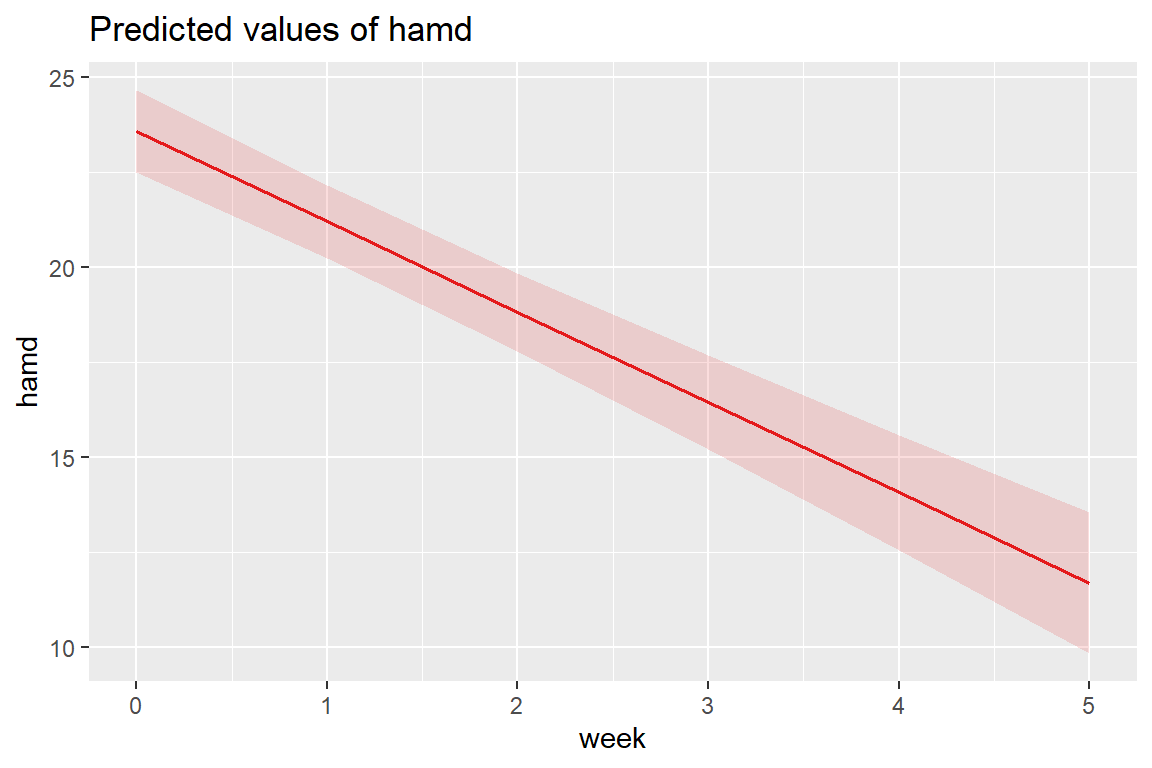
Adding the random slopes didn’t change the estimates for the fixed effects much.
11.5.4 Estimated Marginal Means and Emperical Bayes Plots
df_long %>%
  dplyr::mutate(pred_fixed = predict(fit_lmer_wks_RIAS_reml,
                                     re.form = NA,           # fixed effects only
                                     newdata = .)) %>%
  dplyr::mutate(pred_wrand = predict(fit_lmer_wks_RIAS_reml,  # fixed and random effects both
                                     newdata = .)) %>%
  ggplot(aes(x = week,
             y = hamd,
             group = id)) +
  geom_line(aes(y        = pred_wrand,
                color    = "Individual BLUPs",
                size     = "Individual BLUPs",
                linetype = "Individual BLUPs")) +
  geom_line(aes(y        = pred_fixed,
                color    = "Marginal Mean",
                size     = "Marginal Mean",
                linetype = "Marginal Mean")) +
  theme_bw() +
  scale_color_manual(name   = "Type of Prediction",
                     values = c("Individual BLUPs"     = "gray50",
                                "Marginal Mean" = "blue"))  +
  scale_size_manual(name    = "Type of Prediction",
                    values = c("Individual BLUPs"      = .5,
                               "Marginal Mean" = 1.25))  +
  scale_linetype_manual(name   = "Type of Prediction",
                        values = c("Individual BLUPs"     = "longdash",
                                   "Marginal Mean" = "solid"))  +
  theme(legend.position = c(0, 0),
        legend.justification = c(-0.1, -0.1),
        legend.background = element_rect(color = "black"),
        legend.key.width = unit(1.5, "cm")) +
  labs(x = "Weeks Since Baseline",
       y = "Hamilton Depression Score (HD)")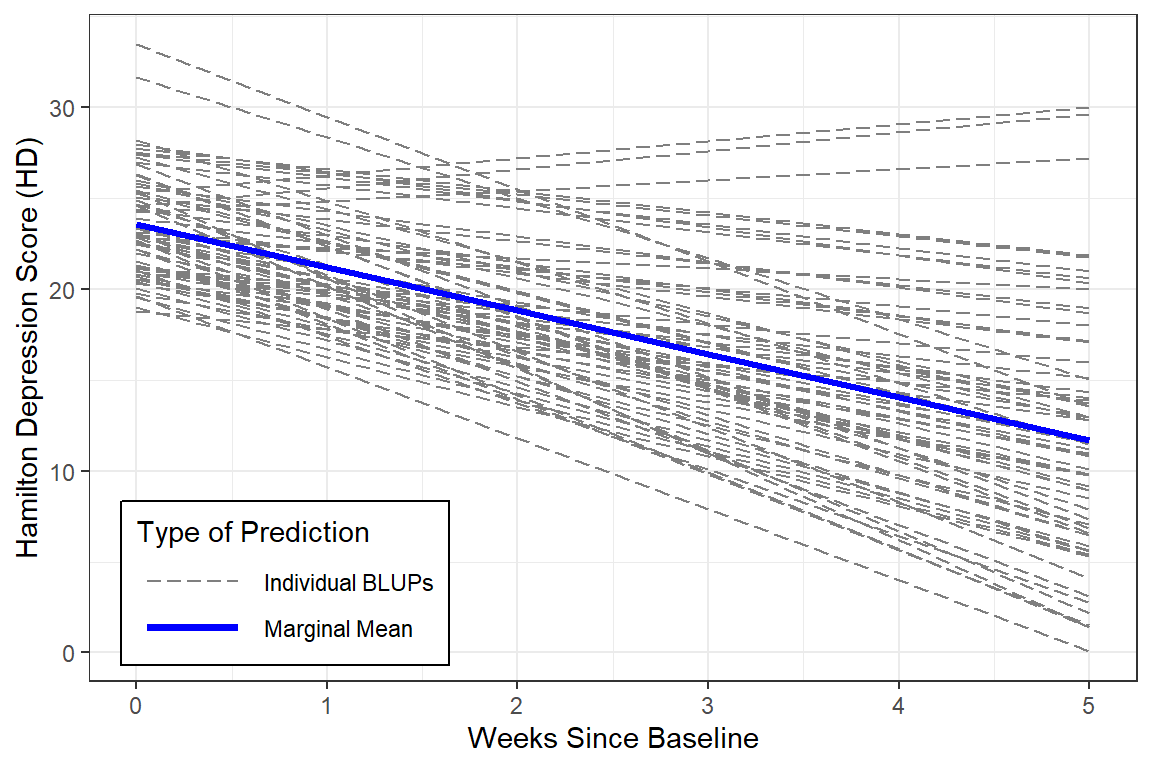
Figure 11.11
Estimated Marginal Means and Best Linear Unbiased Predictions (BLUPs) from the Simple Random Intercetps and Slopes Model
BLUPs are also refered to as Empirical Bayes
Estimates and may be extracted from a model fit. In this cases
there will be a specific intercept ((Intercept)) and time
slope (week) for each individual or person
(id).
11.5.4.2 Random Effects
between-subjects effects
    (Intercept)       week
101   1.0572022 -2.1151378
103   3.6707900 -0.4832479
104   2.6727551 -1.5008819
105  -3.0413391  0.2264496
106   0.3154240  1.0254750
107  -0.6148994 -0.4297385
11.5.4.3 BLUPs or Empirical Bayes Estimates
fixed effects + random effects
    (Intercept)      week
101    24.63425 -4.492185
103    27.24783 -2.860295
104    26.24980 -3.877929
105    20.53571 -2.150598
106    23.89247 -1.351572
107    22.96214 -2.806786
We can create a scatterplot of these to see the correlation between them.
coef(fit_lmer_wks_RIAS_reml)$id %>%
  ggplot(aes(x = week,
             y = `(Intercept)`)) +
  geom_point() +
  geom_hline(yintercept = fixef(fit_lmer_wks_RIAS_reml)["(Intercept)"],
             linetype = "dashed") +
  geom_vline(xintercept = fixef(fit_lmer_wks_RIAS_reml)["week"],
             linetype = "dashed") +
  geom_smooth(method = "lm") +
  labs(x = "Week Change in Depression (slope)",
       y = "Baseline Depression Level (intercept)") +
  theme_bw()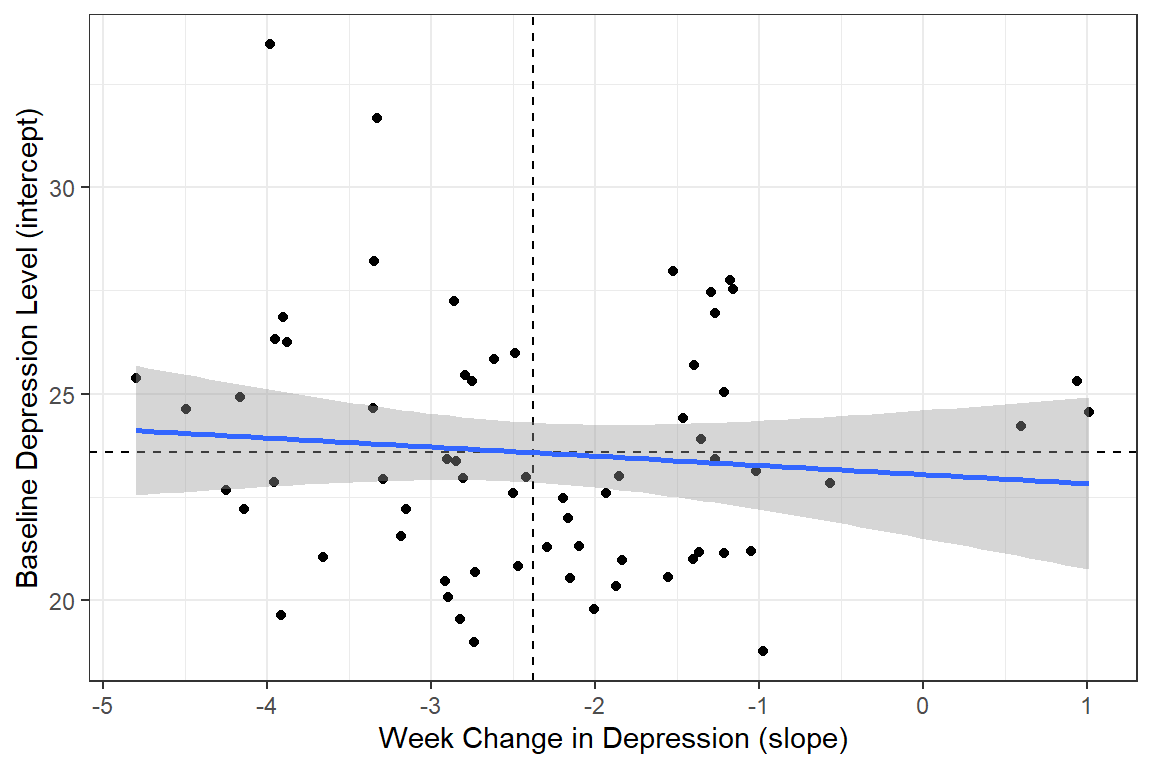
Figure 11.12
Correlation Between Estimated Random Effects (Hedeker’s Figure 4.4 on page 59)
11.6 MLM: Coding of Time
So far we have used the variable week to denote time as weeks since baseline = week \(\in 0, 1, 2, 3, 4, 5\).
But We could CENTER week at the middle of the study (week = 2.5).
11.6.2 Table of Parameter Estimates
apaSupp::tab_lmers(list("0 = Baseline" = fit_lmer_wks_RIAS_reml,
                        "0 = Midway" = fit_lmer_wks_RIAS_reml_wc),
                   caption = "Comparison of Parameter Estimates with Raw Time vs Centered Time",
                   general_note = "Hedeker table table 4.5 on page 58 and table 4.6 on page 61, except using REML here instead of ML")
| 0 = Baseline | 0 = Midway | ||||
|---|---|---|---|---|---|---|
Variable | b | (SE) | p | b | (SE) | p |
(Intercept) | 23.58 | (0.55) | < .001*** | 17.63 | (0.56) | < .001*** |
week | -2.38 | (0.21) | < .001*** | |||
I(week - 2.5) | -2.38 | (0.21) | < .001*** | |||
id.var__(Intercept) | 12.94 | 18.85 | ||||
id.var__week | 2.13 | |||||
id.cov__(Intercept).week | -1.48 | |||||
Residual.var__Observation | 12.21 | 12.21 | ||||
id.var__I(week - 2.5) | 2.13 | |||||
id.cov__(Intercept).I(week - 2.5) | 3.84 | |||||
AIC | 2,232 | 2,232 | ||||
BIC | 2,255 | 2,255 | ||||
Log-likelihood | -1,110 | -1,110 | ||||
Note. Hedeker table table 4.5 on page 58 and table 4.6 on page 61, except using REML here instead of ML | ||||||
* p < .05. ** p < .01. *** p < .001. | ||||||
When Grand-Mean Centering with RAIS (random intercepts and slopes)…
UN-CHANGED
* model fit: AIC, BIC, -2LL, residual variance
* fixed effect of week
* variance for random intercepts
CHANGED
* fixed intercept
* variance for random slopes
* covariance between random intercepts and random slopes
11.6.3 Estimated Marginal Means and Emperical Bayes Plots
df_long %>%
  dplyr::mutate(pred_fixed = predict(fit_lmer_wks_RIAS_reml_wc,
                                     re.form = NA,           # fixed effects only
                                     newdata = .)) %>%
  dplyr::mutate(pred_wrand = predict(fit_lmer_wks_RIAS_reml_wc,  # fixed and random effects both
                                     newdata = .)) %>%
  ggplot(aes(x = week,
             y = hamd,
             group = id)) +
  geom_line(aes(y        = pred_wrand,
                color    = "Individual BLUPs",
                size     = "Individual BLUPs",
                linetype = "Individual BLUPs")) +
  geom_line(aes(y        = pred_fixed,
                color    = "Marginal Mean",
                size     = "Marginal Mean",
                linetype = "Marginal Mean")) +
  theme_bw() +
  scale_color_manual(name   = "Type of Prediction",
                     values = c("Individual BLUPs"     = "gray50",
                                "Marginal Mean" = "blue"))  +
  scale_size_manual(name    = "Type of Prediction",
                    values = c("Individual BLUPs"      = .5,
                               "Marginal Mean" = 1.25))  +
  scale_linetype_manual(name   = "Type of Prediction",
                        values = c("Individual BLUPs"     = "longdash",
                                   "Marginal Mean" = "solid"))  +
  theme(legend.position = c(0, 0),
        legend.justification = c(-0.1, -0.1),
        legend.background = element_rect(color = "black"),
        legend.key.width = unit(1.5, "cm")) +
  labs(x = "Weeks Since Baseline",
       y = "Hamilton Depression Score (HD)")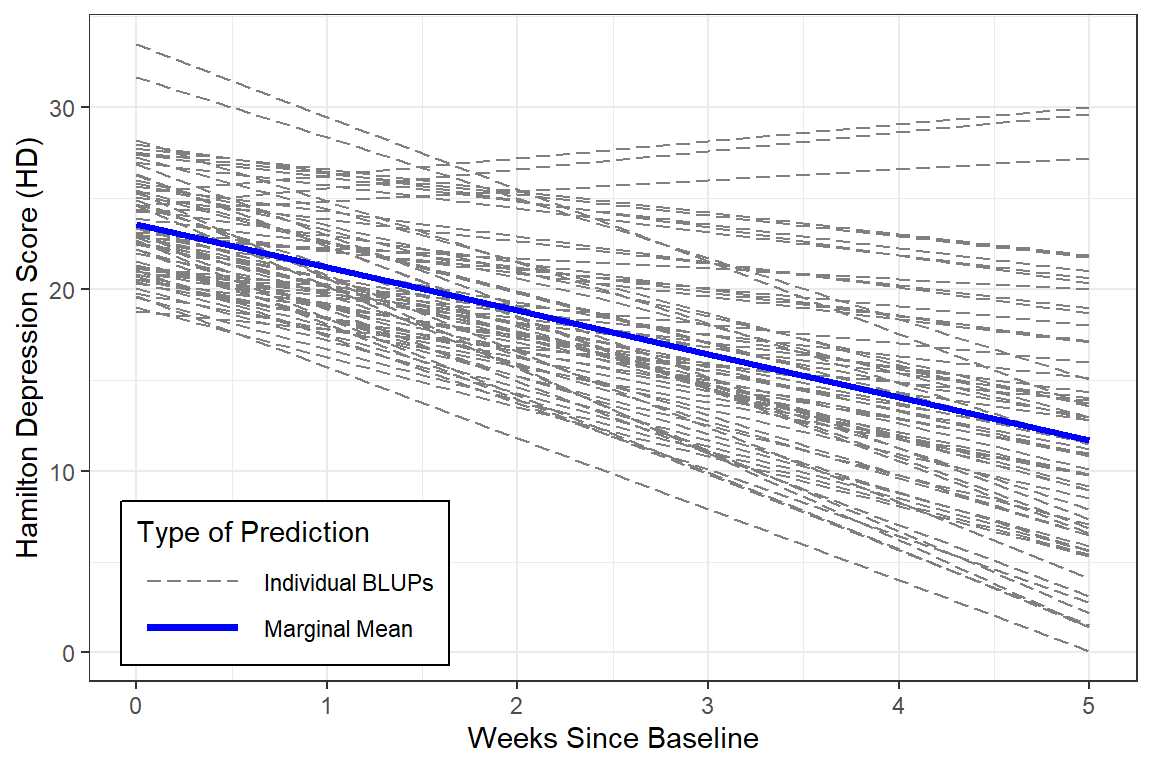
Figure 11.13
Estimated Marginal Means and Best Linear Unbiased Predictions (BLUPs) from the Simple Random Intercetps and Slopes Model, with Time Grand Mean Centered
Again, centering time doesn’t change the interpretation at all, since there are no interactions.
11.7 MLM: Effect of DIagnosis on Time Trends (Fixed Interaction)
The researcher specifically wants to know if the trajectory over time differs for the two types of depression. This translates into a fixed effects interaction between time and group.
Start by comapring random intercepts only (RI) to a random intercetps and slopes (RIAS) model.
11.7.2 Estimated Marginal Means Plot
interactions::interact_plot(fit_lmer_wkdx_RIAS_ml,
                            pred = week,
                            modx = endog,
                            legend.main = "Type of Depression",
                            interval = TRUE) +
  theme_bw() +
  labs(x = "Weeks Since Baseline",
       y = "Estimated Marginal Mean\nHamilton Depression Scores (HD)") +
  theme(legend.background = element_rect(color = "black"),
        legend.position = c(0, 0),
        legend.justification = c(-0.1, -0.1),
        legend.key.width = unit(1.75, "cm"))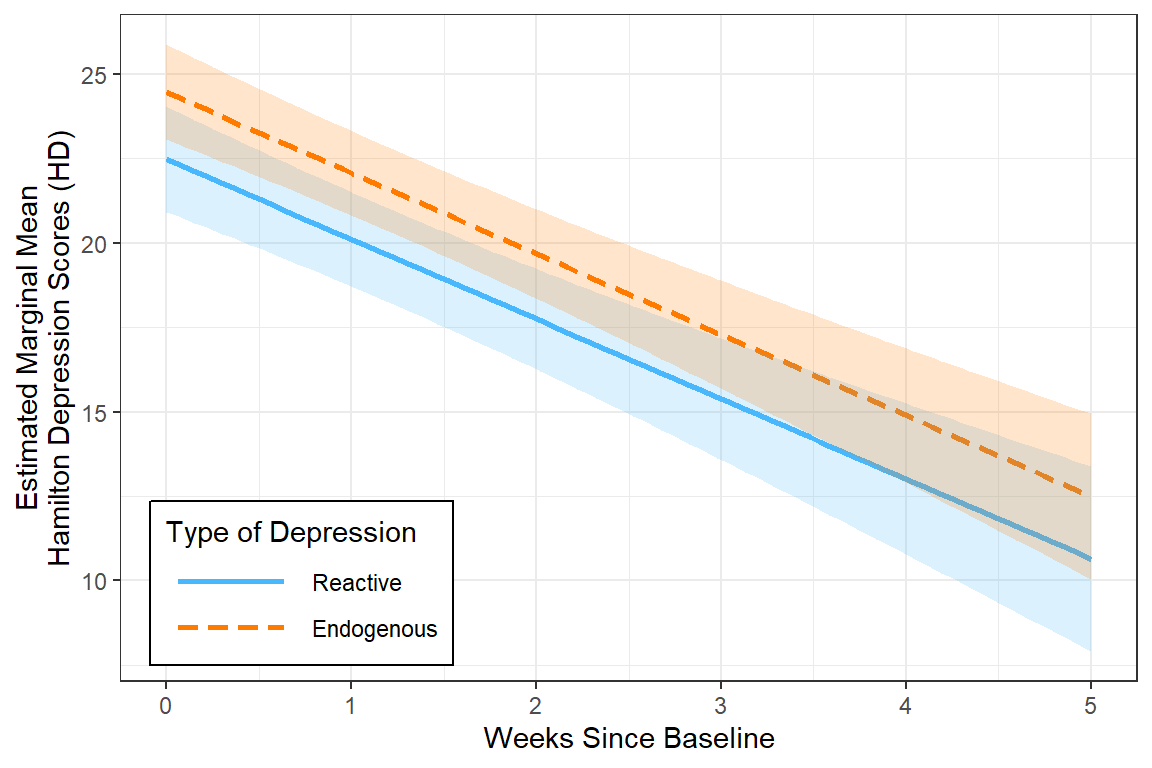
Figure 11.14
Hedeker’s Table 4.7 on page 64
11.7.3 Likelihood Ratio Test
Data: df_long
Models:
Just Time: hamd ~ week + (week | id)
Time X Dx: hamd ~ week * endog + (week | id)
          npar    AIC    BIC  logLik -2*log(L)  Chisq Df Pr(>Chisq)
Just Time    6 2231.0 2254.6 -1109.5    2219.0
Time X Dx 8 2230.9 2262.3 -1107.5 2214.9 4.1083 2 0.1282apaSupp::tab_lmer_fits(list("Just Time" = fit_lmer_wks_RIAS_ml,
"Time X Dx" = fit_lmer_wkdx_RIAS_ml))Model | AIC | BIC | RMSE |
| |
|---|---|---|---|---|---|
Conditional | Marginal | ||||
Just Time | 2231.04 | 2254.60 | 3.00 | .767 | .305 |
Time X Dx | 2230.93 | 2262.34 | 3.00 | .768 | .324 |
Note. Larger values indicated better performance. Smaller values indicated better performance for Akaike's Information Criteria (AIC), Bayesian information criteria (BIC), and Root Mean Squared Error (RMSE). | |||||
The more complicated model (including the moderating effect of diagnosis) is NOT supported.
11.8 MLM: Quadratic Trend
11.8.2 Table of Parameter Estimates
apaSupp::tab_lmers(list("Linear Trend" = fit_lmer_wks_RIAS_ml,
                        "Quadratic Trend" = fit_lmer_quad_RIAS_ml),
                   caption = "MLM: RIAS models fit w/ML",
                   general_note = "Hedeker table 4.5 on page 58 and table 5.1 on page 84")
| Linear Trend | Quadratic Trend | ||||
|---|---|---|---|---|---|---|
Variable | b | (SE) | p | b | (SE) | p |
(Intercept) | 23.58 | (0.55) | < .001*** | 23.76 | (0.55) | < .001*** |
week | -2.38 | (0.21) | < .001*** | -2.63 | (0.48) | < .001*** |
I(week^2) | 0.05 | (0.09) | .562 | |||
id.var__(Intercept) | 12.63 | 10.44 | ||||
id.var__week | 2.08 | 6.64 | ||||
id.cov__(Intercept).week | -1.42 | -0.92 | ||||
Residual.var__Observation | 12.22 | 10.52 | ||||
id.var__I(week^2) | 0.19 | |||||
id.cov__(Intercept).I(week^2) | -0.11 | |||||
id.cov__week.I(week^2) | -0.94 | |||||
AIC | 2,231 | 2,228 | ||||
BIC | 2,255 | 2,267 | ||||
Log-likelihood | -1,110 | -1,104 | ||||
Note. Hedeker table 4.5 on page 58 and table 5.1 on page 84 | ||||||
* p < .05. ** p < .01. *** p < .001. | ||||||
11.8.3 Likelihood Ratio Test
Data: df_long
Models:
fit_lmer_wks_RIAS_ml: hamd ~ week + (week | id)
fit_lmer_quad_RIAS_ml: hamd ~ week + I(week^2) + (week + I(week^2) | id)
                      npar    AIC    BIC  logLik -2*log(L) Chisq Df Pr(>Chisq)
fit_lmer_wks_RIAS_ml     6 2231.0 2254.6 -1109.5    2219.0
fit_lmer_quad_RIAS_ml   10 2227.7 2266.9 -1103.8    2207.7 11.39  4    0.02252

fit_lmer_wks_RIAS_ml
fit_lmer_quad_RIAS_ml *
---
Signif. codes: 0 '***' 0.001 '**' 0.01 '*' 0.05 '.' 0.1 ' ' 1apaSupp::tab_lmer_fits(list("Linear Trend" = fit_lmer_wks_RIAS_ml,
"Quadratic Trend" = fit_lmer_quad_RIAS_ml))Model | AIC | BIC | RMSE |
| |
|---|---|---|---|---|---|
Conditional | Marginal | ||||
Linear Trend | 2231.04 | 2254.60 | 3.00 | .767 | .305 |
Quadratic Trend | 2227.65 | 2266.92 | 2.66 | .799 | .306 |
Note. Larger values indicated better performance. Smaller values indicated better performance for Akaike's Information Criteria (AIC), Bayesian information criteria (BIC), and Root Mean Squared Error (RMSE). | |||||
Even though the Wald test did not find the quadratic fixed time trend to be significant at the population level (marginal), the LRT finds that including the quadratic terms improves the model’s fit.
11.8.4 Estimated Marginal Means Plot
(Intercept)        week   I(week^2)
23.76024931 -2.63257550 0.05148118 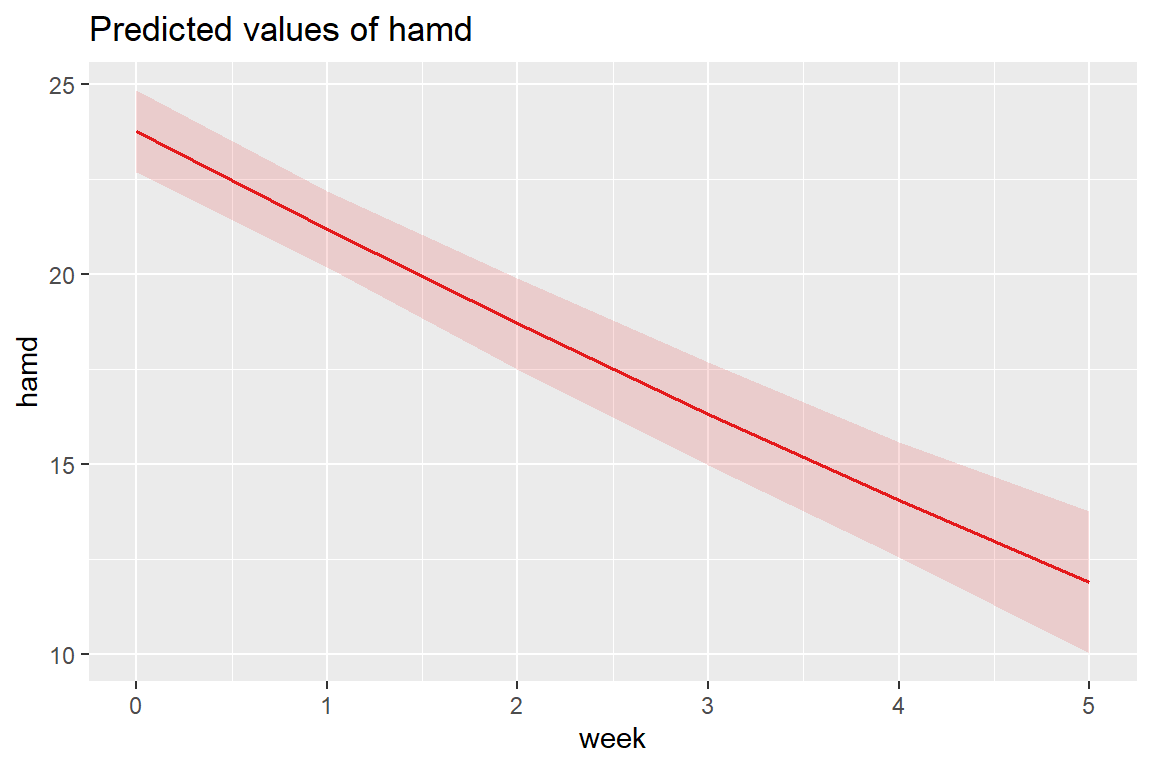
At the population level, the curvature is very slight.
11.8.5 BLUPs or Emperical Bayes Estimates
    (Intercept)        week    I(week^2)
101    25.16568 -5.28320574  0.150797898
103    27.50745 -3.43491942  0.119893070
104    25.99802 -3.09402774 -0.176874809
105    21.01143 -2.95260695  0.164661310
106    23.64346 -0.74434288 -0.141869439
107    22.70272 -1.98456635 -0.179102723
108    22.40954 -4.72427333  0.316018273
113    22.70934 -0.40481066 -0.023811547
114    21.71498 -4.51594039  0.305503426
115    21.54597 -2.55735173  0.139468215
117    20.68538 -3.87700598  0.196726431
118    25.37072 -2.57668561 -0.047612788
120    21.54365 -2.02855857  0.175311125
121    22.58018 -1.75376620 -0.038803501
123    19.25422 -2.87313328  0.017544440
302    21.58631 -3.89089208  0.294415462
303    22.46073 -3.40753346  0.044347424
304    24.67540 -0.37917905 -0.166163234
305    21.27401 -3.68029891 -0.010284082
308    23.09149 -2.47011784  0.005957118
309    22.90665 -1.55838475 -0.062497756
310    23.05813 -5.82989110  0.392498095
311    21.32624 -1.62725872  0.056409374
312    20.97726 -0.80436962 -0.285840159
313    21.61301 -4.45108736  0.355814846
315    25.23222 -4.58343575  0.080215319
316    27.75570 -1.45599106  0.069628465
318    20.56471 -0.29407613 -0.235305940
319    22.38191 -4.51711680  0.466348104
322    24.93396  1.26790220 -0.042514973
327    19.82906 -3.17596440  0.466785078
328    23.74557  1.29271519 -0.129016269
331    21.92610 -1.83150085 -0.074414325
333    23.11845 -0.64673576 -0.127985644
334    27.19413 -6.33064836  0.497609399
335    22.72436 -2.57422920  0.010288104
337    25.62004 -2.06605757 -0.118351519
338    22.89846 -0.54280685 -0.095535665
339    24.27805 -4.99289355  0.444970899
344    22.43029 -4.34889767  0.557803881
345    27.22530 -1.03850791 -0.044993297
346    24.66105 -2.09385824  0.138720526
347    20.11424 -3.85554369  0.239872680
348    23.42448 -4.05934237  0.152401519
349    20.49507 -3.30476908  0.269603183
350    23.29831 -3.86555309  0.351771472
351    27.85601 -2.54762022 -0.174399140
352    21.86126 -2.47215900  0.305550241
353    25.44900 -1.25790274 -0.261971309
354    26.94737  0.07804051 -0.289825508
355    24.47061 -2.72957880 -0.141018009
357    25.37351 -0.82942992 -0.114172123
360    24.04648  1.73526367 -0.131110574
361    25.48488 -7.37196846  0.953493451
501    27.83193 -1.46847456 -0.003542252
502    22.99362 -4.51402369  0.038610170
504    20.80203 -2.67923854  0.167676919
505    20.96545 -6.31342799  0.490342679
507    26.25982  0.08284338 -0.277546394
603    25.55711 -3.23920867  0.099754365
604    26.04324 -6.06910895  0.284967399
606    24.47425 -3.73161413 -0.178377690
607    31.08954  1.15555205 -1.091096102
608    23.46557 -4.87963004  0.180135655
609    25.91657 -2.23143282 -0.347100805
610    30.62473 -0.54534562 -0.593020846
For Illustration, two cases have been hand selected: id = 115 and 610.
fun_115 <- function(week){
  coef(fit_lmer_quad_RIAS_ml)$id["115", "(Intercept)"] +
    coef(fit_lmer_quad_RIAS_ml)$id["115", "week"] * week +
    coef(fit_lmer_quad_RIAS_ml)$id["115", "I(week^2)"] * week^2
}


fun_610 <- function(week){
  coef(fit_lmer_quad_RIAS_ml)$id["610", "(Intercept)"] +
    coef(fit_lmer_quad_RIAS_ml)$id["610", "week"] * week +
    coef(fit_lmer_quad_RIAS_ml)$id["610", "I(week^2)"] * week^2
}
df_long %>%
dplyr::mutate(pred_fixed = predict(fit_lmer_quad_RIAS_ml,
re.form = NA,
newdata = .)) %>% # fixed effects only
dplyr::mutate(pred_wrand = predict(fit_lmer_quad_RIAS_ml,
newdata = .)) %>% # fixed and random effects together
ggplot(aes(x = week,
y = hamd,
group = id)) +
stat_function(fun = fun_115) + # add cure for ID = 115
stat_function(fun = fun_610) + # add cure for ID = 610
geom_line(aes(y = pred_fixed),
color = "blue",
size = 1.25) +
theme_bw() +
theme(legend.position = c(0, 0),
legend.justification = c(-0.1, -0.1),
legend.background = element_rect(color = "black"),
legend.key.width = unit(1.5, "cm")) +
labs(x = "Weeks Since Baseline",
y = "Estimated Hamilton Depression Scores (HD)",
title = "Similar to Hedeker's Figure 5.3 on page 84",
subtitle = "Marginal Mean show in thicker blue\nBLUPs for two of the participant in thinner black")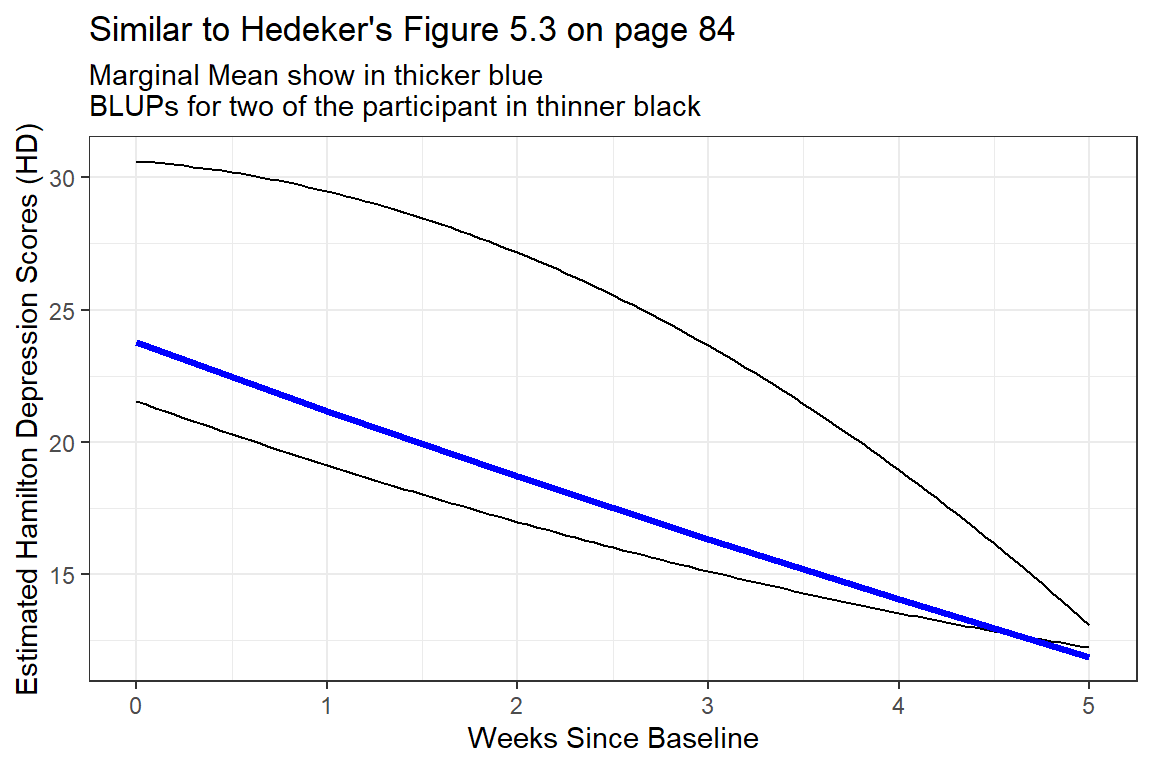
Figure 11.15
Two Example BLUPS for two different participants
These two individuals have quite different curvatures and illustrated how this type of curvatures in person-specific trajectories may end up cancelling each other out to arrive at a fairly linear marginal model.
11.8.6 Estimated Marginal Means and Emperical Bayes Plots
Note: although the BLUPs are shown for all participants, the predictions are just connects and are therefore slightly jagged and now smoother like the lines on the plot above.
df_long %>%
  dplyr::mutate(pred_fixed = predict(fit_lmer_quad_RIAS_ml,
                                     re.form = NA,           # fixed effects only
                                     newdata = .)) %>%
  dplyr::mutate(pred_wrand = predict(fit_lmer_quad_RIAS_ml,  # fixed and random effects both
                                     newdata = .)) %>%
  ggplot(aes(x = week,
             y = hamd,
             group = id)) +
  geom_line(aes(y        = pred_wrand,
                color    = "Individual BLUPs",
                size     = "Individual BLUPs",
                linetype = "Individual BLUPs")) +
  geom_line(aes(y        = pred_fixed,
                color    = "Marginal Mean",
                size     = "Marginal Mean",
                linetype = "Marginal Mean")) +
  theme_bw() +
  scale_color_manual(name   = "Type of Prediction",
                     values = c("Individual BLUPs"     = "gray50",
                                "Marginal Mean" = "blue"))  +
  scale_size_manual(name    = "Type of Prediction",
                    values = c("Individual BLUPs"      = .5,
                               "Marginal Mean" = 1.25))  +
  scale_linetype_manual(name   = "Type of Prediction",
                        values = c("Individual BLUPs"     = "longdash",
                                   "Marginal Mean" = "solid"))  +
  theme(legend.position = c(0, 0),
        legend.justification = c(-0.1, -0.1),
        legend.background = element_rect(color = "black"),
        legend.key.width = unit(1.5, "cm")) +
  labs(x = "Weeks Since Baseline",
       y = "Hamilton Depression Score (HD)")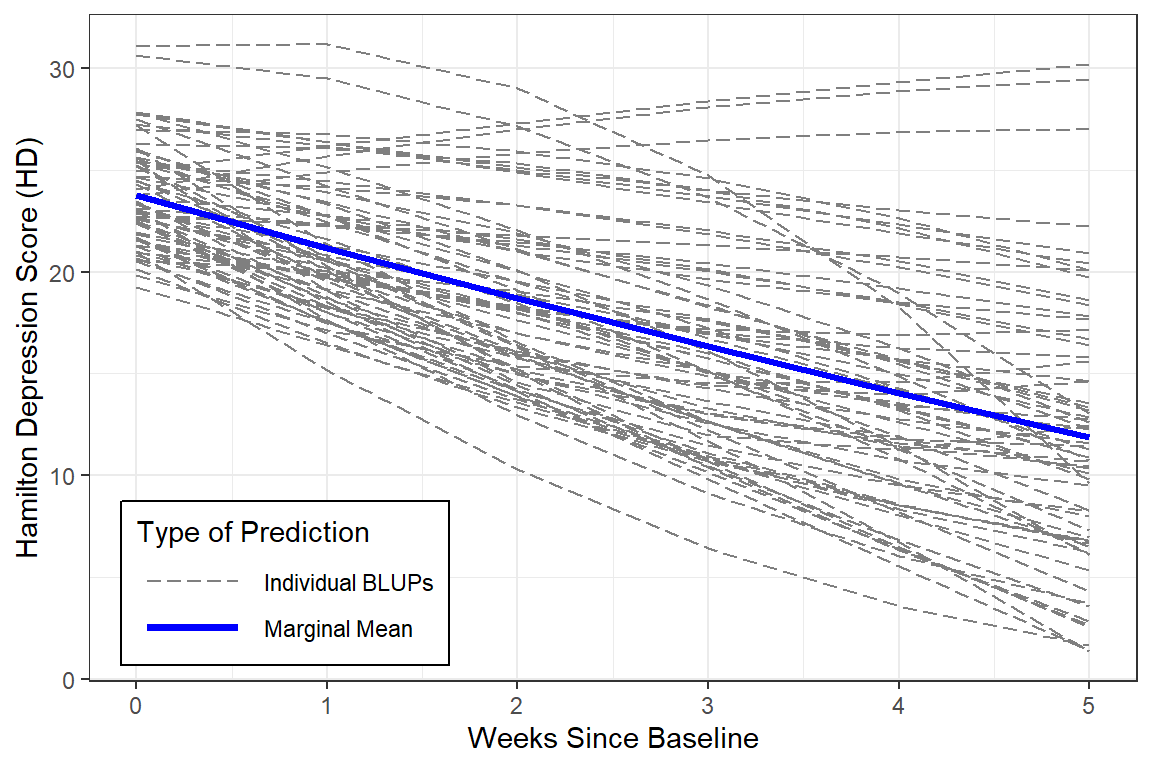
Figure 11.16
Estimated Marginal Means and Best Linear Unbiased Predictions (BLUPs) from the Quadratic Random Intercetps and Slopes Model (Hedeker’s Figure 5.4 on page 85)
At the person-level, the curvature is very diverse (heterogeneous). Some individuals have accelerating downward tend while other have accelerating upward trends.
The improvement that the curvi-linear model provides in describing change across time is perhaps modest.